Blond or Blonde: A Simple English Usage Guide
If you are unsure whether to write blond or blonde, you are not alone. Both forms are established English words, but they are not always used in exactly the same way. The traditional distinction is based on gender, especially in British English, while modern American English often uses blond as a gender-neutral adjective. The choice can also depend on whether the word is being used as an adjective or a noun. Understanding these differences makes it much easier to choose the appropriate form in your writing.
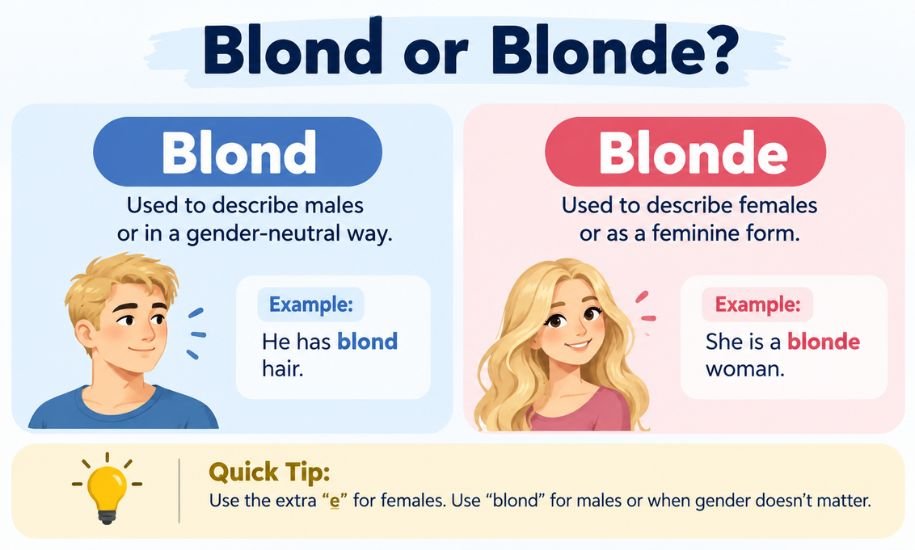
Both blond and blonde are correct. Traditionally, blond is associated with men and boys, while blonde is associated with women and girls, particularly in British English. In modern American English, blond is often used as a gender-neutral adjective for anyone.
Blond or Blonde: What’s the Difference?
The basic distinction is straightforward, but modern usage has become more flexible.
| Form | Common use | Example |
|---|---|---|
| blond | Adjective; traditionally masculine or gender-neutral | He has blond hair. |
| blonde | Traditionally feminine adjective; also a noun | She has blonde hair. |
| blond | Gender-neutral adjective in many modern styles | The child has blond hair. |
| blonde | Noun traditionally referring to a woman with light-colored hair | The actress was described as a blonde. |
The important point is that neither spelling is simply a misspelling of the other. They are both legitimate forms, although style and regional conventions affect which one is preferred.
What Does “Blond” Mean?
Blond is an adjective describing hair that is light in color, typically ranging from pale yellow and golden shades to light brown.
For example:
- He has blond hair.
- The actor appeared with blond hair in the film.
- She decided to dye her hair blond.
- The child was born with naturally blond hair.
In contemporary American English, blond is frequently used regardless of whether the person being described is male or female.
It can therefore be a convenient gender-neutral choice:
She has naturally blond hair.
His blond hair became lighter during the summer.
The model has short blond hair.
The word can also function as a noun, although many modern style guides recommend avoiding this use when a neutral description is possible.
What Does “Blonde” Mean?
Blonde has the same basic meaning: it describes hair that is light, golden, or pale in color.
In traditional usage, especially British English, blonde is commonly used when describing a woman or girl.
For example:
- She has blonde hair.
- The blonde woman was waiting outside.
- Her hair is naturally blonde.
- The character has long blonde hair.
The spelling comes from the historical influence of French, which has masculine and feminine forms of many adjectives. English does not generally change adjectives according to gender, but blond/blonde is an exception that retained this distinction to a degree.
Is “Blonde” Correct for a Female?
Yes. Blonde is traditionally correct when referring to a female person, particularly in British English.
For example:
She is a blonde woman.
She has blonde hair.
However, blond is also increasingly used for women because it functions as a gender-neutral adjective in many modern forms of English.
So both of these can be found in standard usage:
She has blonde hair.
She has blond hair.
The first follows the traditional gender distinction. The second treats blond as a gender-neutral adjective.
If you are writing for a particular publication, follow that publication’s style guide and remain consistent.
Is “Blond” Gender-Neutral?
Yes. Blond can be used as a gender-neutral adjective.
This is especially common in American English and in editorial styles that favor gender-neutral terminology.
For example:
The singer has blond hair.
This sentence does not require the reader to know the person’s gender to determine the spelling.
Using blond as a general adjective can also make writing simpler:
The children all had blond hair.
The character has short blond hair.
She recently dyed her hair blond.
This does not mean that blonde has become incorrect. Rather, the two forms coexist, and different varieties and style preferences use them differently.
Blond or Blonde Hair: Which One Should You Use?
Both blond hair and blonde hair are used in English.
The choice often depends on the convention you are following.
Traditional distinction
In traditional British usage:
- blond hair → associated with a man or boy
- blonde hair → associated with a woman or girl
Examples:
The boy has blond hair.
The girl has blonde hair.
Gender-neutral style
In many modern American contexts, blond hair is used for anyone:
The girl has blond hair.
The boy has blond hair.
The actress appeared with blond hair.
If you want a gender-neutral form, blond is generally the safer choice.
Blond vs. Blonde Pronunciation
There is generally no meaningful pronunciation difference between blond and blonde in English. The final e in blonde is not normally pronounced as a separate syllable.
Both words are typically pronounced with the same vowel and consonant sounds.
The spelling difference therefore matters more in writing than in speech.
This is one reason people may be uncertain about which form to write: when speaking, the distinction is usually not audible.
When Is “Blonde” Used as a Noun?
Historically, blonde can be used as a noun to mean a woman with blond hair.
For example:
The magazine described her as a blonde.
Likewise, blond can traditionally be used as a noun for a man with blond hair.
However, noun usage can sound dated, overly focused on appearance, or less neutral in some contexts. A clearer modern alternative is often to describe the person’s hair directly:
She has blond hair.
rather than:
She is a blonde.
This distinction is particularly useful in formal or neutral writing.
Why Are Blond and Blonde Confused?
The confusion exists because English has retained two spellings for the same basic color description.
There are several reasons the forms can seem difficult:
- They have the same basic meaning. Both describe light-colored hair.
- Their pronunciation is generally the same.
- Traditional English usage distinguishes gender.
- Modern American English often uses blond more broadly.
- British and American conventions can differ.
As a result, someone may learn that blonde is feminine and later encounter blond being used for a woman. Neither observation is necessarily wrong; the difference reflects changing and regional usage.
Examples: Correct Usage in Sentences
Here are some examples showing how the forms work naturally.
Using “blond”
He has naturally blond hair.
The child has short blond hair.
She decided to dye her hair blond.
The actor appeared with blond hair for the role.
Using “blonde”
She has naturally blonde hair.
The actress wore her blonde hair loose.
The character is a young blonde woman.
Her blonde hair stood out against the dark background.
Both sets of examples can be found in standard English. The preferred form depends on the variety and style being followed.
Blond or Blonde for a Female: What’s Best?
If your question is specifically about describing a woman or girl, blonde is the traditional choice.
For example:
She has blonde hair.
This is particularly natural in traditional British English.
However, blond is also acceptable as a gender-neutral adjective:
She has blond hair.
If you are writing for an American audience or following a style guide that prefers gender-neutral terminology, blond may be the preferred form.
Therefore, it is better not to memorize a rule saying that one spelling is always correct for women. Instead, consider your audience and the style of English you are using.
A Simple Way to Remember the Difference
A traditional memory rule is:
Blond = male
Blonde = female
The e in blonde can remind you of the traditional feminine form.
However, treat this as a traditional convention, not an absolute modern grammar rule.
If you want one gender-neutral adjective that works regardless of the person’s gender, use blond.
This is especially useful when the person’s gender is unknown or irrelevant:
The suspect was described as having blond hair.
The child has blond hair.
Common Mistakes to Avoid
1. Assuming “blonde” is always wrong for men
That is too simplistic. Traditional usage favors blond for men, but blonde has also appeared in English with broader usage.
2. Assuming “blond” is only for men
Modern English frequently uses blond as a gender-neutral adjective.
She has blond hair.
This is perfectly acceptable.
3. Treating “blonde” as a misspelling
Blonde is not a misspelling. It is an established form with a long history in English.
4. Assuming the final “e” changes the pronunciation
The two forms are generally pronounced alike in English. The distinction is primarily orthographic.
5. Using the noun unnecessarily
Instead of:
She is a blonde.
you can often write:
She has blond hair.
The second construction is more direct and avoids making hair color the defining noun for the person.
Which Form Should You Choose?
The best choice depends on your audience and purpose.
Choose “blond” when:
- You want a gender-neutral adjective.
- You are following modern American usage.
- You do not need to distinguish gender.
- You are describing hair generally.
- Your publication’s style guide prefers blond.
Choose “blonde” when:
- You are following the traditional feminine distinction.
- You are writing in a style that uses blonde for women and girls.
- Your publication specifically follows that convention.
- You are using the established noun referring to a woman with blond hair, where appropriate.
The most important rule is consistency. If your publication follows a particular style, use that style consistently rather than switching between conventions without a reason.
Blond or Blonde Test
A simple test can help you decide.
Question 1: Are you describing hair rather than using the word as a noun?
If yes, either form may be appropriate depending on your style.
Question 2: Are you following traditional British usage?
If yes, blond is traditionally associated with males and blonde with females.
Question 3: Do you want a gender-neutral adjective?
Use blond.
Question 4: Are you following a specific editorial style?
Follow that style consistently.
Try these:
- “She has ___ hair.”
- “The boy has ___ hair.”
- “The child has ___ hair.”
- “The actress dyed her hair ___.”
Possible choices under a traditional gender distinction are:
- blonde
- blond
- blond
- blonde
Under a gender-neutral style, blond can be used in all four sentences.
What About Frank Ocean’s “Blonde”?
There is one important context in which Blonde has nothing to do with choosing between the two spellings in ordinary grammar: the title of Frank Ocean’s 2016 album.
Blonde is the album’s title, so its capitalization and spelling should be preserved when referring to the work.
That is a proper title rather than an example of a grammatical preference between blond and blonde. It should therefore be treated separately from ordinary descriptions of hair color.
Frequently Asked Questions
Is “blond” or “blonde” correct?
Both are correct. Traditionally, blond is associated with males and blonde with females, particularly in British English. Modern American English often uses blond as a gender-neutral adjective.
Is “blonde” grammatically correct for a woman?
Yes. Blonde is traditionally used for a woman or girl, especially in British English. For example, “She has blonde hair” is standard usage.
Can I say “she has blond hair”?
Yes. Blond is increasingly used as a gender-neutral adjective, so “she has blond hair” is perfectly acceptable, particularly in American English and gender-neutral editorial styles.
Are blond and blonde pronounced differently?
Generally, no. The two forms are normally pronounced the same in English. The difference is primarily a matter of spelling and usage rather than pronunciation.
Is “blonde” a noun?
Yes. Blonde can function as a noun referring traditionally to a woman with blond hair. However, modern neutral writing often prefers “a woman with blond hair” or a similar construction.
Which spelling should I use in formal writing?
Follow the style guide or variety of English appropriate for your audience. If you need a gender-neutral adjective and have no house-style requirement, blond is a straightforward choice.
The Bottom Line
Both blond and blonde are legitimate English forms. The traditional distinction uses blond for males and blonde for females, while modern American and gender-neutral usage often favors blond for everyone. When writing, consider your audience, regional convention, and preferred style rather than treating one spelling as universally correct. For more clear explanations of confusing English words, Grammarifyr helps you know the difference and use the right words.
You may also Read : Manuel or Manual: Meaning and Correct Usage
One Comment