Emersed vs Immersed: Meaning, Differences, and Examples
The words emersed and immersed look and sound similar, but they describe different situations. Both are correct English words, although they are used in different contexts. Emersed generally refers to aquatic plants or objects that rise above the surface of water, while immersed means submerged in a liquid or deeply involved in an activity, subject, or experience. Understanding the difference is particularly useful when discussing aquarium plants, water environments, and cultural experiences. Knowing when to use each word can help you write more clearly and avoid confusing two terms with distinct meanings.
Emersed vs Immersed: Key Differences
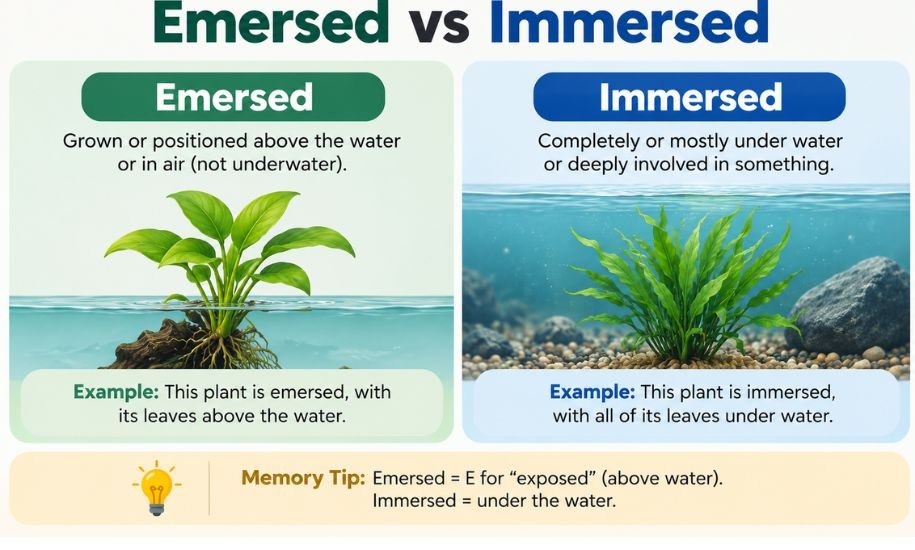
The main difference between these words is the position or involvement they describe. Emersed is primarily a botanical term associated with plants growing above water, whereas immersed is widely used to describe physical submersion and deep involvement.
| Feature | Emersed | Immersed |
|---|---|---|
| Meaning | Rising above the surface of water | Submerged in liquid or deeply involved |
| Part of speech | Adjective | Adjective and past participle |
| Common usage | Botany, aquariums, ecology | Everyday English, science, culture |
| Physical context | Above the waterline | Within or beneath a liquid |
| Figurative meaning | Rarely used | Commonly used |
| Example | The emersed leaves grew above the pond. | The plant was immersed in water. |
Both terms are valid, but the appropriate choice depends on the context. When describing aquatic plants growing above the waterline, emersed is suitable. When describing an object covered by water or someone deeply engaged in an activity, immersed is the correct choice.
What Does Emersed Mean?
Emersed is an adjective that describes something rising or extending above the surface of water. It is particularly common in botany, aquatic biology, and environmental science.
The term is frequently used for aquatic plants that grow in shallow water, wetlands, ponds, and aquariums. These plants may have roots in water or saturated soil while their leaves and stems extend into the air.
For example, some aquatic plants grow with their roots underwater and their leaves exposed to the air. This type of growth is known as emersed growth.
Examples of emersed in sentences:
- The emersed plants grew along the shallow edges of the pond.
- The aquatic species developed broad leaves during emersed growth.
- The aquarium owner cultivated emersed plants in a humid environment.
- Several emersed stems extended above the surface of the water.
Emersed growth can offer aquatic plants access to atmospheric carbon dioxide while their roots continue absorbing water and nutrients. Some species can also adapt from emersed to submerged growth, although their leaf shape and structure may change during the transition.
What Does Immersed Mean?
Immersed is an adjective and the past participle of the verb immerse. It describes something placed in a liquid or a person who is deeply involved in an activity, subject, or experience.
Unlike emersed, this word is commonly used in everyday conversations, academic writing, science, and descriptions of personal experiences.
The word has two main uses:
- Physical meaning: Something is placed into or surrounded by a liquid, such as a plant immersed in water.
- Figurative meaning: Someone is deeply engaged in an activity, such as a student immersed in studying.
Examples of immersed in sentences:
- The scientist immersed the sample in a container of water.
- The aquatic plant remained immersed beneath the water’s surface.
- She was completely immersed in her research project.
- The students became immersed in the local culture during their visit.
The word can also describe an experience that captures someone’s attention so fully that they become deeply engaged with it.
For instance, someone who spends several months learning another language through daily conversations and cultural activities can be described as fully immersed in that language.
Emersed vs Immersed Aquarium Plants
In aquariums, these terms describe different growing conditions. Understanding them can help hobbyists select plants, establish growing environments, and manage plant transitions.
Emersed plants grow with their leaves or stems above the waterline, although their roots may remain in water, moist substrate, or saturated soil. This growing method is common in aquatic plant nurseries.
Immersed plants are placed within a liquid. In aquarium terminology, submerged or submersed is often used more specifically for plants growing entirely underwater.
Some aquatic species can adapt to both conditions. However, they may look different depending on their growing environment.
For example, an aquarium plant cultivated emersed in a nursery may develop firm leaves suited to growing in the air. Once placed underwater, it may gradually produce thinner leaves adapted to submerged conditions. Older leaves may deteriorate during this transition as the plant develops new growth.
Not all aquatic plants can tolerate both environments equally well. Their ability to adapt depends on the species, lighting, nutrients, water conditions, and other growing requirements.
Emersed vs Immersed in Water
When discussing water, the distinction is mainly about whether something extends above the surface or is placed within the liquid.
Emersed is particularly useful when describing plants that grow partly above the waterline. For instance, reeds growing in a pond may have their lower portions in water while their stems and leaves extend into the air.
Immersed describes an object or organism placed in a liquid. It does not always mean that every part is completely beneath the surface, so additional wording may be useful when complete submersion matters.
Examples:
- The emersed leaves received sunlight above the pond.
- The stone was immersed in water for several hours.
- The emersed vegetation provided shelter for small aquatic animals.
- The researcher immersed the material in a liquid solution.
If you specifically mean that something is completely beneath the water’s surface, submerged is often the more precise word.
Emersed vs Immersed in Culture
When discussing cultural experiences, language learning, or social environments, immersed is the appropriate word. It describes being deeply involved in a culture or surrounded by its language, customs, and traditions.
For example:
- She became immersed in Japanese culture while living in Tokyo.
- The students were immersed in local traditions during their exchange programme.
- Living abroad allowed him to become immersed in a different language.
- The documentary immersed viewers in the history of an ancient civilization.
In these sentences, immersion does not involve physical water. Instead, it refers to active participation, close exposure, or deep engagement.
Emersed is not normally used in this figurative sense. Saying someone is “emersed in a culture” would be inappropriate in standard English when you mean that they are deeply involved in it.
Immersed vs Emerged: Understanding the Difference
Immersed and emerged are also sometimes confused because of their similar spelling. However, they have different meanings and grammatical functions.
| Word | Meaning | Example |
|---|---|---|
| Immersed | Placed in a liquid or deeply involved | She was immersed in her studies. |
| Emerged | Came out or became visible | The frog emerged from the pond. |
| Emersed | Growing or extending above water | The emersed leaves reached toward the sunlight. |
| Submerged | Covered by water or another liquid | The submerged rocks were difficult to see. |
Emerged is the past tense and past participle of emerge. It describes an action or change, such as something coming out of a hidden position.
Emersed, on the other hand, is mainly an adjective used in botanical contexts. Although the words are related in meaning, they are not interchangeable.
Examples:
- Correct: The frog emerged from the water.
- Correct: The aquatic plant had emersed leaves.
- Correct: The researcher immersed the plant in water.
- Incorrect: The researcher emersed herself in a new culture.
The final sentence should use immersed because it refers to deep cultural involvement.
Immersion vs Emersion in Psychology
Immersion and emersion have distinct meanings, although immersion is much more familiar in psychology-related discussions.
Immersion can describe deep engagement or involvement in an experience. It may be used when discussing learning environments, virtual experiences, storytelling, or activities that hold someone’s attention.
For example, a language learner may experience immersion by regularly communicating in a language and participating in the culture where it is spoken.
Emersion generally refers to the process of emerging from or rising out of something. It is not a standard opposite of psychological immersion in most everyday psychological writing.
In some contexts, emersion may be used metaphorically to describe coming out of an immersive experience, but the intended meaning should be made clear. For most discussions about attention, engagement, or cultural learning, immersion is the more appropriate term.
How to Remember the Difference
A simple way to distinguish these words is to focus on the position they describe.
- Emersed: Think of something emerging above the water’s surface.
- Immersed: Think of something placed into a liquid or deeply involved in an experience.
For example, if the leaves of a plant are growing above the waterline, describe them as emersed. If a person is deeply engaged in a book, describe them as immersed in it.
Remember that immersed has both literal and figurative meanings, while emersed is mainly used in specialized descriptions of aquatic environments.
Frequently Asked Questions
Is emersed a correct English word?
Yes, emersed is a correct English word. It is mainly used in botany and aquatic sciences to describe plants or plant parts that rise above the surface of water. It is not a misspelling of immersed, although the two words are sometimes confused.
What is the fully immersed meaning?
Fully immersed means completely placed within a liquid or deeply engaged in an activity, subject, or experience. For example, a fully immersed object may be entirely underwater, while a person fully immersed in learning is deeply involved in the process.
Can plants be both emersed and immersed?
Yes, some aquatic plants can grow in both emersed and submerged environments. Their appearance may change as they adapt to different conditions. However, not every species can thrive in both environments, and the transition may require suitable light, nutrients, and water conditions.
Is immersed the opposite of emersed?
In certain aquatic plant contexts, the words can describe contrasting positions relative to the waterline. However, submerged is often a more direct term for something beneath the surface. Immersed also has figurative meanings, so it is not a universal opposite of emersed.
Is emersed the same as emerged?
No. Emersed is primarily a botanical adjective describing something that extends above the water’s surface. Emerged is the past tense of emerge and means to come out, appear, or become visible. For example, a frog emerged from a pond, while a plant may have emersed leaves.
Is immersion the same as emersion in psychology?
No. Immersion can refer to deep involvement in an experience or activity, including language learning and virtual environments. Emersion generally means emerging from something and is not commonly used as a direct psychological opposite of immersion.
The Bottom Line
Although emersed and immersed look similar, their meanings are different. Use emersed when describing aquatic plants or plant parts that grow above the waterline, and immersed when referring to something placed in a liquid or deeply involved in an experience. Understanding these distinctions makes it easier to choose the correct word in scientific descriptions and everyday writing. At Grammarifyr, learning such differences helps you know the difference and use the right words with confidence.
You may also Read : Conex or Connex: Meaning, Differences and Usage