Shinning or Shining: Correct Usage Explained
Have you ever wondered whether the correct spelling is shinning or shining? Although these two words look almost identical, they have different meanings and are used in different situations. One describes something that gives off or reflects light, while the other refers to climbing by using your hands and legs. Understanding this distinction can help you avoid spelling mistakes in everyday writing. Both words are legitimate in English, but choosing the right one depends entirely on what you want to express.
Quick Answer
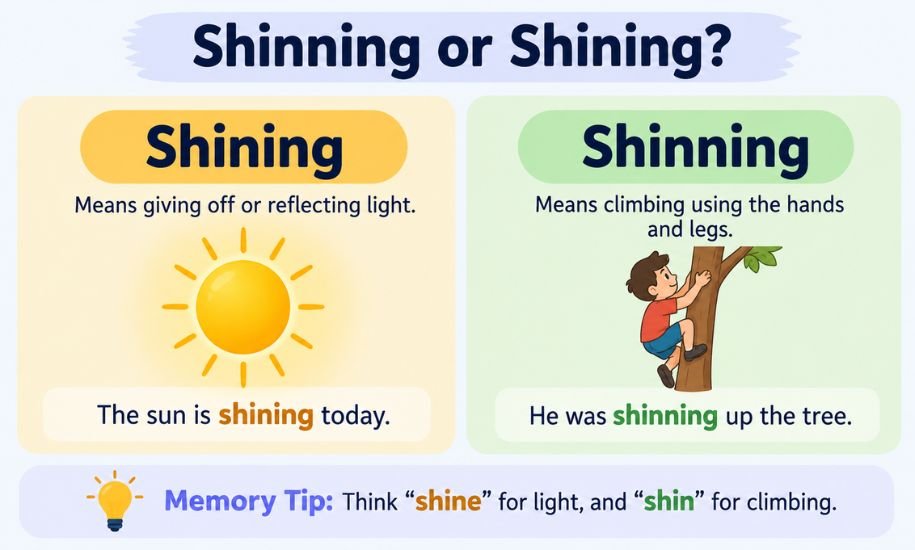
Both shining and shinning are correct English words, but they have different meanings. Shining is the -ing form of shine and means emitting or reflecting light, while shinning is the -ing form of shin, meaning to climb using the hands and legs. For example, “The sun is shining” is correct when describing sunlight.
Shinning or Shining: What Is the Difference?
The main difference between these words is their root verbs. Shining comes from shine, which is associated with brightness, light and polishing. Shinning comes from shin, which can mean climbing up or down an object by gripping it with the hands and legs.
| Feature | Shining | Shinning |
|---|---|---|
| Root verb | Shine | Shin |
| Meaning | Emitting or reflecting light | Climbing using hands and legs |
| Word form | Present participle of shine | Present participle of shin |
| Common usage | Very common | Relatively uncommon |
| Spelling rule | Drop the final e and add -ing | Double the final n and add -ing |
| Example | The stars are shining. | He is shinning up a pole. |
| Adjective use | Yes, as in a shining example | Not commonly used as an adjective |
If you are talking about sunlight, stars, a polished surface or someone’s excellent performance, shining is the appropriate choice. If you are describing someone climbing a pole or tree using their arms and legs, shinning may be correct.
What Does Shining Mean?
Shining is the present participle of the verb shine. It describes the action of producing light, reflecting brightness or making something look polished. It can also be used figuratively to describe someone who is performing exceptionally well or displaying impressive qualities.
The word is used as both a verb form and an adjective, depending on the sentence.
Examples of shining in sentences:
- The sun is shining brightly over the mountains.
- The stars were shining in the clear night sky.
- She polished the silver until it was shining.
- The student is shining in her new academic role.
- His shining personality made everyone feel welcome.
In the first two examples, shining refers to light. In the third, it describes a polished appearance. In the final examples, it conveys excellence or a positive quality.
Shining as a Figurative Expression
The word shining does not always refer to physical light. It can also describe achievement, talent, kindness or success.
For example, a shining example is someone or something that demonstrates a quality particularly well. Similarly, a person who is shining in their career is performing impressively.
This figurative meaning is common in everyday conversation, literature and professional writing.
What Does Shinning Mean?
Shinning is the present participle of the verb shin. It describes climbing or moving up or down a vertical object by gripping it with the hands and legs.
Although the word is less common than shining, it is a valid English word. It is generally used in descriptions of physical climbing.
Examples of shinning in sentences:
- The boy was shinning up the tree to reach a branch.
- The worker was shinning up a pole to inspect the equipment.
- The sailor started shinning up the mast.
- He was shinning down the drainpipe to reach the ground.
In these sentences, shinning describes physical movement rather than brightness.
In ordinary conversation, people may use climbing instead because it is more familiar and widely understood. However, shinning can be useful when describing a particular way of climbing by gripping a surface with the hands and legs.
Why Are Shining and Shinning Spelled Differently?
The spelling difference comes from the rules for adding -ing to verbs. Although the words look similar, their base forms follow different spelling patterns.
1. Shine becomes shining
The verb shine ends in a silent e. When adding -ing, the final e is dropped.
- Shine → Shining
- Write → Writing
- Make → Making
- Drive → Driving
Therefore, shining is the correct form when discussing light or brightness.
2. Shin becomes shinning
The verb shin ends in a consonant preceded by a short vowel. When adding -ing, the final consonant is doubled.
- Shin → Shinning
- Run → Running
- Sit → Sitting
- Swim → Swimming
This is why shinning has two ns. The extra letter is not a spelling mistake when the word refers to climbing.
Understanding these spelling patterns makes it easier to distinguish the two words and apply the same rules to other English verbs.
The Sun Is Shining or Shinning?
The correct sentence is “The sun is shining.”
The verb shine describes the emission or appearance of light. Since the sun produces light, shining is the appropriate word.
Correct
The sun is shining brightly today.
The sentence correctly uses shining to describe sunlight.
Incorrect for this meaning
The sun is shinning brightly today.
Shinning refers to climbing, so it does not express the intended meaning.
Here are a few more examples:
- The sunlight is shining through the curtains.
- The moon is shining over the quiet village.
- The stars are shining beautifully tonight.
- The morning sun was shining on the lake.
In all these examples, shining is used to describe light or brightness.
Shining or Shinning Star: Which Is Correct?
The correct expression is “shining star.” It refers to a star that appears bright in the sky or, figuratively, to a person who demonstrates exceptional talent or potential.
For example:
- A shining star appeared above the horizon.
- She is a shining star in the world of music.
- The young athlete has become a shining star on the team.
The phrase shinning star is not correct when referring to brightness or achievement. The word shinning describes climbing, which does not fit this context.
Shining Synonyms and Related Words
The synonyms of shining depend on whether it refers to physical light, a polished surface or figurative excellence.
| Synonym | Meaning |
|---|---|
| Glowing | Giving off or appearing to give off light |
| Gleaming | Reflecting light brightly |
| Radiant | Emitting or reflecting a strong glow |
| Sparkling | Producing small, bright flashes |
| Glistening | Shining with reflected light, often from moisture |
| Glittering | Reflecting light in bright flashes |
| Luminous | Emitting or radiating light |
| Brilliant | Extremely bright or impressive |
| Lustrous | Having an attractive sheen |
| Outstanding | Exceptionally good or impressive |
For example, glowing and gleaming can describe a bright object, while outstanding can replace shining in a sentence about achievement.
There are fewer direct everyday synonyms for shinning. Depending on the context, climbing, scrambling or scaling may be appropriate alternatives.
Is There a Difference in British and American English?
There is no spelling difference between British and American English when it comes to shining and shinning. Both varieties use the same spelling and grammatical rules.
| British English | American English |
|---|---|
| The sun is shining. | The sun is shining. |
| The stars are shining. | The stars are shining. |
| He was shinning up the pole. | He was shinning up the pole. |
The distinction is based on meaning, not regional spelling preferences. Therefore, shining is correct for light and brightness in both varieties, while shinning is used for the climbing-related action in both.
Common Mistakes to Avoid
Although these words differ by only one letter, confusing them can change the meaning of a sentence.
1. Using shinning to describe sunlight
Incorrect: The sun is shinning through the window.
Correct: The sun is shining through the window.
2. Assuming shinning is always a misspelling
Shinning is a real word. It is correct when describing the action of climbing by gripping an object with the hands and legs.
3. Adding an extra letter to shining
Incorrect: The stars are shinning brightly.
Correct: The stars are shining brightly.
4. Confusing shining with shiny
Shining is usually a verb form or a participial adjective, while shiny is an adjective that describes an object’s appearance.
For example, “The shoes are shining” describes their appearance or the action of polishing them, while “The shoes are shiny” describes their quality.
Easy Way to Remember the Difference
A simple way to remember these words is to connect each one with its root verb.
- Shine → Shining: Think of sunlight, stars, brightness or polished objects.
- Shin → Shinning: Think of climbing a tree, pole or other vertical surface.
Remember the phrase “The sun is shining, but the climber is shinning.” This short example highlights the different meanings and helps you choose the correct spelling.
Frequently Asked Questions
Is shinning a correct English word?
Yes, shinning is a correct English word. It is the present participle of shin, a verb that means to climb an object by gripping it with the hands and legs. It is less common than shining, but it is not a misspelling when used in the correct context.
What is the meaning of shining?
Shining means emitting or reflecting light, appearing bright or making something glossy through polishing. It can also describe excellence or outstanding performance, as in “She is shining in her new position.”
Should I write “keep shining” or “keep shinning”?
The correct expression is “keep shining.” It is an encouraging phrase that means continuing to be positive, confident, talented or successful. Shinning is related to climbing and does not convey this figurative meaning.
Is “shinning” ever correct in a sentence?
Yes. For example, “The boy was shinning up the tree” uses the word correctly to describe climbing. It is appropriate when the intended meaning is the physical action associated with the verb shin.
What is the past tense of shine?
The past tense of shine is commonly shone when referring to emitting or reflecting light, as in “The moon shone brightly.” Shined is also used, particularly when referring to polishing something, as in “He shined his shoes.”
Is shining a verb or an adjective?
Shining is the present participle of the verb shine. It can also function as an adjective, as in “a shining example of kindness.” Its grammatical role depends on how it is used in the sentence.
Final Verdict: Shinning or Shining?
Both words are correct, but they are not interchangeable. Use shining when talking about light, brightness, polished surfaces or outstanding achievements. Use shinning when describing someone climbing by gripping a vertical object with their hands and legs.
Remembering the difference between shine and shin will help you avoid confusion in everyday writing. With clear explanations and practical examples, Grammarifyr helps you understand these small but important differences and choose the right words with confidence.
You may also Read : Curtesy or Courtesy: Meaning, Difference and Examples