Flyers or Fliers? Learn the Difference
If you are talking about a printed sheet used to advertise an event, business, sale, or service, you may wonder whether it should be called a flyer or a flier. The confusion is understandable because both spellings are legitimate English words, and dictionaries recognize both forms. The difference is mainly one of preference and context rather than a simple correct-versus-incorrect rule. For promotional paper, flyer is generally the safest and most common choice. Flier is also correct, particularly when referring to a person or thing that flies.
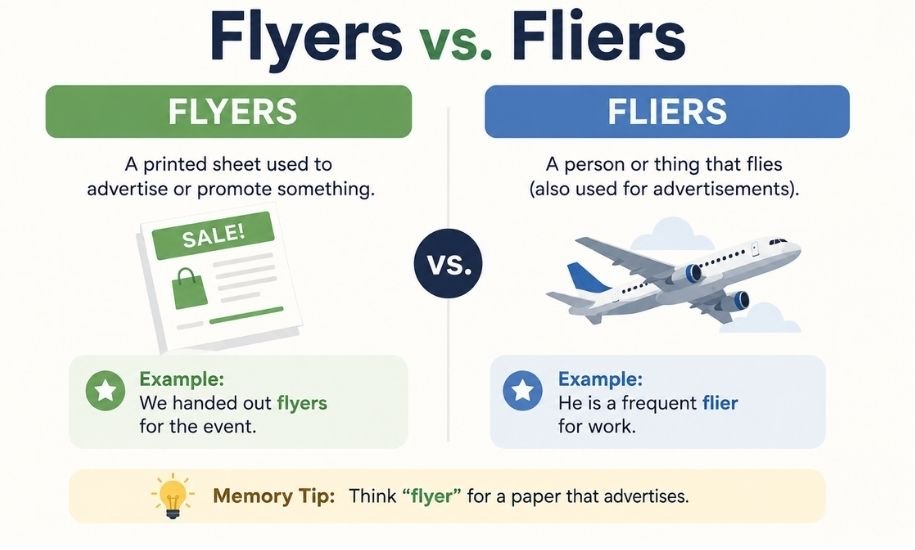
Both flyer and flier are correct spellings. For a printed advertisement or promotional sheet, flyer is usually the best default. Flier is also accepted for this meaning and is traditionally preferred in some contexts for a person or thing that flies.
Flyers vs. Fliers: The Key Difference
The important thing to remember is that neither spelling is simply wrong.
| Form | Correct? | Common meaning | Example |
|---|---|---|---|
| flyer | Yes | Promotional sheet; person or thing that flies | We handed out flyers. |
| flier | Yes | Person or thing that flies; promotional sheet | She is a frequent flier. |
| flyers | Yes | Plural of flyer | The store printed flyers. |
| fliers | Yes | Plural of flier | Frequent fliers receive rewards. |
When referring specifically to advertising material, flyer/flyers is the clearest choice for most modern writing.
When referring to someone who travels by air or something capable of flying, flier/fliers has a long-standing traditional preference, although flyer/flyers is also accepted.
What Does “Flyer” Mean?
A flyer is commonly a small printed sheet containing information or advertising. Businesses, organizations, schools, and individuals may use flyers to promote events, products, services, sales, or announcements.
The word can also refer to a person or thing that flies, so its meaning depends on context.
Examples of “flyer”
- The café distributed flyers announcing its grand opening.
- We printed 500 flyers for the charity event.
- She designed a colorful flyer for the concert.
- The company left promotional flyers at local businesses.
In these examples, flyer clearly means a printed promotional sheet.
What Does “Flier” Mean?
Flier is also a correct English word. One common use is for a person who flies, particularly someone who travels by airplane.
For example:
- He is a frequent flier who travels for work.
- Experienced fliers know how to prepare for long flights.
- The airline offers rewards to frequent fliers.
Flier can also mean a person or thing that flies more generally.
However, flier can refer to printed advertising material as well. Therefore, it would be incorrect to say that fliers can never mean promotional papers.
Flyers or Fliers Paper: Which One Should You Use?
If you mean paper advertisements that you print and hand out, flyers is generally the best choice.
For example:
We printed flyers for the weekend sale.
Volunteers handed out flyers outside the stadium.
The restaurant placed flyers on nearby noticeboards.
You can also write:
We printed fliers for the weekend sale.
That sentence is grammatically acceptable because flier has the same advertising-related meaning. However, flyer is often the more natural choice when the subject is a promotional sheet.
So, if you are asking fliers or flyers paper, there is no absolute spelling error involved. For clarity and consistency, choose flyers when writing about promotional paper.
What About “Fliers or Flyers to Hand Out”?
Both forms can be used in a sentence such as:
We have some flyers to hand out at the event.
You could also write:
We have some fliers to hand out at the event.
The first version is generally preferable when you mean printed promotional material. The context makes the meaning obvious, but flyers is a useful default because it is strongly associated with advertising sheets.
Other natural examples include:
- Please bring the flyers to hand out after the meeting.
- We need more flyers for the open house.
- The volunteers spent the afternoon handing out flyers.
- She prepared flyers to promote the fundraiser.
When Should You Use “Flier”?
Use flier when you want to follow the traditional spelling for someone or something that flies.
A particularly familiar expression is frequent flier:
My father is a frequent flier.
Frequent fliers can earn airline rewards.
That said, frequent flyer is also widely used. You will see both forms in real-world English.
The same flexibility applies to things that fly:
Eagles are powerful fliers.
Eagles are powerful flyers.
Both are possible, although individual dictionaries and style preferences may favor one form.
Why Are These Words Confused?
The confusion comes from a straightforward spelling difference: flyer and flier are formed from the same basic idea of flying, and both have developed overlapping meanings.
There is also a useful historical pattern behind the variation. The spelling flier follows the shorter form of fly + -er, while flyer preserves the letter combination from the base word fly more visibly.
Over time, both spellings became established. As a result, English does not have a universal rule saying that one must always replace the other.
The safest approach is therefore to consider meaning and consistency, rather than treating one spelling as a misspelling.
How Do You Spell “Flyers or Fliers”?
If you are wondering how do you spell flyers or fliers, the answer is that both spellings are correct.
The singular forms are:
- flyer
- flier
Their plural forms are:
- flyers
- fliers
If you are writing about advertising sheets, flyers is usually the easiest choice.
If you are writing about people who fly, fliers is a traditional choice, especially in expressions such as frequent fliers, but flyers is also acceptable.
Correct Usage Examples
Here are some examples that show how the two spellings work in context.
For promotional material
Preferred:
The bookstore distributed flyers for its summer sale.
Also acceptable:
The bookstore distributed fliers for its summer sale.
For people who travel by air
Traditional choice:
Frequent fliers can earn additional airline miles.
Also acceptable:
Frequent flyers can earn additional airline miles.
For something that flies
The hawk is an impressive flier.
The hawk is an impressive flyer.
The surrounding context tells the reader which meaning is intended.
An Easy Way to Remember the Difference
A simple practical rule is:
Think “flyer” for a promotional sheet.
If you are talking about a piece of paper that advertises something, flyer is a reliable default:
concert flyer
restaurant flyer
sale flyer
event flyer
promotional flyer
For someone who flies, remember the familiar expression:
frequent flier
This is not an absolute rule because both spellings overlap, but it can help you make a quick choice when writing.
Common Mistakes to Avoid
1. Saying that “fliers” is always wrong
It isn’t. Fliers is a legitimate plural form of flier, and flier can also refer to promotional material.
2. Assuming “flyers” only means advertising paper
Not necessarily. Flyer can also refer to a person or thing that flies.
3. Treating the two spellings as completely unrelated words
They are closely related variant forms with overlapping meanings. The difference is largely one of usage preference and context.
4. Switching spellings unnecessarily
If you are writing an article, brochure, or business document, consistency is helpful. If you choose flyers for promotional sheets, continue using that form throughout the document unless there is a specific reason to change it.
Is It “Flyers” or “Fliers”? A Simple Rule
If your sentence is about advertising paper, choose flyers:
We need to print more flyers.
If your sentence is about people who fly, fliers is a traditional choice:
Frequent fliers receive special benefits.
But remember that these are preferences, not an absolute correct-versus-incorrect distinction. Both forms have legitimate dictionary usage.
Frequently Asked Questions
Is “flyers” or “fliers” correct?
Both are correct. Flyers is generally the preferred default when referring to printed advertising or promotional sheets. Fliers is also accepted and is traditionally common for people or things that fly.
Is “flyers” the correct spelling for paper advertisements?
Yes. Flyers is a standard spelling for printed advertisements, leaflets, or promotional sheets. Fliers can also be used for the same meaning, but flyers is usually the clearer choice.
Is “fliers” a misspelling of “flyers”?
No. Fliers is a legitimate English word. It is the plural of flier and can refer to people or things that fly as well as, in some usage, printed promotional material.
Which is correct: “flyers” or “fliers to hand out”?
Both are grammatically possible, but flyers to hand out is the more straightforward choice when you mean promotional sheets. For example, “We printed flyers to hand out at the event.”
Is “frequent flier” or “frequent flyer” correct?
Both forms are used. Frequent flier is a traditional spelling, while frequent flyer is also widely accepted. Choose one form and use it consistently in formal writing.
Should I use “flyers” or “fliers” in formal writing?
For printed promotional material, flyers is a safe and widely understood choice. If your style guide or organization has a preferred form, follow it consistently. Neither spelling should automatically be considered an error.
The Bottom Line
Flyers and fliers are both correct. When you mean printed promotional sheets, flyers is usually the best default: “We handed out flyers at the event.” When referring to people or things that fly, flier/fliers has a traditional preference, although flyer/flyers is also accepted. For more clear, practical guidance on confusing English forms, Grammarify helps you choose the right word with confidence.
You may also Read : Mangos or Mangoes? The Correct Plural Explained