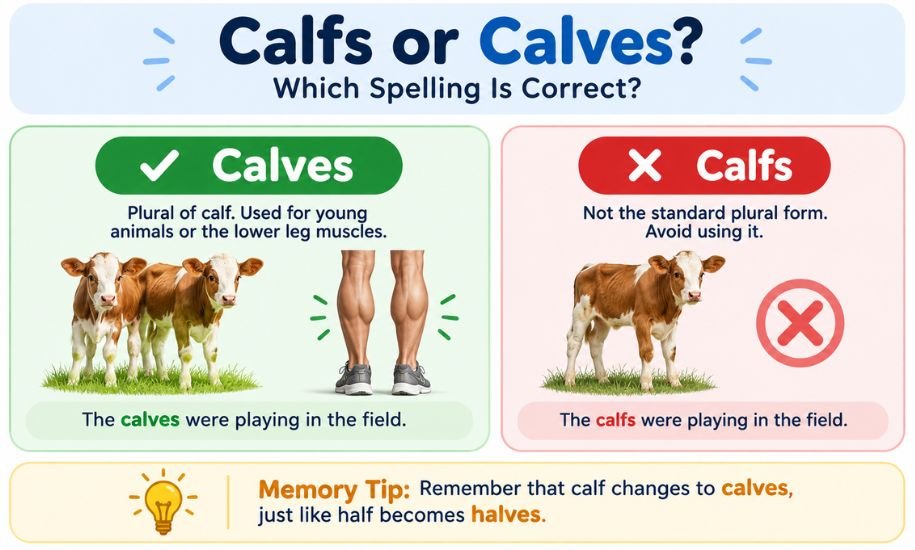
Calfs or Calves: Meaning, Rules, and Examples
Have you ever wondered whether the plural of calf is calfs or calves? The two spellings look reasonable, especially because many English nouns form their plurals by adding -s. However, calf follows a different spelling pattern. Its standard plural is calves, whether you are talking about young animals or the muscles at the back of your lower legs. Understanding this simple rule will help you avoid spelling mistakes and use the word confidently in everyday writing, school assignments, and professional communication.
**Calves** is the correct standard plural of *calf*. The word refers to multiple young animals or the muscles at the back of the lower legs. *Calfs* is not the standard plural and should generally be avoided in formal and everyday English.
Calfs or Calves: Which One Should You Use?
Calves is correct, while calfs is a nonstandard plural. The word calf changes its ending from -f to -ves when it becomes plural.
Here is a quick comparison:
| Feature | Calf | Calves | Calfs |
|---|---|---|---|
| Grammatical form | Singular | Plural | Nonstandard plural |
| Correct in standard English? | Yes | Yes | No |
| Refers to | One young animal or one lower leg | Multiple young animals or lower legs | Not the standard form |
| Example | The calf is resting. | The calves are resting. | The calfs are resting. (Incorrect) |
Remember that calf is the singular form, whereas calves is used when referring to more than one.
What Does “Calf” Mean?
The noun calf has several meanings, depending on the context. Understanding these meanings makes it easier to recognize when to use its plural form.
1. A young animal
A calf is a young cow or the young of certain other large mammals, including elephants and whales.
Examples:
- The farmer bought a healthy calf for his farm.
- A newborn calf stayed close to its mother.
- The elephant protected her calf from danger.
When talking about two or more of these animals, use calves.
For example: “The farmer moved the calves into a larger enclosure.”
2. The muscle at the back of the lower leg
A calf is also the fleshy part at the back of the lower leg, below the knee and above the ankle. The calf muscles help with movements such as walking, running, jumping, and standing on your toes.
Examples:
- My left calf feels sore after the workout.
- She stretched her calf before running.
- The athlete injured a calf muscle during training.
When referring to both legs or several people’s lower-leg muscles, calves is the appropriate plural.
For example: “My calves are tired after a long hike.”
Why Does “Calf” Become “Calves”?
English has several pluralization patterns. Most regular nouns form their plurals by adding -s or -es. For instance, book becomes books, and box becomes boxes.
However, some nouns ending in -f or -fe change that ending to -ves. The word calf follows this pattern:
- Calf → calves
- Half → halves
- Leaf → leaves
- Wolf → wolves
- Knife → knives
- Shelf → shelves
This pattern explains why calves is the standard spelling rather than calfs.
However, not every noun ending in -f follows this rule. Words such as roof and chief usually form their plurals as roofs and chiefs. Therefore, it is best to learn the plural form of each word rather than assume that every -f ending changes to -ves.
Calf Muscle or Calves Muscle: Which Is Correct?
Both calf muscle and calf muscles are grammatically correct, but the singular or plural form of the main noun depends on what you mean.
Calf muscle refers to one muscle or uses calf to describe the muscle group associated with the lower leg. Calf muscles is the natural expression when referring to the muscles collectively.
The word calf remains singular when it functions as a noun modifier before another noun, even when the second noun is plural.
Examples:
- Correct: Calf muscles play an important role in walking.
- Correct: He exercises his calf muscles twice a week.
- Correct: She has pain in both calves.
- Incorrect: She has pain in both calfs.
Notice the difference between calf muscles and calves. In the first expression, calf describes the type or location of the muscles. In the second, calves is the plural form of the noun itself.
The singular form of calves is always calf.
Correct and Incorrect Examples in Sentences
Seeing the words in context is one of the easiest ways to remember the correct form.
| Incorrect sentence | Correct sentence |
|---|---|
| The farmer raised three calfs. | The farmer raised three calves. |
| My calfs hurt after running. | My calves hurt after running. |
| Two calfs were born this morning. | Two calves were born this morning. |
| She stretched her calfs before exercise. | She stretched her calves before exercise. |
| The elephant walked with her two calfs. | The elephant walked with her two calves. |
Here are more examples showing the correct usage:
- The young calves gathered near the feeding area.
- Both of his calves became sore after the race.
- The veterinarian examined the newborn calves.
- Regular stretching can help keep calf muscles flexible.
- One calf was sleeping while the others were feeding.
These examples demonstrate that the correct plural remains calves, regardless of whether the context involves animals or human anatomy.
Is “Calfs” Ever Correct in English?
In standard modern English, calfs is not the accepted plural of calf. It may appear in spelling mistakes, informal online writing, or text written by someone unfamiliar with the irregular plural rule. However, readers should use calves in schoolwork, articles, emails, reports, and other forms of standard writing.
Do not confuse calfs with other English nouns that legitimately take -s in the plural. English plural forms vary from word to word, so the correct spelling of one noun cannot always be predicted from another.
For practical purposes, choose calves whenever you need the plural of calf.
Is the Spelling Different in British and American English?
No. British and American English use the same spelling: calves.
For example:
- British English: The calves were resting in the field.
- American English: The calves were resting in the field.
There is no regional spelling distinction between calfs and calves. If you are writing for a British, American, Australian, or other English-speaking audience, calves is the standard plural.
An Easy Way to Remember the Correct Spelling
A simple memory trick is to connect calves with halves.
Both words change their endings when forming the plural:
- One half, two halves.
- One calf, two calves.
You can also remember the related words leaves and wolves. All three plural forms use -ves.
Whenever you are unsure, write the singular first. If you mean more than one calf, change the ending to form calves, rather than simply adding an s.
Frequently Asked Questions
1. What is the plural of calf?
The plural of calf is calves. It can refer to multiple young animals or the fleshy parts at the back of the lower legs. For example, “The calves are grazing in the field” and “My calves hurt after running” both use the correct plural.
2. Is calfs a real word?
Calfs may appear as a spelling error, but it is not the standard plural of calf. In ordinary English writing, use calves instead.
3. What is the singular of calves muscle?
The singular of calves is calf. When referring to the muscle group, the usual expressions are calf muscle and calf muscles. For example, “My calf muscle is sore” refers to one, while “My calf muscles are sore” refers to the muscles collectively.
4. Is calves correct in British English?
Yes. Calves is correct in both British and American English. Neither variety uses calfs as the standard plural of calf.
5. Why do we say calves instead of calfs?
Some English nouns ending in -f change to -ves in the plural. Calf follows this spelling pattern, just like half becomes halves and wolf becomes wolves. Other words, such as roof, retain the f.
6. Should I write calf muscles or calves muscles?
Use calf muscles, not calves muscles, when referring to the muscles of the lower leg. Here, calf acts as a noun modifier. However, when talking about the lower legs themselves, calves is correct: “My calves are sore.”
Final Verdict: Calfs or Calves?
The correct plural of calf is calves, whether you are writing about baby cows, other young mammals, or the muscles at the back of the lower legs. Calfs is not the standard plural and should be avoided in normal English writing. Remember the pattern half → halves and apply the same spelling change to calf → calves. At Grammarifyr, the goal is to help you know the difference and use the right words, and this simple rule is one worth remembering. For more practical spelling and grammar guidance, English Pairs also offers a useful approach to understanding confusing English word forms.
You may also Read : Recieved or Received: Meaning and Examples