Cue or Queue: What’s the Difference?
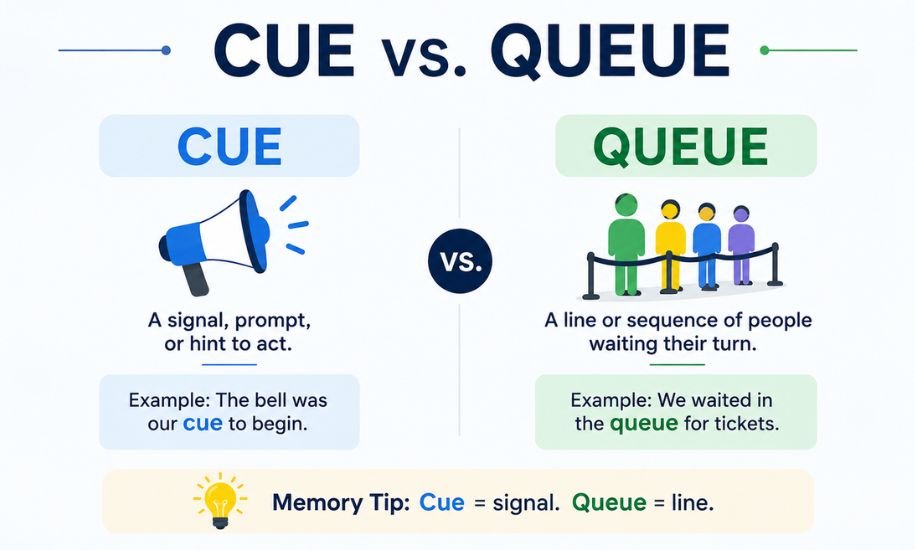
If you are unsure whether to write cue or queue, you are dealing with two different English words that happen to sound exactly the same. The spelling depends on the meaning you want. Cue usually refers to a signal, prompt, hint, or indication, while queue means a line or an ordered sequence of people or things waiting for their turn. Once you connect each spelling with its meaning, the distinction becomes much easier to remember.
Cue means a signal, hint, or prompt, while queue means a line or waiting sequence. Both are correct words, but they cannot normally be substituted for each other. Remember: a cue tells you when to act; a queue is where you wait your turn.
Cue vs. Queue: A Quick Comparison
| Feature | Cue | Queue |
|---|---|---|
| Basic meaning | Signal, hint, or prompt | Line or waiting sequence |
| Part of speech | Noun and verb | Noun and verb |
| Pronunciation | /kjuː/ | /kjuː/ |
| Common phrase | “on cue” | “in the queue” |
| Example | “That was my cue to leave.” | “We waited in the queue.” |
The two words are homophones, meaning they have the same pronunciation but different spellings and meanings.
What Does “Cue” Mean?
Cue is generally used for a signal, indication, hint, or prompt that tells someone what to do or what is about to happen.
As a noun, it can describe a signal given to a performer, a clue about how to respond, or an indication of something.
For example:
- The director gave the actor a cue to enter.
- Her smile was a cue that the conversation had gone well.
- The sound of the bell was our cue to begin.
- That question was my cue to explain the situation.
Cue can also be a verb. To cue someone or something means to signal or prompt them.
- The stage manager cued the performers.
- Please cue the music when the lights come on.
- The presenter cued the next video.
There is also a completely different noun meaning: a cue is the stick used to play billiards or pool.
What Does “Queue” Mean?
Queue refers to a line or an ordered group of people or things waiting for their turn.
For example:
- We stood in a long queue outside the theater.
- There was already a queue at the ticket counter.
- Your request is currently in the queue.
- Several customers are waiting in the queue.
As a verb, queue means to form, join, or place something in a waiting sequence.
- People queued outside the store.
- Customers queued for tickets.
- The files were queued for processing.
The word is especially common in British English when referring to a line of people. American English frequently uses line in ordinary situations, although queue is also familiar in American English, particularly in computing and technical contexts.
Why Are Cue and Queue Confused?
The main reason is pronunciation. Both cue and queue are pronounced like the letter Q: roughly “kyoo.”
Their spellings, however, are very different:
- cue → C-U-E
- queue → Q-U-E-U-E
Because people often encounter these words in conversation before seeing them written, it is easy to choose the wrong spelling.
The difference becomes clearer when you focus on meaning rather than sound. If something signals or prompts an action, use cue. If people or things are waiting in an ordered line, use queue.
Cue Up or Queue Up?
Both cue up and queue up are legitimate expressions, but they mean different things.
Cue up
Cue up means to prepare something so it is ready to start or play at the appropriate moment.
- Cue up the next song.
- I cued up the video before the presentation.
- The technician cued up the recording.
Here, cue has its signal or prompt meaning.
Queue up
Queue up means to form a line or put something into a waiting sequence.
- We queued up outside the venue.
- The customers queued up for tickets.
- The songs were queued up for later playback.
So the easiest distinction is:
Cue up = prepare something to play or begin.
Queue up = line up or place something in a waiting sequence.
Context matters with technology and media. For example, you can queue songs by putting them into an ordered playlist, while you can cue a song when preparing it to start at a particular point.
Right on Cue or Queue?
The correct expression is right on cue.
Right on cue means that something happens exactly when expected or at the appropriate moment.
Examples:
- Right on cue, the lights went out.
- The rain began right on cue.
- Right on cue, the speaker walked onto the stage.
Here, cue means a signal or expected prompt. Queue would not express this meaning.
Therefore:
- right on cue ✓
- right on queue ✗
The same rule applies to “is it right on cue or queue?” The correct form is right on cue.
On Cue or On Queue?
When you mean that something happens at the expected signal or moment, the correct phrase is on cue.
- The actor entered on cue.
- The music started on cue.
- She laughed on cue.
On queue is not the standard expression for this meaning.
However, queue is perfectly correct in phrases such as:
- in the queue
- at the front of the queue
- join the queue
- wait in the queue
Compare:
The actor came on cue.
The audience waited in the queue.
The first describes timing; the second describes a line.
Is It “Social Cues” or “Social Queues”?
The correct phrase is social cues when you are talking about signals or indications in social interactions.
Social cues can include facial expressions, gestures, tone of voice, body language, or other signals that help people understand how someone feels or how they should respond.
Examples:
- He was good at recognizing social cues.
- Her facial expression gave me an important social cue.
- Children gradually learn how to interpret social cues.
Social queues would refer literally to social lines or waiting sequences, which is not the intended meaning in this context.
The plural forms are:
- cue → cues
- queue → queues
How Do You Spell Cue or Queue?
Both spellings are correct because they represent different words.
Cue
Spell it C-U-E when you mean:
- a signal
- a prompt
- a hint
- an indication
- a billiards stick
Example:
That was my cue to leave.
Queue
Spell it Q-U-E-U-E when you mean:
- a line
- a group waiting for service
- an ordered waiting sequence
- a group of tasks waiting to be processed
Example:
My document is still in the print queue.
A useful spelling reminder is that queue contains the letter Q followed by four more letters: UEUE. It looks unusually long, but its pronunciation is simply like “cue.”
Common Mistakes With These Words
1. Using “queue” when you mean a signal
Incorrect: That was my queue to speak.
Correct: That was my cue to speak.
The word describes a signal telling you when to speak.
2. Using “cue” for a line
Incorrect: We stood in the cue for tickets.
Correct: We stood in the queue for tickets.
Here, people are waiting in a line.
3. Writing “right on queue”
Incorrect: Right on queue, the phone rang.
Correct: Right on cue, the phone rang.
The expression refers to something happening at exactly the expected time.
4. Confusing “cue up” with “queue up”
Cue up the video means prepare the video to play.
Queue up for tickets means form a line to get tickets.
5. Writing “social queues”
Incorrect: She is learning to understand social queues.
Correct: She is learning to understand social cues.
The intended meaning is social signals, not waiting lines.
An Easy Way to Remember the Difference
Use this simple rule:
Cue = signal. Queue = line.
If something gives you a signal or hint, choose cue:
The director gave me my cue.
If people or things are waiting their turn, choose queue:
We waited in the queue.
You can also remember the common expressions:
- on cue → at the expected signal
- in the queue → waiting in line
These two phrases neatly demonstrate the difference.
Examples: Cue and Queue in Sentences
Here are some examples showing the distinction in everyday contexts:
Cue:
- The applause was her cue to return to the stage.
- His raised eyebrow was a cue that something was wrong.
- The director cued the music.
- I knew it was my cue to start speaking.
Queue:
- We joined the queue outside the restaurant.
- There were twenty people in the queue.
- The computer placed the request in a queue.
- The passengers queued for boarding.
Notice that the pronunciation does not change, even though the meanings do.
Frequently Asked Questions
Is “cue” or “queue” correct?
Both are correct words. Cue means a signal, hint, or prompt, while queue means a line or an ordered sequence of things waiting to be processed. The correct choice depends on what you mean.
Is it “queue or cue” in “on cue”?
It is on cue. The phrase means that something happens at the expected signal or moment. For example: The singer appeared on cue.
Is it “right on cue or queue”?
The standard expression is right on cue. It means something happens exactly when expected, as in Right on cue, the rain started.
Is “cue up” or “queue up” correct?
Both are correct but have different meanings. Cue up means to prepare something to begin or play, while queue up means to line up or place something into a waiting sequence.
Is it “social cues” or “social queues”?
It is social cues when referring to signals such as facial expressions, gestures, tone, and body language. Social queues would have the literal meaning of social waiting lines and is not the normal expression.
How can I remember the difference?
Think cue = signal and queue = line. A cue tells you when to act, while a queue is where people or things wait their turn.
The Bottom Line
Cue and queue sound identical, but their meanings are different. Use cue for a signal, hint, prompt, or indication, and use queue for a line or waiting sequence. This also explains why we say “right on cue,” “on cue,” and “social cues,” but “in the queue” and “queue up.” When in doubt, remember: a cue tells you what to do; a queue waits for its turn. For more clear explanations of confusing English words, Grammarify follows the same simple principle: know the difference and use the right words.
You may also Read : Firey or Fiery: Which Spelling Is Correct?
One Comment