Ways to Say Hi in Different Languages: Greetings From Around the World
A simple “hi” can open a conversation, but the best greeting changes from one language and culture to another. If you’re traveling, learning a language, meeting someone online, or simply curious about international expressions, knowing a few local greetings can make communication feel more natural.
This guide covers ways to say hi in different languages, with useful distinctions between everyday, formal, and casual greetings. It also takes a closer look at ways to say hi in Spanish, including hola and several expressions you may hear in everyday conversation.
QUICK ANSWER
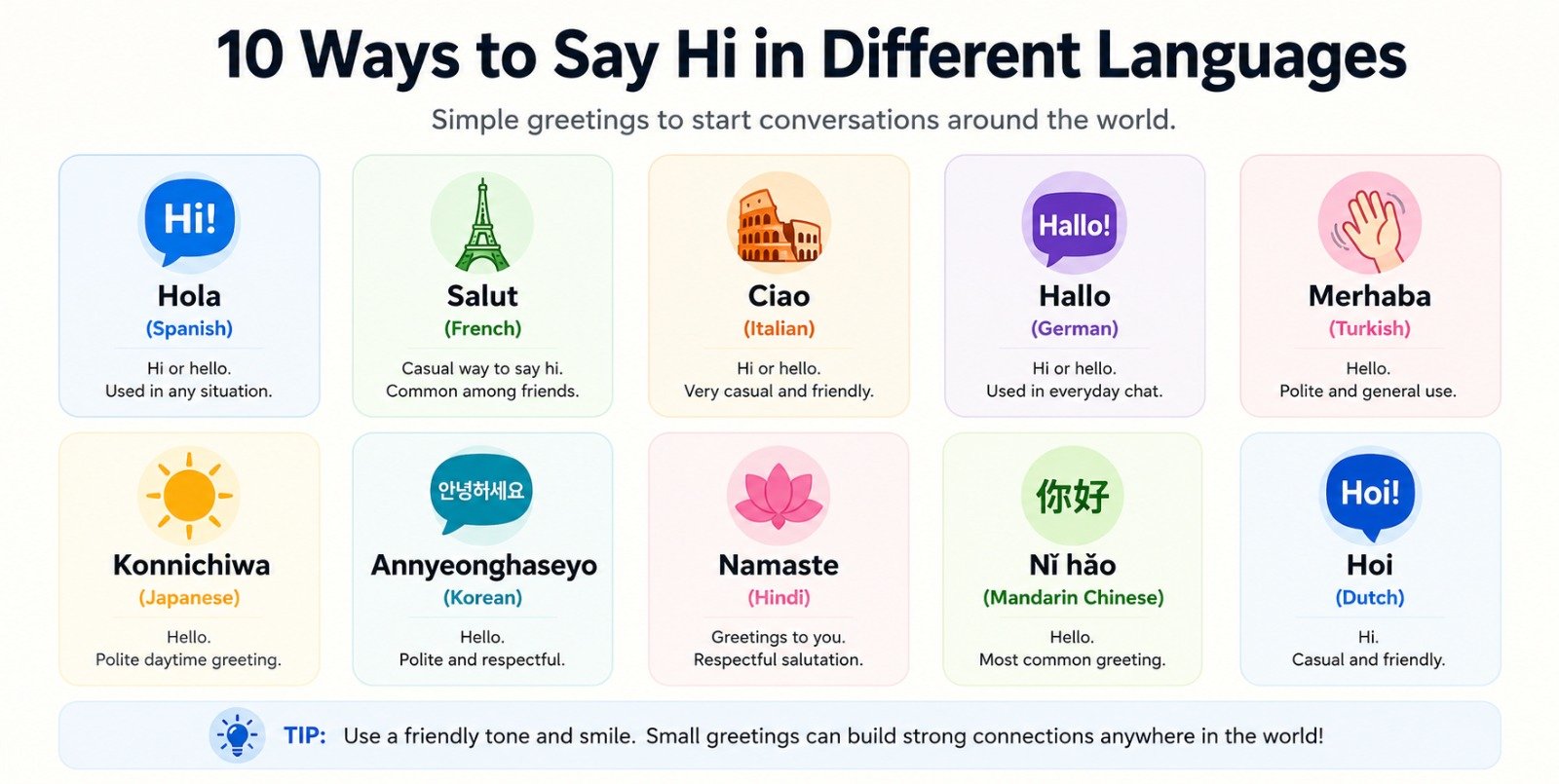
“Hi” can be expressed differently depending on the language and situation. For example, Spanish uses hola, French uses salut casually, Italian uses ciao, German uses hallo, and Mandarin commonly uses nǐ hǎo. In Spanish, hola is the straightforward equivalent of both “hi” and “hello.”
Ways to Say Hi in Different Languages
The table below gives you a practical selection of everyday greetings. Some are direct equivalents of “hi,” while others are more naturally translated as “hello,” “good day,” or another general greeting. That distinction matters because greetings don’t always map perfectly from one language to another.
| Language | Greeting | English Meaning | Typical Use |
|---|---|---|---|
| Spanish | Hola | Hi / Hello | Everyday |
| French | Salut | Hi | Casual |
| German | Hallo | Hi / Hello | Everyday |
| Italian | Ciao | Hi / Hello | Casual |
| Portuguese | Olá | Hi / Hello | Everyday |
| Dutch | Hoi | Hi | Casual |
| Swedish | Hej | Hi / Hello | Everyday |
| Turkish | Merhaba | Hello | Neutral |
| Arabic | Marhaban | Hello | Neutral |
| Persian | Salaam | Hi / Hello | Everyday |
| Hindi | Namaste | Hello / Greetings | Respectful |
| Mandarin Chinese | Nǐ hǎo (你好) | Hello | Neutral |
| Japanese | Konnichiwa (こんにちは) | Hello | Polite |
| Korean | Annyeonghaseyo (안녕하세요) | Hello | Polite |
| Greek | Ya sas (Γεια σας) | Hello | Polite |
| Hebrew | Shalom (שלום) | Hello | General |
| Russian | Zdravstvuyte (Здравствуйте) | Hello | Formal |
| Polish | Dzień dobry | Good day / Hello | Polite |
| Irish | Dia duit | Hello | General |
| Vietnamese | Xin chào | Hello | General |
| Tagalog | Kumusta | Hi / How are you? | Friendly |
| Danish | Hej | Hi | Everyday |
| Finnish | Hei | Hi / Hello | Everyday |
| Czech | Ahoj | Hi | Informal |
| Croatian | Bok | Hi | Informal |
| Armenian | Barev | Hi / Hello | General |
| Basque | Kaixo | Hello | General |
| Afrikaans | Hallo | Hello | Everyday |
These examples reflect commonly documented greetings, but usage can depend on formality, region, relationship, and the exact situation. Omniglot, for example, distinguishes formal and informal forms in its multilingual greeting references.
Other Ways to Say Hi in Different Languages
The word “hi” does not always have one perfect translation. In some languages, the most natural everyday greeting is closer to “hello,” while in others a shorter informal expression is preferred.
Casual Ways to Say Hi in Different Languages
For friends, classmates, relatives, or people you already know, shorter and more relaxed greetings are often appropriate.
- French — Salut: A familiar way to say “hi” and also commonly used when saying goodbye.
- Italian — Ciao: A very familiar greeting that can mean either “hi” or “bye.”
- Dutch — Hoi: A casual “hi.”
- Portuguese — Oi: A common informal greeting, especially in Brazilian Portuguese.
- Russian — Privet (Привет): An informal “hi.”
- German — Hallo: Common in everyday conversation and less formal than greetings such as Guten Tag.
- Korean — Annyeong (안녕): Informal and generally used with people with whom casual speech is appropriate.
- Swedish — Hej hej: A friendly, informal greeting.
- Turkish — Selam: A casual alternative to the more neutral merhaba.
- Japanese — Yā (やあ): A casual greeting used with people you know well.
Rosetta Stone similarly separates casual greetings from more generally polite forms, showing why simply translating “hi” word-for-word isn’t always enough.
Formal Ways to Say Hello in Different Languages
A greeting that works perfectly with a friend may not be the best choice when addressing a stranger, customer, teacher, senior colleague, or other person in a formal setting.
Examples include:
- German: Guten Tag — “Good day”
- French: Bonjour — “Hello / Good day”
- Polish: Dzień dobry — “Good day”
- Russian: Zdravstvuyte — formal “hello”
- Japanese: Konnichiwa — a common polite greeting
- Greek: Ya sas — a polite form of greeting
- Korean: Annyeonghaseyo — polite “hello”
For beginners, learning one neutral or polite greeting first is often more useful than memorizing several slang expressions.
Ways to Say Hi in Spanish
When looking at ways to say hi in Spanish, start with one word: hola.
SpanishDictionary explains that hola works for both “hi” and “hello.” Unlike English, Spanish does not require a separate basic word to distinguish those two levels of casualness.
Hola — Hi or Hello
Hola is the simplest and most versatile Spanish greeting.
You can use it with friends, acquaintances, and in many ordinary situations where you want to greet someone politely.
Example:
“¡Hola! ¿Cómo estás?”
“Hi! How are you?”
One reason hola is such a useful word for beginners is that you don’t need to worry about whether you’re choosing the equivalent of English “hi” or “hello.” It can cover both.
¿Qué tal? — How’s It Going?
¿Qué tal? is a friendly conversational greeting that can be understood as “How’s it going?” or “How are things?”
It often works naturally after hola:
Example:
“¡Hola! ¿Qué tal?”
“Hi! How’s it going?”
Unlike hola, this expression also invites a response about how someone is doing.
Buenas — A Casual Greeting
Buenas is a shortened greeting that you’ll hear in Spanish-speaking contexts. It can serve as a relaxed greeting without specifying días, tardes, or noches.
Because regional habits differ, it’s better to recognize buenas as a casual greeting rather than assume it is used identically everywhere.
Buenos días — Good Morning
Buenos días literally means “good morning” and is appropriate when greeting someone in the morning.
Example:
“Buenos días, profesora.”
“Good morning, teacher.”
It can sound more courteous than simply using hola, particularly in polite or professional situations.
Buenas tardes — Good Afternoon
Buenas tardes means “good afternoon.”
It’s useful when you want a time-specific greeting rather than a general hola.
Example:
“Buenas tardes. ¿Cómo está?”
“Good afternoon. How are you?”
Buenas noches — Good Evening
Buenas noches means “good evening” or “good night,” depending on context.
It can be used when greeting someone in the evening and can also be used when leaving at night.
¿Cómo estás? — How Are You?
¿Cómo estás? means “How are you?” and is commonly used informally with one person.
It is often added after a basic greeting:
Example:
“Hola, ¿cómo estás?”
“Hi, how are you?”
For a formal singular situation, ¿Cómo está? is used instead. When speaking to a group, ¿Cómo están? is appropriate.
¿Qué pasa? — What’s Up?
¿Qué pasa? literally relates to “What’s happening?” but is also used informally as “What’s up?”
It is more conversational than simply saying hola, so it’s better suited to relaxed interactions.
¿Qué onda? — What’s Up?
¿Qué onda? is another informal expression meaning roughly “What’s up?” Its usage is particularly associated with some Latin American varieties, including Mexican Spanish.
Because Spanish varies by country, regional expressions shouldn’t automatically be treated as universal alternatives to hola.
Oye — Hey
Oye is commonly used to get someone’s attention and can sometimes function as a casual conversational opener.
It is not a direct replacement for hola in every situation. If your primary goal is simply to greet someone, hola remains the safer choice.
Spanish Greetings at a Glance
| Spanish Expression | Natural Meaning | Tone | Best Context |
|---|---|---|---|
| Hola | Hi / Hello | Neutral | Almost any everyday greeting |
| ¿Qué tal? | How’s it going? | Friendly | Friends and acquaintances |
| Buenas | Hi / Hello | Casual | Informal everyday situations |
| Buenos días | Good morning | Polite | Morning |
| Buenas tardes | Good afternoon | Polite | Afternoon |
| Buenas noches | Good evening / night | Polite | Evening |
| ¿Cómo estás? | How are you? | Friendly | Informal conversation |
| ¿Qué pasa? | What’s up? | Casual | Friends and familiar people |
| ¿Qué onda? | What’s up? | Very casual/regional | Informal Latin American contexts |
| Oye | Hey | Casual | Getting someone’s attention |
The key distinction is that not all of these mean exactly “hi.” Some are greetings, while others start a conversation by asking how someone is doing or what is happening. SpanishDictionary makes the same distinction among hola, time-based greetings, and informal expressions.
Other Ways to Say Hi When Traveling
Learning a basic greeting before visiting another country can be useful because greetings are often among the first words exchanged.
For example:
- In Italy, ciao is familiar and informal, while salve is a more neutral greeting.
- In France, salut is casual, while bonjour is a standard polite greeting.
- In Germany, hallo is everyday and familiar, while Guten Tag is more formal.
- In Japan, konnichiwa is a common polite greeting, while very casual alternatives are better reserved for people you know well.
- In Korea, annyeonghaseyo is a useful polite greeting for learners.
- In Spanish-speaking countries, hola is the easiest general-purpose starting point.
The important lesson is to learn the social setting, not just the vocabulary. A greeting can be grammatically correct and still sound too casual or too formal for the person you’re addressing.
How to Choose the Right Greeting
When deciding how to say hi, consider four things.
1. Who Are You Greeting?
A close friend and a stranger don’t necessarily require the same greeting. Informal expressions are usually more appropriate among people who already have a comfortable relationship.
2. How Formal Is the Situation?
A workplace meeting, hotel reception, classroom, or business introduction may call for a polite greeting. With friends, a shorter casual expression can sound more natural.
3. What Country or Region Are You In?
Languages aren’t always uniform across borders. Spanish is a particularly good example: an expression common in Mexico may sound less familiar elsewhere in the Spanish-speaking world.
4. What Time Is It?
Some greetings specifically refer to the time of day. Spanish has buenos días, buenas tardes, and buenas noches, while German similarly uses time-specific expressions such as Guten Morgen and Guten Abend.
Common Mistakes When Saying Hi in Another Language
A few simple mistakes are easy to avoid.
Using slang with strangers: A highly informal greeting may be fine between friends but inappropriate with someone you have just met.
Assuming literal translations are interchangeable: “Hi,” “hello,” “good morning,” and “how are you?” can all function as greetings, but they do not have exactly the same meaning.
Ignoring regional differences: A phrase may be perfectly natural in one country but uncommon in another.
Focusing only on pronunciation: Pronunciation matters, but knowing when and with whom to use an expression matters just as much.
Using one greeting everywhere: Some languages have distinct polite and informal forms, so context should guide your choice.
Frequently Asked Questions
What is the easiest way to say hi in different languages?
Learn one common, neutral greeting in each language first. Examples include hola in Spanish, bonjour in French, hallo in German, olá in Portuguese, and merhaba in Turkish.
What are the ways to say hi in Spanish?
The most direct option is hola. Depending on the situation, you can also hear ¿qué tal?, buenas, buenos días, buenas tardes, ¿cómo estás?, and other informal or regional expressions.
Is “hola” hi or hello in Spanish?
Hola can mean both “hi” and “hello.” Spanish does not make the same basic hi versus hello distinction that English does.
What is a casual way to say hi in Spanish?
Hola itself is perfectly natural in casual conversation. Depending on the situation and region, expressions such as ¿qué tal?, buenas, or ¿qué pasa? can make the greeting more conversational.
Is “¿qué tal?” the same as “hola”?
Not exactly. Hola is a direct general greeting, while ¿qué tal? is closer to “How’s it going?” or “How are things?” It can follow hola naturally.
What is the difference between “hi” and “hello” in other languages?
There isn’t one universal rule. Some languages have separate casual and formal greetings, while others use one expression for both “hi” and “hello.” Spanish hola is a clear example of the latter.
Should I use a formal or casual greeting?
Use a neutral or polite greeting when you’re unsure. Once you know the relationship and local conventions, you can switch to a more informal expression when appropriate.
Conclusion
Learning ways to say hi in different languages is more than memorizing a list of translations. The most useful approach is to understand whether a greeting is casual, polite, regional, time-specific, or conversation-starting. For Spanish, hola is the dependable everyday choice, while expressions such as ¿qué tal?, buenas, and ¿qué pasa? add different shades of friendliness and context.
The best greeting is the one that fits both the language and the person you’re speaking to. That’s the kind of small distinction Grammarifyr makes easier to understand, helping you choose words that sound natural rather than merely translated.
You may also Read : 50+ Ways to Say Hi: Different, Funny, Friendly & Creative Greetings