100+ Ways to Say Hello in Different Languages
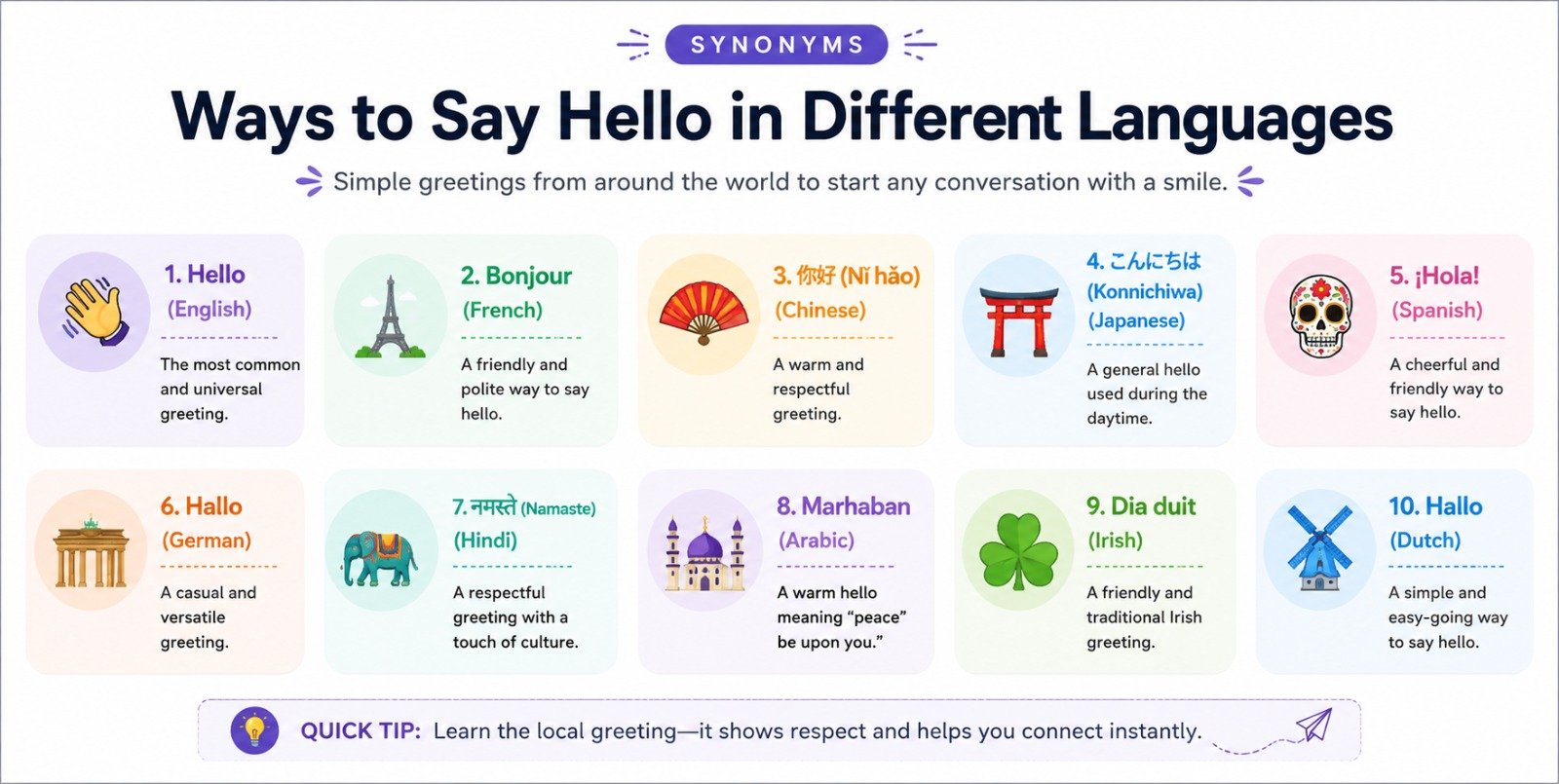
A simple greeting can make a conversation feel warmer, especially when you use someone’s own language. There are countless ways to say hello in different languages, and the best choice often depends on the country, relationship, time of day, and level of formality.
Below, you’ll find common greetings from around the world, plus practical explanations of when to use them. You’ll also find a closer look at ways to say hello in Spanish, including casual and time-specific expressions.
Ways to Say Hello in Different Languages
There isn’t always a perfect one-word equivalent of English “hello.” Some languages use different greetings according to the time of day, social relationship, or level of politeness.
The table below focuses on commonly used greetings rather than attempting to list every possible regional or informal expression. Current language-learning references likewise distinguish common polite greetings from casual alternatives.
| Language | Greeting | English Meaning | Typical Context |
|---|---|---|---|
| Spanish | Hola | Hello / Hi | General |
| French | Bonjour | Hello / Good day | Polite, daytime |
| German | Hallo | Hello | General |
| Italian | Ciao | Hi / Hello | Casual |
| Portuguese | Olá | Hello | General |
| Dutch | Hallo | Hello | General |
| Swedish | Hej | Hi / Hello | General |
| Danish | Hej | Hi / Hello | General |
| Finnish | Hei | Hi / Hello | General |
| Norwegian | Hei | Hi / Hello | General |
| Polish | Dzień dobry | Good day | Polite |
| Czech | Ahoj | Hi / Hello | Casual |
| Greek | Γεια σας (Yia sas) | Hello | Polite/general |
| Russian | Здравствуйте | Hello | Formal/polite |
| Turkish | Merhaba | Hello | General |
| Arabic | مرحبًا (Marhaban) | Hello | General |
| Hebrew | שלום (Shalom) | Hello / Peace | General |
| Persian | سلام (Salam) | Hello | General |
| Hindi | नमस्ते (Namaste) | Greetings / Hello | Polite/respectful |
| Bengali | হ্যালো (Hyālō) | Hello | General |
| Urdu | السلام علیکم | Peace be upon you | Traditional greeting |
| Japanese | こんにちは | Hello | Common daytime greeting |
| Korean | 안녕하세요 | Hello | Polite |
| Mandarin Chinese | 你好 (Nǐ hǎo) | Hello | General |
| Cantonese | 你好 | Hello | General |
| Vietnamese | Xin chào | Hello | General |
| Thai | สวัสดี | Hello | Polite/general |
| Indonesian | Halo | Hello | General |
| Filipino | Kumusta | Hello / How are you? | General |
| Malay | Hai | Hi | Casual/general |
| Georgian | გამარჯობა (Gamarjoba) | Hello | General |
| Armenian | Բարև (Barev) | Hello | General |
| Albanian | Përshëndetje | Hello | General |
| Basque | Kaixo | Hello | General |
| Irish | Dia dhuit | Hello | Traditional |
| Afrikaans | Hallo | Hello | General |
| Swahili | Jambo | Hello | Common learner greeting |
| Amharic | ሰላም (Selam) | Hello / Peace | General |
| Māori | Kia ora | Hello / Be well | Friendly/general |
| Fijian | Bula | Hello / Life | Friendly |
| Hawaiian | Aloha | Hello / Love | General |
| Samoan | Talofa | Hello | General |
This broad selection reflects the type of international greeting lists provided by language-learning and education sites, although individual expressions can have regional or contextual differences.
Other Ways to Say Hello in European Languages
Europe offers a particularly interesting range of greetings because some expressions are formal, while others are strongly associated with friends and informal conversations.
Other Ways to Say Hello in French
Bonjour is the standard everyday greeting and can mean “hello” or literally “good day.” It is a safe choice when greeting someone politely during the day.
Salut is much more casual. Use it with friends, family, or people with whom you have an informal relationship.
Bonsoir means “good evening” and is appropriate later in the day.
The important distinction is that bonjour and salut aren’t simply interchangeable versions of the same word. Their level of familiarity is different.
Other Ways to Say Hello in Italian
Salve is a useful neutral or polite greeting.
Ciao is one of the best-known Italian greetings, but it is informal and can mean both “hello” and “goodbye.”
Buongiorno means “good morning” or “good day” and is appropriate in many polite daytime situations.
Buonasera means “good evening.”
So, if you’re meeting someone you don’t know well, salve or buongiorno may be more appropriate than ciao.
Other Ways to Say Hello in German
Hallo is a common everyday greeting.
Guten Morgen means “good morning.”
Guten Tag means “good day” and is a more neutral or polite option.
Guten Abend means “good evening.”
For casual conversations, Hallo works naturally. In more formal situations, a time-specific greeting can sound more appropriate.
Other Ways to Say Hello in French, German, and Italian
| Language | Casual | Neutral/Polite | Time-Specific |
|---|---|---|---|
| French | Salut | Bonjour | Bonsoir |
| German | Hallo | Guten Tag | Guten Morgen / Guten Abend |
| Italian | Ciao | Salve | Buongiorno / Buonasera |
| Spanish | Hola | Hola | Buenos días / Buenas tardes |
Other Ways to Say Hello in Asian Languages
Asian languages demonstrate especially well why a direct translation isn’t always enough.
Other Ways to Say Hello in Japanese
こんにちは (Konnichiwa) is a widely recognized Japanese greeting generally associated with daytime.
おはようございます (Ohayō gozaimasu) is a polite way to say “good morning.”
おはよう (Ohayō) is the more casual version of “good morning.”
やあ (Yā) is an informal greeting that can be used among people who are familiar with one another.
Japanese greetings are strongly influenced by social relationships and politeness, so beginners should avoid assuming that the most casual option works in every situation.
Other Ways to Say Hello in Korean
안녕하세요 (Annyeonghaseyo) is a standard polite greeting.
안녕 (Annyeong) is more casual and is generally suitable among close friends or people in informal relationships.
The difference is important: learning the word alone isn’t enough; knowing who you’re talking to helps you choose the right form.
Other Ways to Say Hello in Chinese
In Mandarin, 你好 (Nǐ hǎo) is a common way to say hello.
You may also encounter 嗨 (Hāi), which is essentially an informal “hi,” particularly in modern casual communication.
In Cantonese-speaking contexts, greetings can differ from Mandarin even when written forms overlap. That’s one reason it’s better to identify the specific variety of Chinese before learning a greeting.
Other Ways to Say Hello in Hindi
नमस्ते (Namaste) is widely recognized as a respectful greeting.
You may also hear नमस्कार (Namaskar) in some contexts. English “hello” is also commonly adapted into Hindi speech as हेलो (Hello/Helo).
It’s worth remembering that translating namaste simply as “hello” doesn’t capture all of its cultural and contextual meaning.
Other Ways to Say Hello in Middle Eastern Languages
Other Ways to Say Hello in Arabic
Marhaban (مرحبًا) is a common general greeting.
Ahlan (أهلًا) is another friendly greeting.
As-salamu alaykum (السلام عليكم) is a widely recognized traditional greeting meaning “peace be upon you,” with wa alaykum as-salam used as a traditional response.
Arabic varies considerably across countries and dialects, so greetings heard in Morocco may differ from those commonly heard in the Gulf or Levant.
Other Ways to Say Hello in Hebrew
Shalom (שלום) can mean “hello,” “goodbye,” and “peace,” depending on context.
Shalom is therefore more than a simple translation of the English word “hello.”
Other Ways to Say Hello in Latin and South American Languages
Spanish and Portuguese are two of the most useful languages to learn for travelers across large parts of the Americas.
Other Ways to Say Hello in Portuguese
Olá is the straightforward equivalent of “hello.”
Oi is shorter and more casual, especially in Brazilian Portuguese.
Bom dia means “good morning.”
Boa tarde means “good afternoon.”
Boa noite means “good evening” or “good night,” depending on context.
The exact style of greeting can vary between Brazil, Portugal, and other Portuguese-speaking communities.
Ways to Say Hello in Spanish
If you’re specifically looking for ways to say hello in Spanish, the simplest answer is hola.
But Spanish offers much more than one greeting. The best expression depends on the time of day, how well you know someone, and whether you’re speaking formally or casually. SpanishDictionary identifies hola as the most common general greeting and also lists time-specific and informal alternatives.
Other Ways to Say Hello in Spanish: Hola
Hola means “hello” or “hi” and is the most versatile everyday Spanish greeting.
Example:
¡Hola! ¿Cómo estás?
Hello! How are you?
It can be used with friends, acquaintances, coworkers, and people you have just met.
Other Ways to Say Hello in Spanish: Buenos Días
Buenos días means “good morning.”
It is commonly used in the morning and can work in both formal and informal situations. SpanishDictionary notes that buen día is also used, while the grammatically correct form is buenos días, not buenas días.
Example:
¡Buenos días, profesora!
Good morning, professor!
Other Ways to Say Hello in Spanish: Buenas Tardes
Buenas tardes means “good afternoon.”
It is useful when greeting someone later in the day.
Example:
Buenas tardes, señor García.
Good afternoon, Mr. García.
You can also combine it naturally with hola:
Hola, buenas tardes.
This combination is commonly used in Spanish conversation.
Other Ways to Say Hello in Spanish: Buenas Noches
Buenas noches means “good evening” or “good night.”
Unlike English, where “good night” is often primarily a farewell, Spanish speakers can use buenas noches as an evening greeting as well as a farewell.
Example:
Hola, buenas noches. ¿Cómo está?
Hello, good evening. How are you?
Other Ways to Say Hello in Spanish: ¿Qué Tal?
¿Qué tal? is a casual way to ask something like “How’s it going?” or “How are things?”
It works especially well after hola:
¡Hola! ¿Qué tal?
This isn’t a literal replacement for “hello,” but it serves as a natural conversation opener.
Other Ways to Say Hello in Spanish: ¿Cómo Estás?
¿Cómo estás? means “How are you?” and is generally informal when speaking to one person.
For a formal situation, ¿Cómo está? is appropriate when addressing one person formally. For a group, ¿Cómo están? can be used.
Other Ways to Say Hello in Spanish: ¿Qué Pasa?
¿Qué pasa? literally asks “What’s happening?” but is commonly used as a casual “What’s up?”
It is better suited to informal conversations than professional introductions.
Other Ways to Say Hello in Spanish: ¿Qué Onda?
¿Qué onda? is another informal greeting meaning roughly “What’s up?” Its use is particularly associated with certain Latin American varieties of Spanish, so it isn’t equally natural everywhere.
Other Ways to Say Hello in Spanish: ¡Buenas!
¡Buenas! is a shortened informal greeting. SpanishDictionary notes that it can function as a casual greeting across different times of day, including as a shortened form related to buenas tardes and buenas noches.
This is useful when you want something short and friendly rather than a full formal greeting.
Different Ways to Say Hello in Different Languages by Situation
A greeting becomes easier to choose when you start with the situation rather than the translation.
| Situation | Good Approach | Examples |
|---|---|---|
| Meeting someone new | Use a neutral/polite greeting | Bonjour, Hola, Merhaba |
| Greeting a friend | Use a casual expression | Ciao, Salut, Hi |
| Morning | Use a morning greeting | Buenos días, Guten Morgen |
| Evening | Use an evening greeting | Buonasera, Buenas noches |
| Professional setting | Prefer polite/neutral forms | Guten Tag, Bonjour |
| Casual text | Short greetings work well | Hi, Hey, Oi |
| Formal conversation | Avoid slang | Polite forms are safer |
| Traveling | Learn the local standard greeting | One common local greeting |
The key lesson is that different ways to say hello in different languages aren’t all direct synonyms. A phrase that works perfectly with a close friend may sound too informal when addressing a customer, teacher, elder, or business contact.
Greetings That Depend on the Time of Day
Some languages use greetings that explicitly refer to the time.
Morning Greetings
- English: Good morning
- Spanish: Buenos días
- French: Bonjour
- German: Guten Morgen
- Italian: Buongiorno
- Portuguese: Bom dia
- Japanese: Ohayō gozaimasu
Afternoon Greetings
- Spanish: Buenas tardes
- French: Bonjour
- Portuguese: Boa tarde
Evening Greetings
- Spanish: Buenas noches
- French: Bonsoir
- German: Guten Abend
- Italian: Buonasera
- Portuguese: Boa noite
Don’t assume every language divides the day in exactly the same way as English. The boundaries and customary usage can vary.
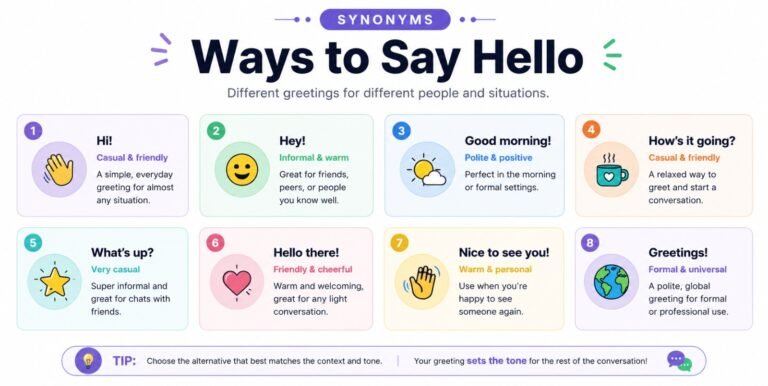
Casual Ways to Say Hello
When you’re talking to friends, classmates, siblings, or people you know well, a casual greeting usually sounds more natural.
Other Ways to Say Hello Casually
- Hi
- Hey
- What’s up?
- How’s it going?
- Ciao
- Salut
- Oi
- Ahlan
- Annyeong
- Hej
Some of these are not literal translations of “hello.” Instead, they’re conversation openers that perform a similar social function.
For example, “What’s up?” asks about someone’s current situation, while “hello” simply establishes the greeting. The distinction becomes even more important when translating expressions into another language.
Polite Ways to Say Hello
When meeting a client, teacher, manager, older person, customer, or someone you don’t know well, choose a neutral or polite greeting.
Good options include:
- Bonjour
- Guten Tag
- Buenos días
- Merhaba
- Dzień dobry
- Annyeonghaseyo
- Marhaban
- Hello
When you’re uncertain about the social rules of a language, starting with the more polite option is usually safer than immediately using slang.
How to Choose the Right Greeting
Before choosing among the ways to say hello in different languages, consider four things:
1. Who are you greeting?
A close friend and a stranger may require different expressions.
2. Where are you?
Languages often have regional differences, and the same phrase may sound more natural in one country than another.
3. What time is it?
Some languages commonly use specific morning, afternoon, or evening greetings.
4. How formal is the situation?
A workplace meeting calls for a different level of formality than a message to a friend.
A simple, widely recognized greeting is often the best starting point when you’re learning.
Common Mistakes When Using Greetings in Other Languages
One common mistake is assuming that a translation dictionary tells you everything you need to know.
For example, learning that ciao = hello doesn’t automatically tell you when ciao is appropriate. Likewise, learning that ¿Qué pasa? = what’s up? doesn’t mean it should replace hola in every Spanish conversation.
Another mistake is ignoring regional differences. Spanish is spoken across many countries, and expressions that sound completely normal in Mexico may not be equally common in Spain or Argentina.
Finally, pronunciation matters. A greeting that you spell correctly but pronounce poorly may be difficult for the listener to understand.
Why Learning Hello in Another Language Matters
Learning one greeting can be a surprisingly useful first step when learning a language.
You don’t need to become fluent before using a local greeting. Knowing a simple expression can make travel interactions easier and show that you’re making an effort to communicate respectfully.
It also gives you a starting point for learning other useful phrases such as “thank you,” “please,” “excuse me,” and “goodbye.”
Frequently Asked Questions
What are some ways to say hello in different languages?
Common examples include Hola in Spanish, Bonjour in French, Hallo in German, Ciao in Italian, Merhaba in Turkish, Konnichiwa in Japanese, Annyeonghaseyo in Korean, and Marhaba in Arabic.
How do you say hello in Spanish?
The most common general greeting is hola. Depending on the time and situation, you can also use buenos días, buenas tardes, buenas noches, ¿qué tal?, or other informal expressions.
What are different ways to say hello in Spanish casually?
For casual situations, you can use hola, ¿qué tal?, ¿qué pasa?, ¿qué onda?, ¿cómo vas?, or ¡buenas! The natural choice can vary by country and relationship.
Is “ciao” formal or informal?
Ciao is generally informal in Italian. It is commonly used among friends, family, and people who have a familiar relationship. For more formal situations, salve or a suitable time-based greeting is usually a better choice.
Is “buenas noches” a greeting or a goodbye in Spanish?
It can be either. Buenas noches can be used when greeting someone in the evening and when saying good night or leaving at night.
What is the most polite way to say hello in another language?
There isn’t one universal “most polite” greeting. Each language has its own conventions. A neutral or formal greeting is generally safer when meeting a stranger, customer, teacher, elder, or professional contact.
Why are there different ways to say hello in the same language?
Greetings change according to factors such as time of day, familiarity, region, age, social status, and formality. That’s why a language can have several natural greetings rather than one universal equivalent of “hello.”
Should I use a formal or casual greeting when traveling?
If you’re unsure, start with a common neutral or polite greeting. Once you understand the local social conventions, you can adopt more casual expressions with friends and other familiar people.
Final Thoughts
The best greeting isn’t necessarily the one that translates most literally to “hello.” It is the one that fits the language, relationship, location, time of day, and social setting. Start with a common neutral expression, then learn casual or formal alternatives as you become more familiar with the language.
From hola and bonjour to konnichiwa and merhaba, exploring different greetings is a simple way to make communication more natural and culturally aware. Grammarifyr focuses on those small but meaningful differences that help you choose the right words for the right situation.
You may also Read : 75 Ways to Say Hello: Different, Funny, Friendly & Professional Greetings
One Comment