Other Ways to Say “Because”: 25 Natural Alternatives for Better Writing
Using because is perfectly correct, but repeating it throughout an essay, email, or conversation can make your writing feel predictable. Fortunately, English offers many other ways to express a reason, cause, or explanation.
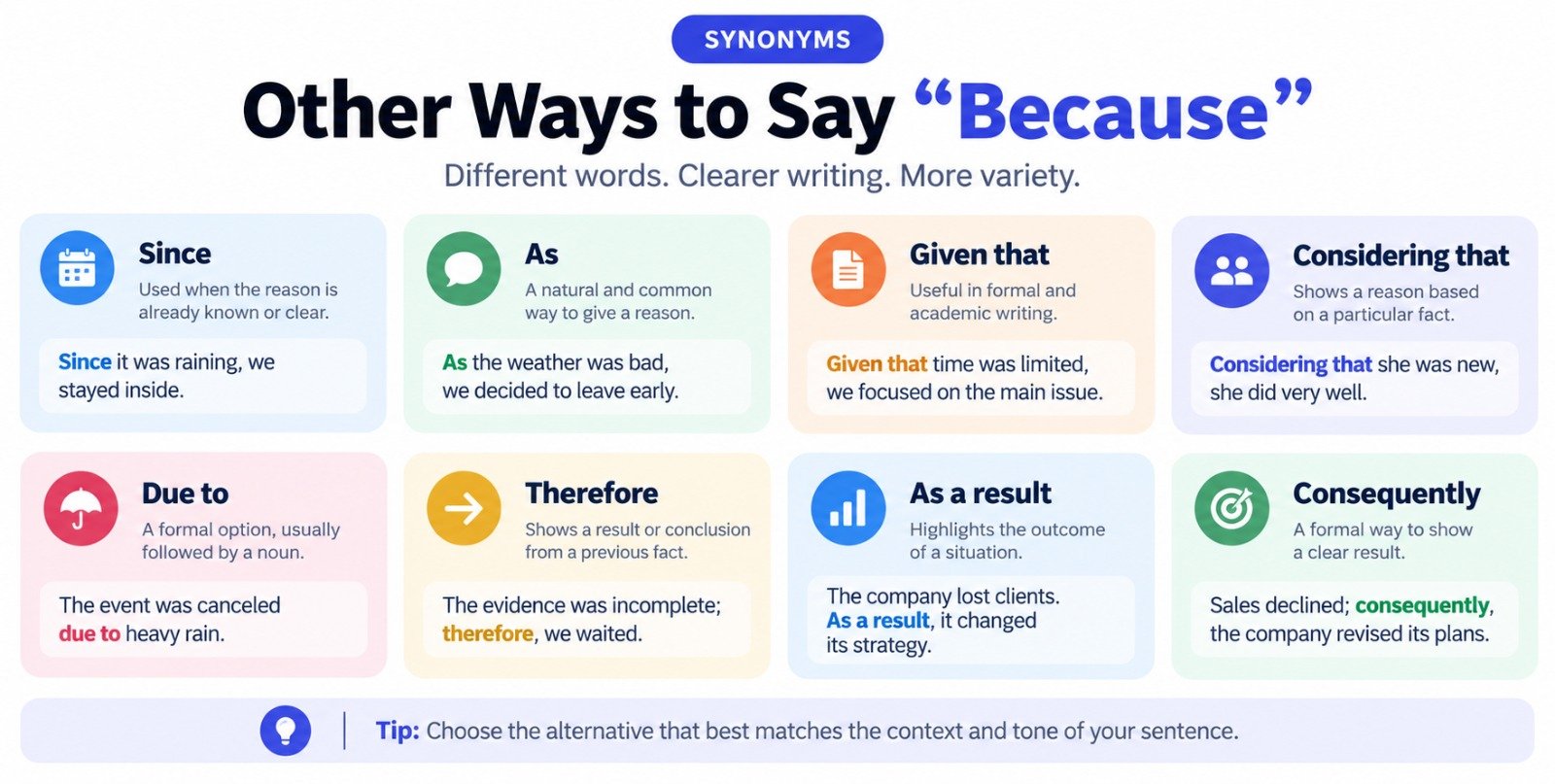
The best alternative depends on your sentence and the tone you want. Words such as since and as work naturally in everyday writing, while given that, considering that, and on account of can suit more formal contexts. If you’re looking for another way to say because of this, expressions such as therefore, as a result, and consequently may be more appropriate because they emphasize a result rather than simply introducing a reason.
Quick Comparison: Alternatives to “Because”
| Alternative | Tone | Best Used For | Example |
|---|---|---|---|
| Since | Neutral | Everyday and written English | Since it was raining, we stayed inside. |
| As | Neutral/Formal | Explanations and writing | As the store was closed, we returned later. |
| Given that | Formal | Essays and professional writing | Given that time was limited, we focused on the main issue. |
| Considering that | Neutral/Formal | Reasoned explanations | Considering that he was new, he did very well. |
| Seeing that | Casual/Neutral | Conversational explanations | Seeing that you’re busy, I’ll handle it. |
| Due to | Formal | Causes before nouns | The match was canceled due to heavy rain. |
| Owing to | Formal | Formal written English | The flight was delayed owing to bad weather. |
| On account of | Formal | Formal explanations | The event was postponed on account of the storm. |
| As a result | Neutral/Formal | Showing a consequence | The road was flooded. As a result, traffic stopped. |
| Therefore | Formal | Conclusions and results | The evidence was incomplete; therefore, we waited. |
| Consequently | Formal | Clear cause-and-effect relationships | Sales declined; consequently, the company changed its strategy. |
The table also highlights an important point: not every alternative is grammatically interchangeable with “because.” Some introduce a reason, while others describe the result of a previous situation.
Other Ways to Say “Because”
1. Since
Since is one of the most natural alternatives to because when the reason is already known or relatively clear from context.
Example:
“Since you have already finished your work, you can leave early.”
It works well in conversations, emails, essays, and general writing.
2. As
As can introduce a reason and often sounds slightly more polished than because.
Example:
“As the weather was getting worse, we decided to go home.”
It is particularly common when the reason is background information rather than the main point of the sentence.
3. Given that
Given that is a useful choice when you want to emphasize a fact or circumstance that provides a logical reason.
Example:
“Given that the deadline is tomorrow, we need to finish the report today.”
This phrase is especially useful in professional and academic writing.
4. Considering that
Considering that means taking a particular fact into account.
Example:
“Considering that she had only practiced for a week, her performance was impressive.”
It works well when the reason involves a circumstance that helps explain a result.
5. Seeing that
Seeing that is a natural but somewhat conversational way to introduce a reason.
Example:
“Seeing that everyone was tired, we decided to end the meeting.”
It is more comfortable in speech and informal writing than in highly formal academic work.
6. For
For can sometimes introduce a reason, particularly in literary, traditional, or formal-sounding writing.
Example:
“She could not attend, for she was feeling unwell.”
This usage is grammatically valid, but it can sound old-fashioned or literary in everyday conversation. It should not automatically replace because in modern informal writing.
Formal Ways to Say “Because”
When writing an academic paper, business document, report, or formal explanation, you may want something more precise than repeatedly using because.
7. Due to
Due to is normally followed by a noun or noun phrase rather than a complete clause.
Example:
“The flight was delayed due to severe weather.”
Compare:
- Because the weather was severe, the flight was delayed.
- Due to severe weather, the flight was delayed.
This distinction matters. Due to is not simply a word-for-word replacement for because.
8. Owing to
Owing to is another formal expression that indicates a cause.
Example:
“Owing to unexpected technical problems, the meeting was postponed.”
It is particularly suitable for formal notices, reports, and professional writing.
9. On account of
On account of means because of or as a result of a particular circumstance.
Example:
“The outdoor event was canceled on account of heavy rain.”
It has a formal tone and is less common in casual conversation.
10. By reason of
By reason of is a highly formal expression and is most useful in specialized or official writing.
Example:
“The application was rejected by reason of incomplete documentation.”
For ordinary writing, because, since, or due to will usually sound more natural.
11. In view of the fact that
This phrase can introduce a reason based on a known circumstance.
Example:
“In view of the fact that the evidence was limited, the researchers avoided making a definite conclusion.”
Although grammatically useful, it can be unnecessarily wordy. In many situations, given that is cleaner.
Other Ways to Say “Because” in an Essay
Academic writing benefits from variety, but replacing because with complicated expressions simply to sound intelligent can make an essay less readable.
Here are some natural choices:
12. Given that
“Given that the population is increasing, additional housing may be necessary.”
13. Since
“Since technology has changed the way people communicate, traditional forms of correspondence have become less common.”
14. As
“As the study involved a small sample, the findings should be interpreted carefully.”
15. Considering that
“Considering that the experiment was conducted under controlled conditions, the results are significant.”
16. In light of the fact that
This can be useful when a conclusion is based on a particular circumstance.
Example:
“In light of the fact that several participants withdrew, the researchers repeated the analysis.”
However, don’t overuse long constructions. Academic writing usually becomes stronger when the connection between ideas is clear and concise.
Another Way to Say “Because of This”
The phrase “because of this” is slightly different from “because.” It usually refers back to an earlier fact and explains what happened as a consequence.
For example:
“The roads were flooded. Because of this, several schools closed.”
Depending on the sentence, you could use:
17. As a result
As a result is one of the most natural alternatives when you want to emphasize a consequence.
Example:
“The company lost several major clients. As a result, it reduced its operating costs.”
18. Therefore
Therefore shows that the second statement follows logically from the first.
Example:
“The evidence was inconclusive; therefore, the researchers conducted another test.”
It is particularly common in formal and academic writing.
19. Consequently
Consequently clearly signals that something happened as a result of an earlier event.
Example:
“The project exceeded its budget. Consequently, the launch was delayed.”
This sounds more formal than that’s why.
20. Thus
Thus is concise and often appears in academic, professional, and formal writing.
Example:
“The sample size was too small; thus, the results cannot be generalized.”
21. Hence
Hence can indicate a logical or resulting consequence.
Example:
“The instructions were unclear; hence, several participants made mistakes.”
It is formal and less common in casual conversation.
22. For this reason
For this reason is a straightforward replacement when you want to explicitly connect a previous fact with a conclusion.
Example:
“The equipment was outdated. For this reason, the laboratory replaced it.”
23. As a consequence
This phrase emphasizes that an event or decision produced a particular outcome.
Example:
“The company failed to meet the deadline. As a consequence, the contract was canceled.”
24. Accordingly
Accordingly is useful when an action follows from a previous situation or judgment.
Example:
“The original plan was no longer practical. Accordingly, the team adopted a different approach.”
It is more formal than everyday alternatives.
25. This resulted in
This resulted in is useful when you want to describe a direct outcome.
Example:
“The server experienced a major failure. This resulted in several hours of downtime.”
Unlike because of this, it focuses strongly on the resulting event.
Because vs. Because of: What Is the Difference?
One of the most useful distinctions to understand is the difference between because and because of.
Because is normally followed by a clause containing a subject and verb.
“We stayed home because it was raining.”
Because of is normally followed by a noun, pronoun, or noun phrase.
“We stayed home because of the rain.”
Another example:
“The game was canceled because the field was flooded.”
versus:
“The game was canceled because of the flooded field.”
This is why phrases such as due to and owing to cannot always be substituted directly for because.
Because vs. Therefore: Don’t Treat Them as Identical
A common mistake is assuming that because and therefore have exactly the same grammatical function.
They don’t.
Because introduces a reason:
“The match was canceled because it was raining.”
Therefore introduces a conclusion or result:
“It was raining; therefore, the match was canceled.”
The relationship between the ideas is similar, but the direction is different:
Because: result ← reason
Therefore: reason → result
The same distinction applies to as a result, consequently, thus, and hence.
How to Choose the Right Alternative
The best replacement depends on what you are trying to communicate.
For everyday conversation, choose simple expressions such as since, as, or seeing that.
For professional communication, given that, considering that, and carefully used due to can work well.
For academic writing, prioritize clarity. Since, as, given that, and therefore are often more useful than unnecessarily complicated expressions.
For cause-and-effect writing, use therefore, as a result, consequently, thus, or hence when you are describing an outcome.
For formal notices, expressions such as due to, owing to, and on account of may be appropriate.
The goal isn’t to avoid because completely. It is to use the expression that best communicates the relationship between your ideas.
Common Mistakes When Replacing “Because”
Using “due to” before a complete clause
Incorrect or awkward:
“The event was canceled due to it was raining.”
Better:
“The event was canceled because it was raining.”
Or:
“The event was canceled due to heavy rain.”
Using “therefore” as a direct synonym for “because”
Instead of:
“I left early therefore I was tired.”
Use:
“I left early because I was tired.”
Or restructure the sentence:
“I was tired; therefore, I left early.”
Choosing an overly formal expression
A phrase such as “in view of the fact that” may be grammatically acceptable, but it can make a simple sentence unnecessarily heavy.
Instead of:
“In view of the fact that it was raining, we stayed home.”
A simpler option is:
“Since it was raining, we stayed home.”
Clear writing is usually better than complicated writing.
Quick Examples: Which Alternative Fits Best?
Casual:
“Since you’re already here, let’s have coffee.”
Neutral:
“As the store was closing, we decided to leave.”
Professional:
“Given that the deadline has changed, we will revise the schedule.”
Academic:
“Considering that the sample was relatively small, the findings should be interpreted cautiously.”
Formal:
“The ceremony was postponed owing to severe weather.”
Cause and effect:
“The weather deteriorated. As a result, the flight was canceled.”
Formal result:
“The evidence was insufficient; consequently, no final decision was made.”
Simple result:
“The road was closed. For this reason, we took another route.”
Frequently Asked Questions
What is another word for “because”?
Common alternatives include since, as, given that, considering that, and seeing that. The best choice depends on the sentence and desired level of formality.
What is another way to say “because of this”?
Useful alternatives include as a result, therefore, consequently, thus, hence, for this reason, and as a consequence. These expressions usually emphasize the result of something mentioned previously.
What is a formal way to say “because”?
For formal writing, you can use given that, considering that, due to, owing to, on account of, or in view of the fact that, depending on the grammatical structure of the sentence.
What can I use instead of “because” in an essay?
Since, as, given that, and considering that are useful choices. For showing a result rather than a reason, use transitions such as therefore, consequently, or as a result.
Is “due to” the same as “because”?
They can express a similar cause, but they do not always work in the same grammatical position. Because generally introduces a clause, while due to is normally followed by a noun or noun phrase.
Is “therefore” a synonym for “because”?
Not exactly. Because introduces a reason, while therefore introduces a result or conclusion. They can express the same cause-and-effect relationship from different directions.
Which alternative to “because” sounds most natural?
For everyday English, since and as are usually natural choices. However, because itself is completely natural and should not be avoided simply for the sake of variety.
Can I use “as” instead of “because”?
Yes, as can introduce a reason in many sentences. However, it can sometimes be ambiguous because as has several other meanings, so because may be clearer when the reason is especially important.
Final Thoughts
There are plenty of other ways to say because, but good writing isn’t about replacing a simple word with a more complicated one every time. Since and as are excellent for natural variety, while given that and considering that can suit more formal explanations. When you need another way to say because of this, choose a result-focused expression such as as a result, therefore, or consequently.
The key is to consider the sentence’s grammar, the relationship between the ideas, and the level of formality you want. Grammarifyr makes these small differences easier to understand so you can choose the right words for the situation.
You may also Read : Different Ways to Say No: Polite, Professional, Casual & Funny Phrases