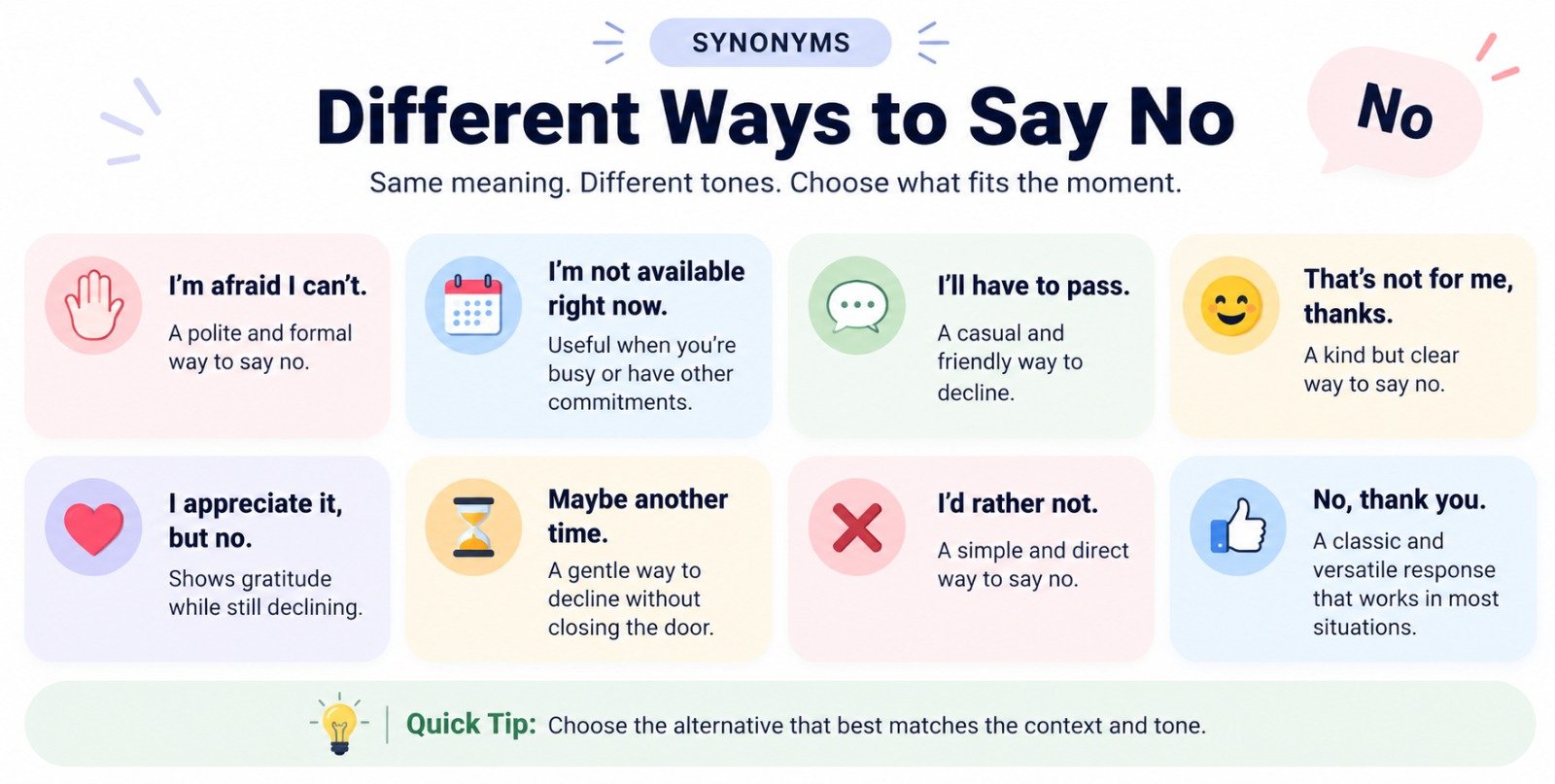
Different Ways to Say No: Polite, Professional, Casual & Funny Phrases
Saying “no” is simple, but choosing the right words can make a big difference. A blunt refusal may sound rude, while an overly indirect response can leave the other person confused. The best wording depends on your relationship, situation, and the tone you want to create.
This guide explores different ways to say no, including polite, professional, casual, firm, and funny ways to say no. You’ll also find practical examples to help you choose the right expression for conversations, texts, invitations, and workplace situations.
Different Ways to Say No at a Glance
There isn’t one perfect replacement for “no.” Some expressions are gentle, some are direct, and others are appropriate only in casual or humorous situations.
| Expression | Tone | Best Used For | Formality |
|---|---|---|---|
| I’m afraid I can’t. | Polite | Requests and professional situations | Formal |
| I’ll have to pass. | Friendly | Offers and invitations | Neutral |
| That won’t work for me. | Direct but respectful | Requests and plans | Neutral |
| I’d rather not. | Gentle | Personal situations | Neutral |
| I’m unable to commit right now. | Professional | Workplace requests | Formal |
| Maybe another time. | Friendly | Social invitations | Casual |
| No, thank you. | Polite | Offers and invitations | Neutral |
| I’m not comfortable with that. | Firm | Personal boundaries | Neutral |
| Hard pass. | Playful | Friends and informal chats | Very casual |
| Absolutely not. | Strong | Firm refusals | Neutral |
What Is Another Way to Say No?
An alternative to “no” can communicate the same general refusal while changing the tone.
For example, “I’ll pass” sounds more relaxed than “No,” while “I must respectfully decline” sounds considerably more formal. Similarly, “That won’t work for me” focuses on the circumstances rather than simply rejecting the person or request.
The right choice depends on what you are refusing and how strongly you need to communicate your decision.
Other Ways to Say No
Here are some versatile alternatives that work in a range of everyday situations:
- No, thank you.
- I’m afraid I can’t.
- I’d rather not.
- I’ll have to pass.
- Not this time.
- Maybe another time.
- I don’t think I can.
- That won’t work for me.
- I’m not able to do that.
- Unfortunately, I can’t.
- I appreciate the offer, but I’ll pass.
- Thanks for asking, but I’ll decline.
- I’m going to sit this one out.
- That’s not something I can agree to.
- I’ll give it a miss.
These aren’t perfect substitutes in every situation. For example, “Maybe another time” suggests possible interest in the future, while “Absolutely not” communicates a firm refusal.
Polite Ways to Say No
Sometimes you want to decline without making the other person feel rejected. A polite refusal acknowledges the request while making your decision clear.
I’m Afraid I Can’t
This is a courteous way to refuse a request, particularly in formal or professional conversations.
Example:
“I’m afraid I can’t attend the meeting on Friday.”
No, Thank You
This is one of the simplest and safest ways to decline an offer.
Example:
“No, thank you. I’ve already had enough to eat.”
I’d Rather Not
Use this when you don’t want to do something but don’t necessarily need to provide a detailed explanation.
Example:
“I’d rather not discuss that right now.”
I Appreciate the Offer, but I’ll Pass
This phrase works especially well when someone has offered you something and you want to show appreciation.
Example:
“I appreciate the offer, but I’ll pass this time.”
Maybe Another Time
This is useful when you want to decline an invitation without closing the door completely.
Example:
“Thanks for inviting me, but I can’t make it tonight. Maybe another time.”
Ways to Say No Without Being Rude
A respectful “no” usually works better when you are clear, brief, and considerate. You don’t need to create a complicated excuse.
Try these expressions:
- “Thanks for thinking of me, but I can’t.”
- “I appreciate you asking, but I’ll have to decline.”
- “I understand, but I’m not able to help this time.”
- “That sounds interesting, but I’ll pass.”
- “I’m sorry, but I’m not available.”
- “Thank you, but that isn’t something I can take on.”
- “I understand why you’re asking, but I have to say no.”
- “I’d love to help, but I don’t have the time right now.”
A short explanation can make a refusal feel warmer, but you don’t have to justify every decision. If someone continues to pressure you, a simple “I understand, but my answer is still no” can be more effective than repeatedly explaining yourself.
Professional Ways to Say No
Workplace communication often requires a balance between being cooperative and protecting your time or responsibilities. A professional refusal should usually be clear rather than vague.
I’m Unable to Commit Right Now
This works when your workload or current responsibilities prevent you from accepting something new.
Example:
“I’m unable to commit to another project right now because of my current deadlines.”
I’m Currently at Capacity
This is useful when you have too much work to take on another responsibility.
Example:
“I’m currently at capacity, so I wouldn’t be able to give this project the attention it deserves.”
That Doesn’t Align With My Current Priorities
This is a tactful option when you need to decline something because it isn’t consistent with your present goals or responsibilities.
Example:
“Thank you for the suggestion, but it doesn’t align with my current priorities.”
I Won’t Be Able to Take This On
This is direct and professional without sounding unnecessarily harsh.
Example:
“I won’t be able to take this on this week, but I can revisit it next month.”
Could We Consider Another Option?
Instead of simply rejecting a request, this phrase opens the door to an alternative solution.
Example:
“I can’t take the lead on this project. Could we consider another option?”
Ways to Say No at Work
When refusing a request from a manager or colleague, context matters. A casual “Nope” may sound dismissive, whereas a long explanation may be unnecessary.
Consider:
- “I don’t have the bandwidth to take this on right now.”
- “I’m not able to meet that deadline.”
- “I can help with part of it, but I can’t take responsibility for the whole project.”
- “I’ll need to decline because I have other deadlines.”
- “I can’t commit to that timeline.”
- “I’m currently focused on higher-priority tasks.”
- “I won’t be able to attend, unfortunately.”
- “Could we revisit this next week?”
The most effective workplace refusals often explain what you can do, rather than focusing only on what you cannot do.
Formal Ways to Say No
Formal language is useful for business correspondence, official communication, and situations where you want to maintain a respectful distance.
I Must Respectfully Decline
Example:
“Thank you for the invitation, but I must respectfully decline.”
Unfortunately, I’m Unable to
Example:
“Unfortunately, I’m unable to participate in the proposed event.”
I’m Not in a Position to
This is useful when circumstances prevent you from agreeing.
Example:
“I’m not in a position to approve the request at this stage.”
I Cannot Accommodate That Request
This sounds formal and is particularly appropriate for business communication.
Example:
“Unfortunately, we cannot accommodate that request at this time.”
I’m Unable to Accept
Example:
“Thank you for the opportunity. I’m unable to accept the offer at this time.”
Casual Ways to Say No
With friends, siblings, classmates, or people you know well, you can use more relaxed language.
I’ll Pass
A simple, natural way to decline.
Example:
“Want to come out tonight?”
“I’ll pass tonight. I’m exhausted.”
Nah, I’m Good
This is friendly and informal.
Example:
“Want another slice?”
“Nah, I’m good, thanks.”
Not Today
Useful when you don’t want to do something at the moment.
Example:
“Want to go shopping?”
“Not today. Maybe tomorrow.”
I’m Going to Sit This One Out
This works well for invitations, activities, or group plans.
Example:
“Everyone’s going hiking Saturday, but I’m going to sit this one out.”
Maybe Next Time
This sounds friendly and leaves open the possibility of accepting a future invitation.
Example:
“Thanks for inviting me. I can’t come tonight, but maybe next time.”
Funny Ways to Say No
Humor can make a refusal lighter when you’re talking to someone who understands your personality and sense of humor. These expressions are best reserved for friends and informal conversations.
Hard Pass
A playful way to say you definitely don’t want something.
Example:
“Do you want to watch another three-hour documentary?”
“Hard pass.”
Respectfully, Nope
This combines mock-formal language with a casual refusal.
Example:
“Would you like to volunteer for another presentation?”
“Respectfully, nope.”
I Choose Peace
A humorous response when accepting the request would probably create unnecessary trouble or effort.
Example:
“Want to get involved in that argument?”
“Nope. I choose peace.”
My Answer Has Left the Building
A deliberately dramatic way to communicate that your answer is definitely no.
Example:
“Are you changing your mind?”
“Absolutely not. My answer has left the building.”
I’m Allergic to That Idea
A playful way to reject an idea.
Example:
“Should we wake up at 4 a.m. for the road trip?”
“I’m allergic to that idea.”
That’s a No From Me
This can be humorous depending on how you deliver it.
Example:
“Should we order five desserts?”
“That’s a no from me.”
Funny phrases can easily sound dismissive when used with the wrong person. Avoid them in formal emails, serious conversations, or situations where someone’s feelings are at stake.
Ways to Say No to an Invitation
You don’t have to invent an elaborate excuse when declining an invitation. A simple expression of appreciation followed by a clear refusal is usually enough.
Try:
- “Thanks for inviting me, but I can’t make it.”
- “I appreciate the invitation, but I’ll have to pass.”
- “I’m sorry, but I won’t be able to come.”
- “Thanks, but I’m going to sit this one out.”
- “I can’t make it this time, but I hope you have a great time.”
- “That sounds fun, but I already have plans.”
- “I won’t be able to join you, unfortunately.”
Ways to Say No in a Text Message
Texting allows for shorter and more conversational responses.
- “Sorry, I can’t.”
- “I’ll pass this time.”
- “Not tonight, sorry!”
- “I’m good, thanks.”
- “Maybe next time!”
- “Can’t make it, unfortunately.”
- “I’d rather stay in tonight.”
- “Thanks for asking, but I’m going to pass.”
For close friends, a little humor can work:
“Hard pass 😂”
or
“My couch has already claimed me tonight.”
Ways to Say No to a Request
When someone asks you to do something, the best response depends on whether you want to soften the refusal or establish a firm boundary.
Gentle:
“I’m sorry, but I can’t help with that right now.”
Neutral:
“I’m not able to do that.”
Professional:
“I won’t be able to take responsibility for that task.”
Firm:
“I’m not comfortable agreeing to that.”
Alternative-focused:
“I can’t do that, but I may be able to help with something else.”
Offering an alternative is useful when you genuinely want to help but cannot fulfill the exact request.
Firm Ways to Say No
Sometimes being too polite creates confusion. If you have already made your decision or need to establish a clear boundary, direct language is better.
- No, thank you.
- I can’t agree to that.
- I’m not comfortable with that.
- I won’t be able to do that.
- That’s not something I’m willing to do.
- My answer is no.
- I need to say no.
- I’ve decided not to.
- Please respect my decision.
- Absolutely not.
A firm refusal doesn’t have to be aggressive. “I’m not comfortable with that” can communicate a strong boundary while remaining respectful.
Creative Ways to Say No
If you want something less predictable without sounding rude, try:
- “I’m going to pass on that one.”
- “That’s not quite for me.”
- “I think I’ll sit this one out.”
- “I’ll leave that opportunity to someone else.”
- “I’m going to take a rain check.”
- “I’ll have to decline this time.”
- “That’s not something I can take on.”
- “I think I’ll bow out.”
- “I’m going to opt out this time.”
These expressions add variety without making the refusal unnecessarily complicated.
How to Choose the Right Way to Say No
Before choosing an expression, think about four things: who you’re talking to, what you’re refusing, how firm you need to be, and whether you want to leave the door open.
For example, telling a close friend “Hard pass” may sound perfectly natural. Saying the same thing to a client could come across as unprofessional.
Likewise, “Maybe another time” is appropriate when you genuinely might accept later. If you know you don’t want to participate at all, a clearer expression such as “I’ll have to decline” avoids giving the other person false expectations.
When You Want to Be Polite
Use:
“I appreciate the offer, but I’ll have to decline.”
When You Want to Be Direct
Use:
“That won’t work for me.”
When You Want to Be Professional
Use:
“I’m unable to commit to that at this time.”
When You Want to Be Friendly
Use:
“Thanks for asking, but I’ll pass this time.”
When You Want to Be Funny
Use:
“Hard pass.”
Common Mistakes When Saying No
A refusal can become more difficult when the wording is unclear or overly complicated.
Being too vague:
“I’ll see what I can do” may sound like a yes when you actually mean no.
Overexplaining:
You don’t always need a long justification. A short, honest explanation is often enough.
Using humor in serious situations:
A funny refusal can work with friends but may be inappropriate when discussing work, relationships, or sensitive boundaries.
Apologizing excessively:
A brief “I’m sorry” is fine, but repeatedly apologizing can make a reasonable boundary sound like something you did wrong.
Giving a false promise:
Don’t say “Maybe next time” if you already know you will never accept. Choose a more definitive phrase instead.
Frequently Asked Questions
What are some different ways to say no politely?
You can say “No, thank you,” “I’m afraid I can’t,” “I’d rather not,” “I’ll have to pass,” or “I appreciate the offer, but I’ll decline.” The best choice depends on the situation and how formal you want to sound.
What is another way to say no without being rude?
“That won’t work for me” is a useful neutral alternative. You can also say “I appreciate you asking, but I’m unable to” when you want to sound more considerate.
What are some professional ways to say no?
Professional options include “I’m currently at capacity,” “I’m unable to commit right now,” “I won’t be able to take this on,” and “That doesn’t align with my current priorities.”
What are some funny ways to say no?
For informal conversations, you can use “Hard pass,” “Respectfully, nope,” “I choose peace,” or “I’m allergic to that idea.” These are humorous and should generally be reserved for people who understand your sense of humor.
How can I say no without explaining myself?
You can simply say “No, thank you,” “I’d rather not,” “I’m not able to do that,” or “I’m not comfortable with that.” You aren’t always required to provide a detailed explanation for a personal decision.
How do I say no to an invitation nicely?
Start by acknowledging the invitation and then decline clearly. For example: “Thanks for inviting me, but I won’t be able to make it.” If appropriate, you can add a warm closing such as “I hope you have a great time.”
Is “I’ll pass” a polite way to say no?
Yes. “I’ll pass” is generally polite and natural in casual or neutral situations. It is less suitable for highly formal communication, where “I must respectfully decline” or “I’m unable to accept” may be better.
Is it better to say “no” directly?
It depends on the situation. Direct language is often best when you need to establish a firm boundary, while a softer expression can be more appropriate for invitations, offers, and everyday requests.
Conclusion
Knowing different ways to say no gives you more control over how your refusal sounds. A professional situation may call for “I’m unable to commit right now,” while a friend might be perfectly happy with “I’ll pass.” For a firm boundary, direct wording is usually better, while humor belongs mainly in relaxed conversations.
The goal isn’t to avoid the word “no” at all. It’s to choose language that matches the context, relationship, audience, and level of firmness you need. Grammarifyr makes those small differences in everyday English easier to recognize, so you can choose the words that fit the moment naturally.
You may also Read : 30 Other Ways to Say “This Shows” in an Essay
One Comment