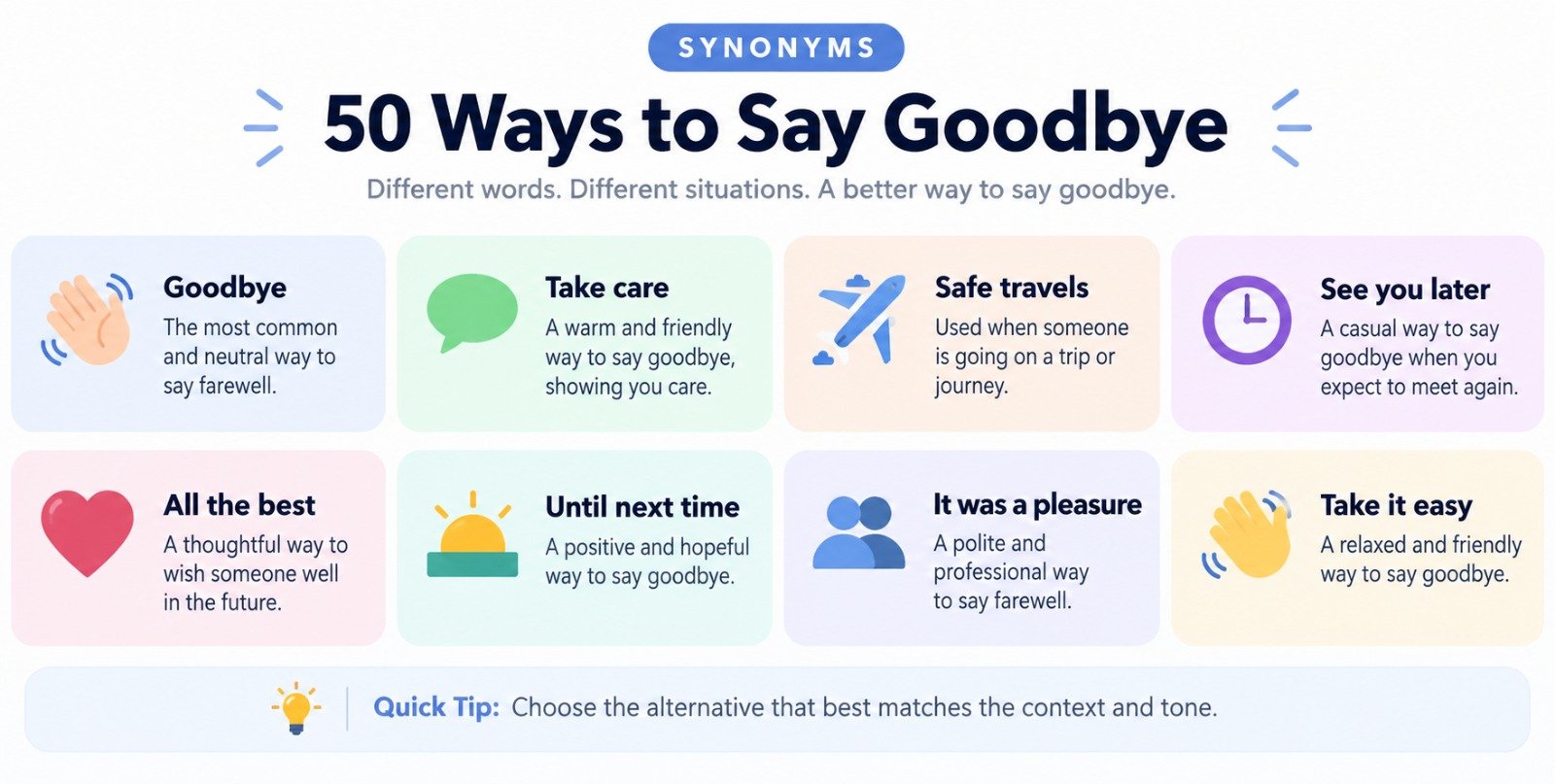
50 Ways to Say Goodbye: Casual, Funny, Sweet & Meaningful Expressions
Saying goodbye doesn’t always have to sound the same. A quick “Bye” works with a friend, but a coworker, loved one, or someone you may never see again might call for something warmer, more thoughtful, or more formal. These 50 ways to say goodbye give you natural options for conversations, text messages, professional situations, and emotional farewells.
The phrase also has a musical connection. “50 Ways to Say Goodbye” by Train is a well-known song, while “How Do I Say Goodbye” by Dean Lewis is a separate song with a much more emotional theme. Below, you’ll find useful everyday expressions as well as context around these song-related searches.
50 Ways to Say Goodbye
Here are 50 natural expressions, organized by the situation in which they work best. They aren’t all interchangeable: some are casual, some formal, while others communicate affection or finality.
| # | Goodbye Expression | Tone | Best Used For |
|---|---|---|---|
| 1 | Goodbye | Neutral | Most everyday situations |
| 2 | Bye | Casual | Friends and familiar people |
| 3 | Bye-bye | Playful | Children or close relationships |
| 4 | See you later | Casual | Friends and coworkers |
| 5 | See you soon | Warm | Someone you’ll meet again soon |
| 6 | See you around | Casual | Acquaintances and coworkers |
| 7 | Catch you later | Very casual | Friends |
| 8 | Talk to you later | Casual | Phone, text, or conversation |
| 9 | Talk soon | Friendly | Friends and colleagues |
| 10 | Take care | Warm | General farewell |
| 11 | Take it easy | Casual | Friends and acquaintances |
| 12 | Have a good one | Friendly | Everyday situations |
| 13 | Have a good day | Polite | Work or everyday conversations |
| 14 | Have a great day | Warm | Friendly or professional |
| 15 | Have a good night | Neutral | Evening departures |
| 16 | Good night | Neutral | Evening or bedtime |
| 17 | Until next time | Warm | Future reunions |
| 18 | Until we meet again | Meaningful | Emotional farewells |
| 19 | Farewell | Formal | Written or serious situations |
| 20 | So long | Old-fashioned | Playful or literary use |
| 21 | Stay safe | Caring | Travel or uncertain situations |
| 22 | See you next time | Friendly | Recurring meetings |
| 23 | See you tomorrow | Specific | When meeting the next day |
| 24 | See you Monday | Casual | Workplace |
| 25 | I’m off | Casual | Announcing your departure |
| 26 | I’ve got to go | Casual | Leaving a conversation |
| 27 | I should get going | Polite | Ending a visit |
| 28 | I’ll let you go | Considerate | Ending a phone call |
| 29 | I’ll catch up with you later | Friendly | Friends or colleagues |
| 30 | Keep in touch | Warm | When you want continued contact |
| 31 | Don’t be a stranger | Friendly | Someone you want to hear from |
| 32 | Until we cross paths again | Meaningful | Future reunion |
| 33 | Wishing you well | Warm | Personal or professional farewell |
| 34 | All the best | Polite | Emails and professional situations |
| 35 | Best wishes | Polite | Written farewells |
| 36 | Take good care of yourself | Caring | Close relationships |
| 37 | Stay well | Warm | Friends, family, or colleagues |
| 38 | Safe travels | Caring | Someone going on a trip |
| 39 | Enjoy the rest of your day | Polite | Customer or workplace settings |
| 40 | It was great seeing you | Warm | After a visit |
| 41 | It was nice talking with you | Polite | Ending a conversation |
| 42 | Thanks for everything | Appreciative | Meaningful farewells |
| 43 | I’ll miss you | Emotional | Close friends or loved ones |
| 44 | Goodbye for now | Warm | Temporary separation |
| 45 | Until we meet again | Emotional | Meaningful goodbye |
| 46 | See you on the flip side | Playful | Informal conversations |
| 47 | Peace out | Very casual | Friends and informal settings |
| 48 | Later | Very casual | Texts and friends |
| 49 | I’m out | Very casual | Informal conversations |
| 50 | Take care until next time | Warm | Friendly departures |
Other Ways to Say Goodbye Casually
See You Later
“See you later” is one of the easiest alternatives to “goodbye.” It suggests that you expect to see the person again.
Example:
“Thanks for hanging out. See you later!”
Catch You Later
“Catch you later” is more informal and relaxed. It works particularly well between friends.
Example:
“I’ve got to run. Catch you later!”
Talk to You Later
Use this when you expect to speak with the person again, especially by phone or message.
Example:
“I have a meeting now. Talk to you later.”
Later
“Later” is a very short, informal farewell. It sounds natural in texts and casual conversations but isn’t suitable for formal correspondence.
Example:
“I’m heading home. Later!”
Take It Easy
“Take it easy” can mean goodbye while also expressing a relaxed, friendly wish for the other person.
Example:
“Have a good weekend. Take it easy!”
Other Ways to Say Goodbye to Friends
Friends usually don’t need a formal farewell. Short, relaxed expressions often sound more natural.
See You Around
“See you around” works when you expect to encounter someone again but don’t have a specific plan.
Example:
“Great catching up with you. See you around!”
Talk Soon
“Talk soon” is particularly useful in texts, chats, and phone conversations.
Example:
“I’ll send you the photos tonight. Talk soon!”
Have a Good One
This is a friendly, flexible way to end a casual conversation.
Example:
“Thanks for stopping by. Have a good one!”
Don’t Be a Stranger
This expression means you hope the person will stay in contact. It is warmer than a simple “goodbye.”
Example:
“It was great seeing you. Don’t be a stranger!”
Keep in Touch
Use “keep in touch” when you genuinely want to continue communicating after someone leaves.
Example:
“Good luck with your new job, and keep in touch.”
Other Ways to Say Goodbye Professionally
A workplace goodbye should usually be polite without sounding overly emotional.
Have a Good Day
“Have a good day” is a safe choice for customers, colleagues, managers, and other professional contacts.
Example:
“Thank you for your time. Have a good day.”
All the Best
“All the best” is especially useful in emails and professional messages.
Example:
“It’s been a pleasure working with you. All the best.”
Best Wishes
“Best wishes” is appropriate when someone is leaving a position, starting something new, or moving away.
Example:
“Congratulations on your new role. Best wishes for the future.”
Wishing You Well
This has a warmer tone than a basic professional goodbye.
Example:
“Thank you for all your support. Wishing you well in your next chapter.”
It Was Nice Talking With You
This is useful when ending a professional conversation, especially with someone you don’t know well.
Example:
“Thank you for explaining everything. It was nice talking with you.”
Other Ways to Say Goodbye in a Text Message
Text messages allow for shorter and more relaxed farewells.
Talk Soon
A natural choice when you expect another conversation.
“I’ve got to finish some work. Talk soon!”
Take Care
Simple, warm, and suitable for almost any relationship.
“Good luck tomorrow. Take care!”
Catch You Later
This has a friendly, conversational feel.
“I’m going to grab dinner. Catch you later!”
Later!
“Later!” is quick and informal, making it particularly suitable for friends.
Bye for Now
“Bye for now” suggests that the separation is temporary.
“I’m heading to bed. Bye for now!”
Other Ways to Say Goodbye Sweetly
Some farewells are meant to communicate more than simply leaving.
Take Good Care of Yourself
This is affectionate and shows genuine concern.
Example:
“Get some rest and take good care of yourself.”
Stay Safe
“Stay safe” works especially well when someone is traveling or facing a difficult situation.
Example:
“Text me when you arrive. Stay safe.”
I’ll Miss You
This is much more emotional than “goodbye” and should generally be reserved for people you care about.
Example:
“I know we’ll talk every day, but I’ll still miss you.”
It Was Great Seeing You
This is warm without being overly emotional.
Example:
“Thanks for coming over. It was great seeing you.”
Goodbye for Now
This suggests that the goodbye isn’t permanent.
Example:
“Goodbye for now. We’ll see each other again soon.”
Other Ways to Say Goodbye in a Funny Way
Humorous farewells are best reserved for people who understand your sense of humor.
Peace Out
“Peace out” is an informal, playful way to announce that you’re leaving.
Example:
“I’m exhausted. Peace out!”
See You on the Flip Side
This playful expression works among friends and in informal conversations.
Example:
“I’m heading home. See you on the flip side!”
I’m Out
“I’m out” is extremely casual and can sound humorous when you’re dramatically announcing your departure.
Example:
“This party is getting wild. I’m out!”
So Long
“So long” has an old-fashioned flavor and can be used humorously today.
Example:
“So long, everyone. See you next week!”
I’m Off
“I’m off” is a simple British-influenced expression meaning that you’re leaving.
Example:
“It’s getting late, so I’m off.”
Other Ways to Say Goodbye When You Don’t Know When You’ll Meet Again
A normal “bye” may feel inadequate when someone is moving away, leaving a job, or beginning a new chapter.
Until We Meet Again
This is a meaningful farewell that emphasizes the hope of seeing the person again.
Example:
“Thank you for all the memories. Until we meet again.”
Until Next Time
This is less emotional and more optimistic.
Example:
“Thanks for a wonderful evening. Until next time!”
Keep in Touch
This works especially well when physical distance will make regular meetings more difficult.
Example:
“Good luck with your move, and please keep in touch.”
Wishing You Well
Use this when you want to leave someone with a sincere positive message.
Example:
“I’m sorry you’re leaving, but I’m wishing you well.”
Thanks for Everything
This phrase adds gratitude to the farewell, making it more meaningful.
Example:
“Thanks for everything you’ve done for me. I’ll never forget it.”
Other Ways to Say Goodbye Without Actually Saying “Goodbye”
Sometimes the most natural farewell doesn’t contain the word “goodbye” at all.
You can say:
- “Take care.”
- “See you soon.”
- “Talk soon.”
- “Have a great day.”
- “Stay safe.”
- “All the best.”
- “Keep in touch.”
- “Safe travels.”
- “Enjoy your evening.”
- “It was great seeing you.”
- “I’ll let you go.”
- “I should get going.”
- “See you next time.”
These expressions often sound more natural than repeating “goodbye,” particularly when the person is someone you’ll see or talk to again.
50 Ways to Say Goodbye: Which One Should You Choose?
The best expression depends on who you’re speaking to and why you’re leaving.
For a close friend, “Catch you later,” “Talk soon,” or “Take care” feels natural.
For a coworker, “Have a good day,” “See you tomorrow,” or “All the best” may be more appropriate.
For a professional email, “Best wishes” or “All the best” is generally safer than highly casual expressions such as “Peace out.”
For a loved one, “Take good care of yourself,” “I’ll miss you,” or “Until we meet again” can communicate more emotion.
For someone traveling, “Safe travels” is more specific than simply saying “goodbye.”
The key is not to choose the longest or most creative phrase. Choose the one that matches the relationship and situation.
Train’s “50 Ways to Say Goodbye”
The phrase “50 Ways to Say Goodbye” is also strongly associated with Train’s song of the same name.
Train released “50 Ways to Say Goodbye” in 2012 as part of the album California 37. The song takes a humorous approach to the end of a relationship. Instead of openly admitting that his relationship has ended, the narrator comes up with exaggerated explanations for what happened.
This creates an interesting contrast with ordinary goodbye expressions. The title suggests a huge collection of ways to say farewell, but the song is really built around a humorous breakup story rather than a literal list of 50 conventional goodbye phrases.
What Is “50 Ways to Say Goodbye” by Train About?
At its core, the song is about denial, embarrassment, and a breakup presented through humor. The narrator doesn’t want to tell people the straightforward truth, so he invents increasingly unusual explanations.
The playful storytelling is what gives the song its distinctive character. It should therefore not be interpreted as a literal guide containing 50 ways to say goodbye.
Why Is the Train Song Called “50 Ways to Say Goodbye”?
The title is intentionally playful. Rather than offering 50 standard expressions such as “see you later” or “take care,” the song uses the idea of multiple explanations as part of its comedic breakup narrative.
This is why someone searching for train 50 ways to say goodbye may find information about the song rather than a list of farewell expressions.
50 Ways to Say Goodbye Lyrics: What Should You Know?
The keyword “50 ways to say goodbye lyrics” generally refers to Train’s song. Readers looking for the lyrics are often also interested in the song’s meaning, artist, album, and story.
Rather than reproducing the complete lyrics, it is more useful to explain the central idea: the narrator is dealing with a breakup and gives humorous, exaggerated explanations rather than simply admitting that his relationship ended.
The title itself is part of the joke. The song’s content shouldn’t be confused with a literal collection of 50 everyday farewell phrases.
How Do I Say Goodbye Lyrics: A Different Song
“How Do I Say Goodbye” is a different song, associated with singer-songwriter Dean Lewis.
Unlike Train’s humorous “50 Ways to Say Goodbye,” Dean Lewis’s “How Do I Say Goodbye” has a deeply emotional subject. It explores the difficulty of saying goodbye to someone extremely important and the fear associated with losing a loved one.
Therefore, searches for “how do I say goodbye lyrics” should not automatically be treated as searches for Train’s song.
How Is “How Do I Say Goodbye” Different From “50 Ways to Say Goodbye”?
| Song | Artist | General Theme | Overall Tone |
|---|---|---|---|
| “50 Ways to Say Goodbye” | Train | Breakup and humorous excuses | Playful |
| “How Do I Say Goodbye” | Dean Lewis | Family, love, separation, and loss | Emotional |
This distinction matters because the two titles sound similar but have very different subjects and moods.
Common Mistakes When Saying Goodbye
Not every farewell fits every situation.
“Peace out” is fine with a close friend but would be inappropriate in a formal business email.
“Bye-bye” can sound playful or childish, so it isn’t normally the best choice for a professional situation.
“Farewell” is grammatically correct but can sound dramatic or formal in everyday conversation.
“I’ll miss you” communicates emotion rather than simply marking the end of a conversation. It should be used when you genuinely feel that sentiment.
“Keep in touch” implies that you want the relationship to continue, so it may sound strange if you’re deliberately ending contact.
Understanding these differences is more useful than treating every expression as an exact synonym for “goodbye.”
Frequently Asked Questions
What are some different ways to say goodbye?
Natural alternatives include “See you later,” “Take care,” “Talk soon,” “Catch you later,” “Have a good day,” “Until next time,” “All the best,” and “Keep in touch.”
What is a casual way to say goodbye?
“Bye,” “Later,” “See you later,” “Catch you later,” and “Take it easy” are all casual choices. “Later” and “Peace out” are especially informal.
What is a polite way to say goodbye professionally?
“Have a good day,” “All the best,” “Best wishes,” “Wishing you well,” and “It was nice talking with you” work well in professional settings.
What is a sweet way to say goodbye?
“Take good care of yourself,” “I’ll miss you,” “Until we meet again,” and “Goodbye for now” can make a farewell feel warmer and more personal.
Is “50 Ways to Say Goodbye” a Train song?
Yes. “50 Ways to Say Goodbye” is a song by Train, released in 2012 on the album California 37. Its humorous storyline focuses on a breakup and the narrator’s exaggerated explanations.
Does Train’s “50 Ways to Say Goodbye” actually list 50 goodbyes?
No. The title is playful rather than a literal promise of 50 standard farewell expressions. The song uses humorous explanations as part of its breakup narrative.
Who sings “How Do I Say Goodbye”?
Dean Lewis sings “How Do I Say Goodbye.” It is separate from Train’s “50 Ways to Say Goodbye” and has a considerably more emotional subject.
Can I use “farewell” instead of “goodbye”?
Yes, but the tone is different. “Farewell” tends to sound more formal, dramatic, literary, or final than the everyday word “goodbye.”
What is the best goodbye for a text message?
For most casual texts, “Talk soon,” “Take care,” “See you later,” “Later,” or “Bye for now” sounds natural. The right choice depends on your relationship with the recipient.
Conclusion
There are plenty of natural ways to say goodbye, but the best expression depends on the moment. Use casual phrases such as “See you later” with friends, professional options such as “All the best” at work, and warmer expressions such as “Take good care of yourself” when the farewell carries more emotion. And when you encounter “50 Ways to Say Goodbye,” remember that it can refer either to everyday farewell expressions or to Train’s humorous song. Keeping those meanings separate makes your choice of words much clearer. Grammarifyr helps you understand these small differences so your goodbyes sound natural, appropriate, and true to the situation.
You may also Read : Ways to Say Goodbye in Spanish: 8+ Natural Expressions for Every Situation
One Comment