30 Other Ways to Say “This Shows” in an Essay
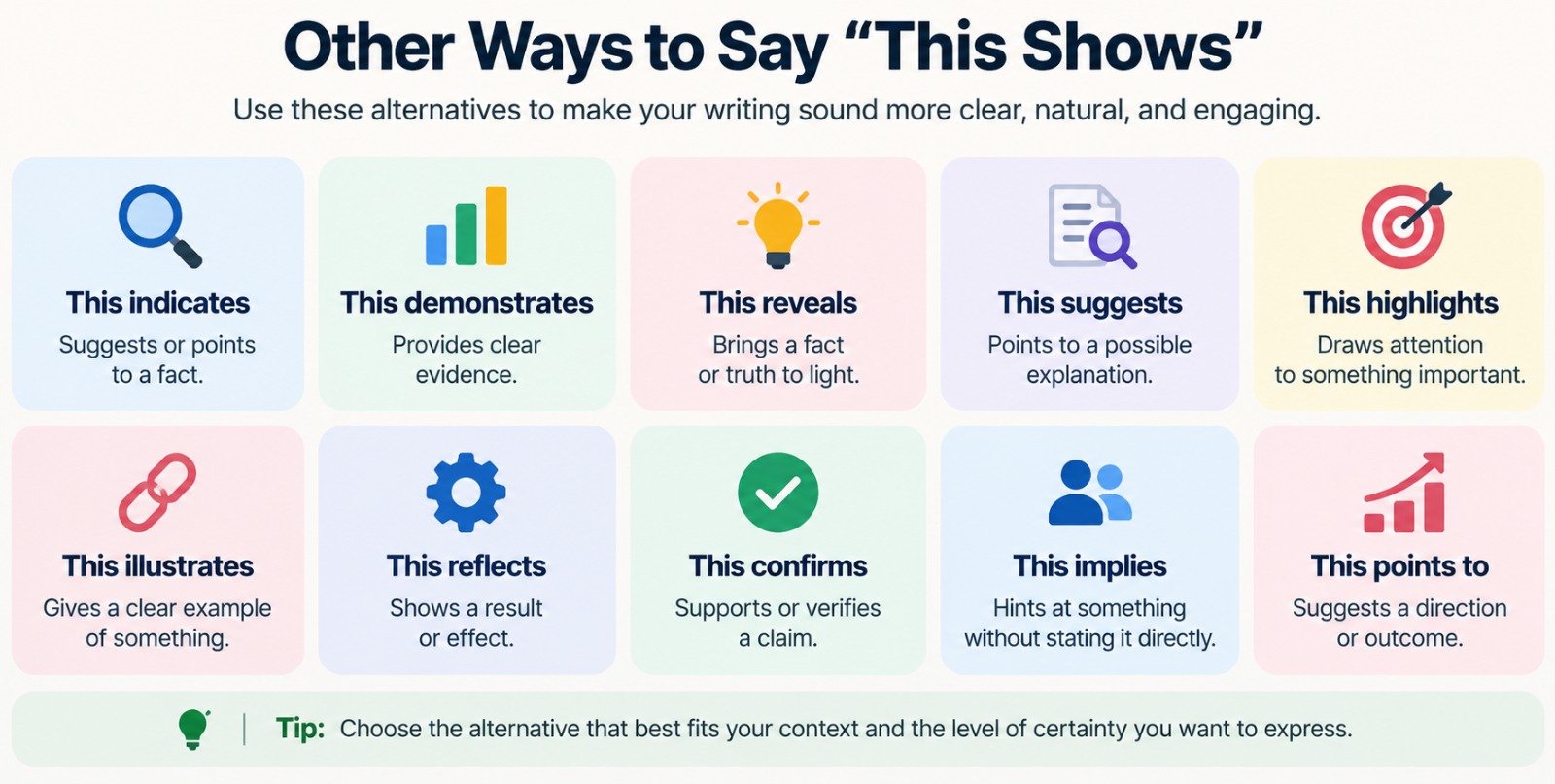
The phrase “this shows” is useful, but using it repeatedly can make an essay sound predictable or repetitive. Fortunately, there are many other ways to say this shows depending on what your evidence actually means. You can use words such as demonstrates, indicates, suggests, reveals, and illustrates to make your writing more precise.
The best alternative depends on your level of certainty, the type of evidence you are discussing, and whether you are writing a formal academic essay or a more conversational piece.
Why Look for Other Ways to Say “This Shows”?
There is nothing grammatically wrong with “this shows.” It is clear and natural English. The problem arises when the same expression appears several times in an essay.
For example:
The character avoids his friends. This shows that he feels lonely. Later, he refuses an invitation. This shows that he is becoming isolated.
The meaning is understandable, but repeating the same structure makes the analysis less varied.
A stronger version might be:
The character avoids his friends. This suggests that he feels lonely. Later, his refusal of an invitation reveals how isolated he has become.
The second version gives the reader more information about the relationship between the evidence and the conclusion.
Other Ways to Say “This Shows”
Here are some of the most useful alternatives, particularly for essays, academic writing, literary analysis, and analytical paragraphs.
1. This Demonstrates
“This demonstrates” is one of the strongest and most natural alternatives to “this shows.” Use it when the evidence clearly supports your point.
Example:
The repeated references to poverty demonstrate the author’s concern about social inequality.
2. This Indicates
“This indicates” works well when evidence points toward a particular conclusion. It is especially useful in academic and analytical writing.
Example:
The decline in attendance indicates that students are becoming less engaged with the program.
3. This Suggests
Use “this suggests” when your interpretation is reasonable but not completely certain. It is an excellent choice when you want to avoid making an overly strong claim.
Example:
The character’s silence suggests that she is uncomfortable with the situation.
4. This Reveals
“This reveals” is particularly effective when evidence makes an attitude, feeling, motive, or previously hidden detail clear.
Example:
His reaction to the criticism reveals his insecurity.
5. This Illustrates
“This illustrates” is useful when a quotation, example, event, or detail provides a clear representation of an idea.
Example:
The protagonist’s decision illustrates the conflict between personal freedom and social responsibility.
6. This Highlights
Use “this highlights” when the evidence draws attention to an important feature or idea.
Example:
The contrast between the two characters highlights their different attitudes toward authority.
7. This Emphasizes
“This emphasizes” means that something gives particular importance or prominence to an idea.
Example:
The author’s repetition of the phrase emphasizes the character’s growing frustration.
8. This Confirms
Use “this confirms” when the evidence supports something that has already been established or strongly expected.
Example:
The final paragraph confirms that the narrator has changed significantly.
9. This Reinforces
“This reinforces” is useful when new evidence strengthens an existing argument or interpretation.
Example:
The second example reinforces the argument that education can influence social mobility.
10. This Reflects
Use “this reflects” when something represents or mirrors a broader condition, attitude, value, or trend.
Example:
The character’s distrust of strangers reflects the uncertainty of the society around him.
11. This Implies
“This implies” is appropriate when something communicates an idea indirectly rather than stating it directly.
Example:
Her refusal to answer implies that she already knows the truth.
12. This Underscores
“This underscores” is a formal option meaning that something strongly emphasizes an important point.
Example:
The unequal distribution of resources underscores the wider problem of economic inequality.
13. This Points To
“This points to” works when evidence leads the reader toward a particular conclusion.
Example:
The unusual changes in behavior point to a deeper conflict within the family.
14. This Provides Evidence That
This is especially useful in academic essays because it explicitly connects evidence to a claim.
Example:
The survey results provide evidence that students benefit from additional study time.
15. This Supports the Idea That
Use this phrase when you want to make the connection between evidence and your argument especially clear.
Example:
The character’s actions support the idea that fear can influence decision-making.
16. This Establishes
“This establishes” is stronger than “this shows” and should be used when the evidence firmly establishes a fact, relationship, or interpretation.
Example:
The historical records establish a clear connection between the two events.
17. This Demonstrates the Importance of
This is helpful when the evidence specifically draws attention to why something matters.
Example:
The character’s sacrifice demonstrates the importance of loyalty in the novel.
18. This Draws Attention To
Use this phrase when the evidence directs the reader’s focus toward a particular issue.
Example:
The sudden change in tone draws attention to the narrator’s growing anxiety.
19. This Makes Clear That
This is a straightforward alternative when the evidence makes a particular conclusion easy to understand.
Example:
The final scene makes clear that the protagonist has accepted responsibility for his actions.
20. This Conveys
“This conveys” works particularly well when discussing messages, emotions, attitudes, or meanings communicated through language.
Example:
The author’s use of short sentences conveys a sense of urgency.
21. This Depicts
Use “this depicts” when discussing how writing, art, media, or description presents a person, situation, or idea.
Example:
The scene depicts the devastating effects of war on ordinary families.
22. This Portrays
“This portrays” is commonly used in literary and visual analysis when something presents a particular image or characterization.
Example:
The dialogue portrays the character as confident but emotionally guarded.
23. This Signifies
“This signifies” is useful when something represents or has a particular meaning.
Example:
The recurring image of darkness signifies the character’s uncertainty.
24. This Exemplifies
Use “this exemplifies” when a specific example clearly represents a broader principle or idea.
Example:
Her willingness to help strangers exemplifies the novel’s theme of compassion.
25. This Demonstrates How
This construction is useful when explaining the relationship between an action and its effect.
Example:
The character’s decision demonstrates how fear can affect rational judgment.
26. This Indicates That
This is a slightly more formal version of “this shows that” and works particularly well with research, statistics, and evidence.
Example:
The findings indicate that regular feedback improves student performance.
27. This Suggests That
Use this when the evidence supports a possible interpretation rather than a definite conclusion.
Example:
The narrator’s hesitation suggests that he is hiding something.
28. This Reveals That
This is particularly useful in literary analysis when evidence exposes a character’s feelings, motives, or personality.
Example:
His willingness to accept blame reveals that he understands the consequences of his actions.
29. This Helps Explain
Sometimes the evidence does not directly “show” something but instead helps the reader understand why it happens.
Example:
The character’s difficult childhood helps explain his distrust of authority.
30. This Provides Insight Into
This is a polished option for analytical writing when evidence helps readers understand a broader issue or character.
Example:
The conversation provides insight into the family’s complicated relationship.
Best Alternatives at a Glance
| Alternative | Formality | Best Used For | Example |
|---|---|---|---|
| This demonstrates | Formal | Strong evidence | This demonstrates the impact of poverty. |
| This indicates | Formal | Evidence pointing to a conclusion | This indicates a change in behavior. |
| This suggests | Formal/Neutral | Tentative interpretations | This suggests that he feels uncertain. |
| This reveals | Formal | Hidden feelings or information | This reveals her true motivation. |
| This illustrates | Formal | Examples and concepts | This illustrates the central theme. |
| This highlights | Formal | Important points | This highlights the social divide. |
| This emphasizes | Formal | Importance or emphasis | This emphasizes the author’s message. |
| This confirms | Formal | Established conclusions | This confirms the earlier prediction. |
| This reinforces | Formal | Strengthening an argument | This reinforces the main argument. |
| This reflects | Formal | Broader ideas or conditions | This reflects social attitudes. |
| This implies | Formal | Indirect meanings | This implies that he knew the truth. |
| This underscores | Very formal | Strong emphasis | This underscores the seriousness of the issue. |
| This conveys | Formal | Emotions or messages | This conveys a sense of fear. |
| This exemplifies | Formal | Representative examples | This exemplifies the importance of courage. |
| This provides evidence that | Academic | Research and arguments | This provides evidence that the policy worked. |
Other Ways to Say “This Shows” in an Essay
When writing an essay, “this demonstrates,” “this indicates,” “this suggests,” “this reveals,” and “this illustrates” are among the most useful choices.
However, they are not completely interchangeable.
Consider these differences:
The character refuses to leave the house. This shows that he is afraid.
You could write:
The character refuses to leave the house. This suggests that he is afraid.
This is appropriate if fear is an interpretation rather than an established fact.
You could also write:
The character refuses to leave the house. This demonstrates his fear.
This sounds more confident and implies that the evidence strongly supports the interpretation.
Or:
The character’s refusal to leave the house reveals his fear.
This focuses on the evidence exposing an underlying emotion.
Choosing the right verb therefore makes your analysis more accurate.
Other Ways to Say “Shows” in Academic Writing
Sometimes you do not need to keep the word “this” at all. Removing it can make your writing more specific.
Instead of:
This shows that social inequality affects education.
Try:
The unequal distribution of resources demonstrates how social inequality affects education.
Instead of:
This shows that the character is angry.
Try:
The character’s increasingly aggressive language reveals his anger.
Instead of:
This shows the importance of teamwork.
Try:
The team’s successful collaboration highlights the importance of teamwork.
This approach makes your writing more analytical because the subject of the sentence becomes the actual evidence.
Strong Academic Alternatives vs. Softer Alternatives
Not every replacement has the same level of certainty.
Stronger Expressions
Use these when the evidence provides substantial support:
- This demonstrates
- This establishes
- This confirms
- This proves
- This clearly indicates
Be careful with “this proves.” In an academic essay, evidence does not always provide absolute proof. It is often better to use “demonstrates” or “indicates” when the conclusion remains open to interpretation.
More Cautious Expressions
Use these when you are interpreting evidence without claiming certainty:
- This suggests
- This implies
- This may indicate
- This appears to demonstrate
- This points to
For example:
The character avoids discussing his childhood. This suggests that the experience remains painful for him.
The word “suggests” leaves room for interpretation and is therefore safer than claiming that the behavior definitively proves his emotional state.
How to Avoid Repeating “This Shows” in an Essay
Replacing every “this shows” with “this demonstrates” does not necessarily improve your writing. If you use “this demonstrates” five times in one paragraph, the writing can still sound repetitive.
Instead, vary your sentence structure.
Use the Evidence as the Subject
Instead of:
This shows that the author dislikes war.
Write:
The repeated descriptions of destruction reveal the author’s opposition to war.
Connect the Evidence Directly to the Argument
Instead of:
This shows that education is important.
Write:
The character’s commitment to learning highlights the role education plays in his development.
Use an Analytical Verb
Instead of:
This shows that the character is nervous.
Write:
The character’s hesitant speech suggests that he is nervous.
Explain the Significance
Instead of stopping at:
This shows that the policy was unsuccessful.
Add the analytical consequence:
The continued decline in participation indicates that the policy failed to address the needs of its intended audience.
This makes the sentence more valuable because it explains not only what the evidence shows, but why it matters.
“This Shows” vs. “This Demonstrates”
These phrases are close in meaning, but “this demonstrates” generally sounds more formal and analytical.
This shows:
The experiment shows that temperature affects the reaction.
This demonstrates:
The experiment demonstrates that temperature affects the reaction.
For school and university essays, “demonstrates” can be a useful choice when your evidence strongly supports the conclusion.
“This Shows” vs. “This Suggests”
These phrases have an important difference.
“This shows” can sound relatively definite.
“This suggests” is more cautious.
Compare:
The character’s silence shows that she is angry.
with:
The character’s silence suggests that she is angry.
The second sentence acknowledges that silence can have several interpretations. For literary analysis, this kind of cautious language is often useful.
“This Shows” vs. “This Indicates”
“This indicates” is particularly natural when working with statistics, research findings, observations, or measurable evidence.
For example:
The survey results indicate that students prefer online resources.
“Indicates” focuses on what the evidence points toward, while “shows” is more general.
Common Mistakes When Replacing “This Shows”
Using “Proves” Too Often
“Proves” is extremely strong. Unless your evidence genuinely establishes something conclusively, use demonstrates, indicates, or suggests instead.
Choosing a Synonym Without Considering Meaning
Not every alternative works in every sentence.
For example, “this illustrates” is not always a natural replacement for “this shows.” It works best when something provides an example or representation of an idea.
Similarly, “this reveals” is especially appropriate when something makes a hidden detail, emotion, or motive apparent.
Repeating the Same Replacement
Changing “this shows” to “this demonstrates” throughout an essay does not solve the underlying repetition problem. Vary both your vocabulary and sentence structure.
Making Claims Too Strong
Academic writing should accurately reflect the evidence. If your evidence only provides a possible interpretation, “this suggests” may be better than “this proves.”
How to Choose the Right Alternative
A simple way to choose is to ask what your evidence actually does.
Does it provide strong evidence?
Use demonstrates or establishes.
Does it point toward a conclusion?
Use indicates or points to.
Does it offer a possible interpretation?
Use suggests or implies.
Does it expose a hidden feeling or fact?
Use reveals.
Does it provide an example of an idea?
Use illustrates or exemplifies.
Does it draw attention to something important?
Use highlights or underscores.
Does it strengthen an existing argument?
Use reinforces or supports the idea that.
This small distinction can make your writing sound considerably more precise.
Examples of Better Essay Sentences
Here are a few examples of how you can replace repetitive uses of “this shows.”
Basic:
The author uses dark imagery. This shows that the setting is frightening.
Improved:
The author’s use of dark imagery creates a threatening atmosphere.
Basic:
The character refuses to apologize. This shows that he is stubborn.
Improved:
The character’s refusal to apologize reveals his stubborn nature.
Basic:
The statistics show that unemployment increased.
Improved:
The statistics indicate that unemployment increased.
Basic:
The repeated imagery shows the importance of nature.
Improved:
The repeated imagery highlights the importance of nature throughout the text.
Basic:
Her decision shows that she values independence.
Improved:
Her decision demonstrates her strong commitment to independence.
Frequently Asked Questions
What are other ways to say “this shows” in an essay?
Common alternatives include “this demonstrates,” “this indicates,” “this suggests,” “this reveals,” “this illustrates,” “this highlights,” and “this emphasizes.” The best choice depends on how strongly your evidence supports the claim.
What is a formal way to say “this shows”?
“This demonstrates” and “this indicates” are two natural formal alternatives. “This underscores” and “this establishes” can also work when their specific meanings fit the context.
What is another way to say “shows” in academic writing?
Depending on the context, you can use demonstrates, indicates, suggests, reveals, illustrates, highlights, reflects, conveys, signifies, exemplifies, or reinforces.
Is “this shows” acceptable in an essay?
Yes. “This shows” is grammatically correct and can be perfectly appropriate. However, repeating it frequently can make an essay sound repetitive, so varying your vocabulary and sentence structure can improve the writing.
Is “this demonstrates” better than “this shows”?
Not always. “This demonstrates” sounds more formal and can suggest stronger evidence, while “this shows” is broader and more neutral. Choose the expression that accurately represents your evidence.
Can I use “this suggests” instead of “this shows”?
Yes, when the evidence supports a possible interpretation rather than a definite conclusion. “This suggests” is more cautious than “this demonstrates.”
What is the best alternative to “this shows that”?
There is no single best replacement. “This demonstrates that” works for strong evidence, “this indicates that” for evidence pointing toward a conclusion, and “this suggests that” for a more tentative interpretation.
How can I avoid saying “this shows” repeatedly?
Vary your analytical verbs and sentence structures. You can use demonstrates, indicates, suggests, reveals, highlights, or reinforces, but you can also make the evidence itself the subject of the sentence instead of beginning every sentence with “this.”
Conclusion
The best alternative to “this shows” depends on what your evidence is doing. Use “this demonstrates” for strong support, “this indicates” when evidence points toward a conclusion, “this suggests” for a cautious interpretation, and “this reveals” when something exposes an underlying idea or feeling. Other options such as highlights, illustrates, reinforces, reflects, and underscores can add further precision.
Good academic writing is not simply about replacing one word with another. The goal is to choose language that accurately communicates the relationship between your evidence and your argument. That is the kind of word choice Grammarifyr focuses on, helping you understand the small differences between similar expressions so your writing sounds clear, natural, and precise.
You may also Read : 50 Ways to Say Goodbye: Casual, Funny, Sweet & Meaningful Expressions