Ways to Say Goodbye in Spanish: 8+ Natural Expressions for Every Situation
Saying goodbye in Spanish is about more than simply using adiós. Spanish speakers have many natural expressions for leaving a conversation, saying goodbye to a friend, ending a visit, or telling someone you expect to see them again. The best choice depends on the situation, your relationship with the other person, and sometimes the region.
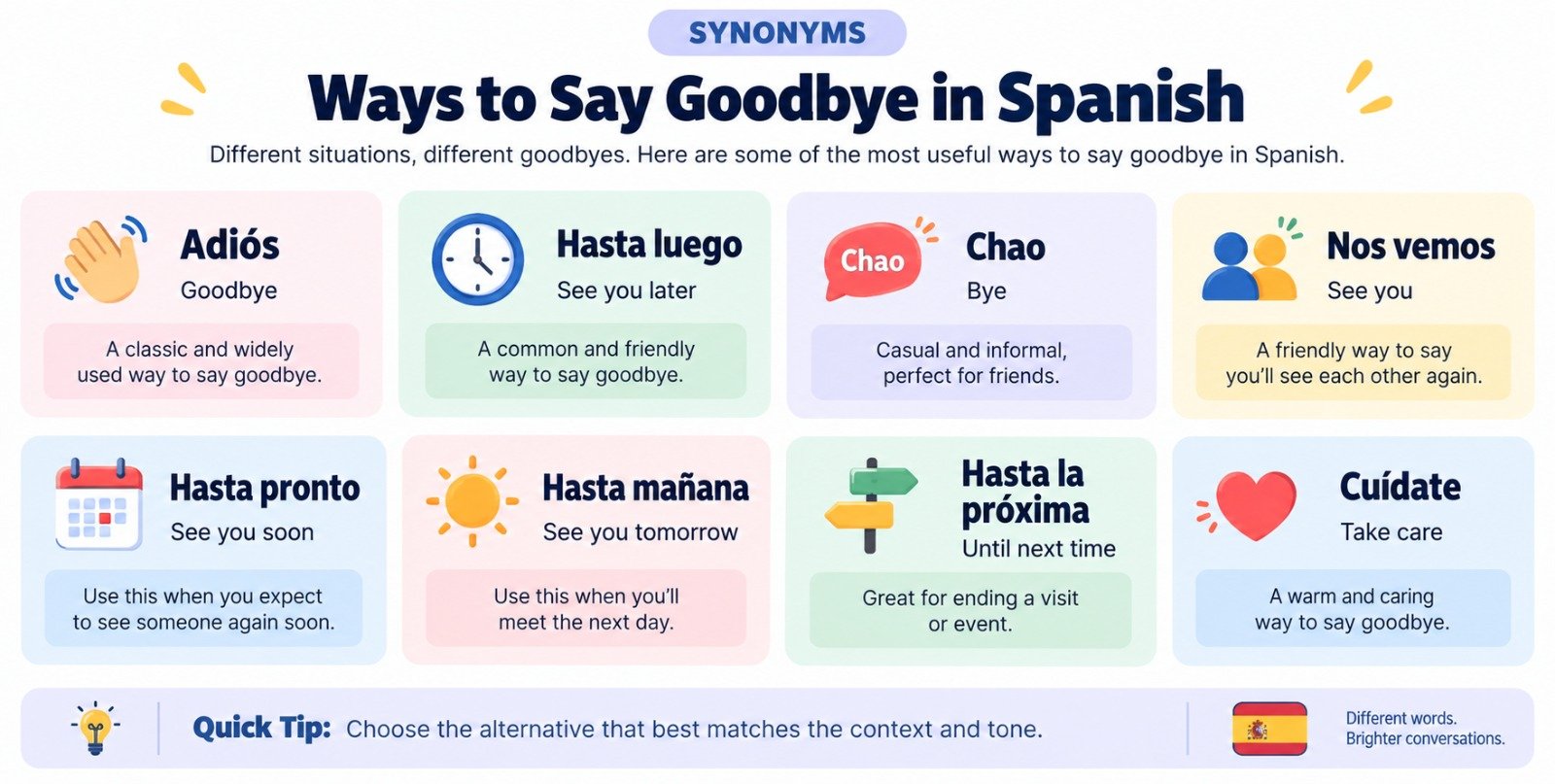
If you’re looking for ways to say goodbye in Spanish, the most useful expressions include adiós, hasta luego, chao, nos vemos, hasta pronto, hasta mañana, hasta la próxima, and cuídate.
8 Ways to Say Goodbye in Spanish
Here are eight useful expressions that cover most everyday situations.
1. Adiós
Adiós is the classic Spanish word for “goodbye.” It is widely understood and can be used in both formal and informal situations.
It can sound completely neutral, although in some contexts it may feel a little more final than expressions such as hasta luego or nos vemos.
Example:
“Adiós, María. Que tengas un buen día.”
“Goodbye, María. Have a good day.”
Use adiós when you simply want to say goodbye without suggesting a particular time when you will meet again.
2. Hasta luego
Hasta luego means “see you later.” It is one of the most natural everyday farewells in Spanish.
Unlike adiós, it carries the idea that you will see the person again, although it does not necessarily mean that you will literally meet later that same day.
Example:
“Me tengo que ir. ¡Hasta luego!”
“I have to go. See you later!”
For everyday conversations, this is often a safer choice than using adiós when you expect to see the person again.
3. Chao
Chao is the Spanish equivalent of a casual “bye.” It is short, friendly, and commonly used in informal conversation.
You may also see chau, especially in countries such as Argentina and Uruguay. Regional spelling and pronunciation can vary, but both forms are recognizable in much of the Spanish-speaking world.
Example:
“¡Chao! Nos vemos mañana.”
“Bye! See you tomorrow.”
Because it is informal, chao is particularly suitable for friends, classmates, relatives, and casual acquaintances.
4. Nos vemos
Nos vemos literally relates to “we see each other,” but naturally translates as “see you.”
It is friendly and conversational and works especially well when you expect to encounter the person again.
Example:
“Bueno, nos vemos el lunes.”
“Okay, see you Monday.”
This expression is particularly useful when you know when the next meeting will happen, but it can also be used as a general friendly farewell.
5. Hasta pronto
Hasta pronto means “see you soon.”
It is useful when you expect to see someone again relatively soon. It sounds warmer and more specific than simply saying adiós.
Example:
“Gracias por venir. ¡Hasta pronto!”
“Thanks for coming. See you soon!”
The phrase does not specify exactly when the next meeting will happen, so it is flexible.
6. Hasta mañana
Hasta mañana means “see you tomorrow.”
This is one of the easiest Spanish farewells because the phrase clearly tells the listener when you expect to meet again.
Example:
“Que descanses. Hasta mañana.”
“Get some rest. See you tomorrow.”
It is especially natural among coworkers, classmates, family members, or friends who know they will meet the following day.
7. Hasta la próxima
Hasta la próxima means “until next time” or “see you next time.”
Unlike hasta mañana, it does not specify a particular day. It works when you expect another meeting but do not know exactly when it will happen.
Example:
“Gracias por todo. Hasta la próxima.”
“Thanks for everything. Until next time.”
It can work in casual conversations and in situations where a meeting, event, or visit has come to an end.
8. Cuídate
Cuídate means “take care.”
Rather than focusing simply on leaving, this expression adds a warm and caring feeling. It is especially natural between friends, family members, and people who have a friendly relationship.
Example:
“Me voy a casa. Cuídate.”
“I’m going home. Take care.”
For a warmer farewell, cuídate can be combined with another goodbye expression.
Spanish Goodbye Expressions at a Glance
| Expression | English meaning | Tone | Best used for |
|---|---|---|---|
| Adiós | Goodbye | Neutral | General situations |
| Hasta luego | See you later | Neutral/friendly | Everyday conversations |
| Chao | Bye | Casual | Friends and informal situations |
| Nos vemos | See you | Friendly | People you expect to see again |
| Hasta pronto | See you soon | Friendly | An upcoming reunion |
| Hasta mañana | See you tomorrow | Neutral/friendly | When meeting the next day |
| Hasta la próxima | Until next time | Neutral/friendly | Unspecified future meetings |
| Cuídate | Take care | Warm | Friends, family, acquaintances |
Other Ways to Say Goodbye in Spanish
The eight expressions above are not the only possibilities. Depending on the circumstances, Spanish speakers can use several other natural farewell phrases.
Que te vaya bien
Que te vaya bien means roughly “take care” or “I hope things go well for you.”
It can be a warm way to end a conversation, particularly when someone is leaving or heading somewhere.
Example:
“Bueno, me voy. Que te vaya bien.”
“Well, I’m leaving. Take care.”
The phrase is not simply another literal translation of “goodbye”; it expresses a good wish toward the other person.
Me voy
Me voy means “I’m leaving” or “I’m off.”
It is useful when you want to announce your departure rather than simply give a farewell.
Example:
“Ya es tarde, me voy.”
“It’s late, I’m off.”
You can follow it with another farewell such as hasta luego or cuídate.
Hablamos luego
Hablamos luego means “we’ll talk later.”
This is particularly useful when you plan to communicate again, perhaps by phone or message. It does not necessarily mean that you will physically meet the person.
Example:
“Ahora tengo que trabajar. Hablamos luego.”
“I have to work now. We’ll talk later.”
Buenas noches
Buenas noches means “good night,” but it can also function as a farewell when leaving someone in the evening or at night.
Example:
“Gracias por la cena. Buenas noches.”
“Thanks for dinner. Good night.”
It is therefore related to saying goodbye, but it is more specifically connected with the time of day.
Que tengas un buen día
This means “have a good day.” It is a polite and pleasant way to end a conversation during the daytime.
It is especially useful in service interactions and other everyday situations where you want to leave someone with a friendly closing remark.
Other Ways to Say Goodbye in Spanish to Friends
When saying goodbye to friends, you can be more relaxed and personal. Expressions such as chao, nos vemos, hasta luego, and cuídate work naturally.
For example:
“¡Chao! Nos vemos el sábado.”
“Bueno, cuídate. Hablamos luego.”
“Me voy. ¡Hasta luego!”
The best choice depends on whether you expect to meet again, speak later, or simply want to wish your friend well.
Other Ways to Say Goodbye in Spanish Formally
In professional or more formal situations, adiós, hasta luego, and que tenga un buen día can work depending on the context.
With someone you address formally, the phrase cuídese can be used instead of the informal cuídate.
For example:
“Muchas gracias por su tiempo. Hasta luego.”
The important distinction is not just the vocabulary but also the tú/usted relationship. Spanish changes certain expressions depending on whether you are speaking informally or formally.
How to Choose the Right Spanish Goodbye
Not every Spanish farewell is interchangeable.
If you simply want to say “goodbye,” choose adiós.
If you expect to see the person again, hasta luego or nos vemos sounds natural.
If you want something casual and friendly, chao is a good choice.
If you’re leaving at night, buenas noches may be more appropriate.
If you’re saying goodbye to someone you care about, cuídate adds warmth.
If you know you will meet tomorrow, hasta mañana is more precise than a general goodbye.
This small difference in meaning can make your Spanish sound much more natural.
Regional Differences in Spanish Goodbyes
Spanish is spoken across many countries, so everyday vocabulary is not completely uniform.
One noticeable example is chao/chau. Both forms are encountered in Spanish-speaking regions, with chau especially associated with varieties of Spanish spoken in countries such as Argentina and Uruguay.
Likewise, the frequency of particular farewell expressions can vary from country to country. Hasta luego, nos vemos, and adiós are widely understood, so learners can use them confidently across many Spanish-speaking environments.
When traveling, listening to local speakers is one of the easiest ways to discover which informal expressions are most common in that particular region.
Ways to Say Goodbye in French
Spanish is not the only language with several natural ways to say goodbye. If you’re also learning French, there are a number of useful equivalents.
The standard French farewell is au revoir, meaning “goodbye.” For informal situations, salut can mean “bye,” although it can also mean “hi.”
Other useful French expressions include:
- À bientôt — See you soon
- À plus tard — See you later
- À demain — See you tomorrow
- À la prochaine — See you next time
- Bonne journée — Have a good day
- Bonne soirée — Have a good evening
As in Spanish, these expressions are not exact synonyms. The appropriate choice depends on whether you are leaving casually, expecting to meet again, or wishing someone a pleasant day or evening.
What Are 5 Ways to Say Goodbye in French?
If you only need five common French expressions, these are useful choices:
- Au revoir — Goodbye
- Salut — Bye
- À bientôt — See you soon
- À plus tard — See you later
- Bonne journée — Have a good day
The most basic option is au revoir, while salut is more informal. The expressions beginning with à generally indicate another expected meeting or time, while bonne journée is a good-wish farewell rather than a direct translation of “goodbye.”
Spanish vs. French Goodbyes
| Situation | Spanish | French |
|---|---|---|
| Standard goodbye | Adiós | Au revoir |
| Casual bye | Chao | Salut |
| See you later | Hasta luego | À plus tard |
| See you soon | Hasta pronto | À bientôt |
| See you tomorrow | Hasta mañana | À demain |
| See you next time | Hasta la próxima | À la prochaine |
| Have a good day | Que tengas un buen día | Bonne journée |
The two languages have several parallel ways of expressing a farewell, but you should learn each expression as it is naturally used rather than assuming that every phrase has a perfect word-for-word equivalent.
Frequently Asked Questions
What is the most common way to say goodbye in Spanish?
Adiós is the standard and widely recognized Spanish word for “goodbye.” However, hasta luego and nos vemos are also extremely useful in everyday conversation.
Is “hasta luego” formal or informal?
Hasta luego is generally neutral and works well in ordinary conversation. It can be used with friends, coworkers, acquaintances, and in many polite everyday situations.
Is “chao” the same as “adiós”?
Both can be used to say goodbye, but they have a different feel. Chao is generally more casual, while adiós is the standard neutral goodbye and can sometimes sound more final.
How do you say “see you tomorrow” in Spanish?
You say hasta mañana, which literally communicates that you expect to see the person tomorrow.
What is a friendly way to say goodbye in Spanish?
Nos vemos, hasta luego, and cuídate are all friendly choices. Cuídate is especially warm because it means “take care.”
How do you say “good night” when saying goodbye in Spanish?
Use buenas noches. It can function as both a greeting and a farewell at night, depending on the context.
Can I use “adiós” with friends?
Yes. Adiós is grammatically and socially acceptable with friends, although casual expressions such as chao or nos vemos may sound more relaxed.
What is the difference between “nos vemos” and “hasta luego”?
Nos vemos means “see you” and is a friendly general farewell. Hasta luego means “see you later” and more directly suggests seeing the person again later, although neither phrase guarantees a specific meeting time.
Conclusion
Learning different ways to say goodbye in Spanish helps you communicate more naturally because each expression carries a slightly different feeling. Adiós is the straightforward choice, while hasta luego and nos vemos are excellent everyday alternatives. For casual conversations, chao works well; for warmer farewells, cuídate adds a personal touch.
The same principle applies when learning French or another language: the best expression depends on the relationship, setting, expected reunion, and level of formality. Grammarifyr makes these small but meaningful language differences easier to understand, so you can choose the right words for the moment.
You may also Read : Different Ways to Say Goodbye: 100+ Casual, Formal & Funny Farewell Phrases

One Comment