Other Ways to Say “But”: 25 Better Alternatives for Writing and Speaking
The word “but” is one of the most useful ways to connect two contrasting ideas. However, using it repeatedly can make your writing feel predictable, especially in essays, professional emails, articles, and formal communication. Fortunately, English offers many other ways to say “but,” and each one has its own tone and grammatical function.
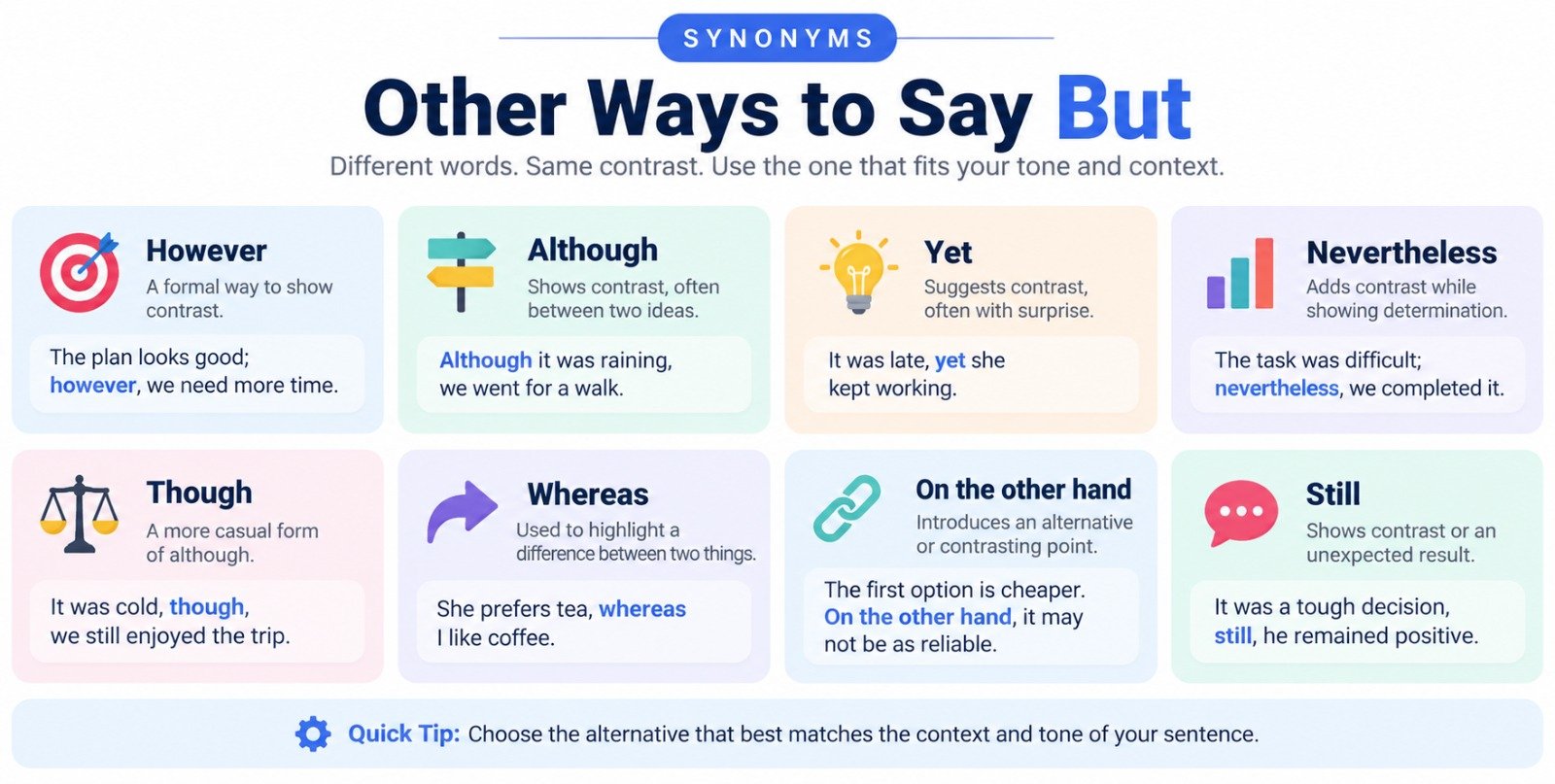
The best alternative depends on what you want to express. However works well in professional writing, though sounds natural in conversation, although introduces a concession, while whereas is particularly useful when comparing two things. These alternatives are not always interchangeable, so choosing the right one matters.
What Does “But” Mean?
“But” is primarily a conjunction used to introduce an idea that contrasts with or opposes the idea before it.
For example:
I wanted to go, but I was too tired.
The first part expresses a desire to go, while the second introduces a reason that prevents it. “But” can also be used to introduce exceptions, as in:
Everyone came but James.
Because “but” has more than one grammatical use, an alternative that works for contrast may not work when “but” means except.
Other Ways to Say “But” at a Glance
| Alternative | Tone | Best Used For | Example |
|---|---|---|---|
| However | Formal/neutral | Essays, emails, professional writing | The plan was good; however, it was expensive. |
| Yet | Neutral | Direct contrast | She was tired, yet she continued. |
| Although | Neutral/formal | Concession | Although it was late, we stayed. |
| Though | Casual/neutral | Conversation and informal writing | It was difficult, though we managed. |
| Nevertheless | Formal | Academic and professional writing | The risks were high; nevertheless, we proceeded. |
| Nonetheless | Formal | Formal arguments | The evidence was limited; nonetheless, it mattered. |
| Still | Neutral | Contrast with an existing fact | It was expensive. Still, I bought it. |
| Even so | Neutral | Unexpected continuation | It was raining. Even so, we went out. |
| On the other hand | Neutral | Presenting another perspective | It is small. On the other hand, it is affordable. |
| Whereas | Formal | Comparing two things | Anna likes tea, whereas Mark prefers coffee. |
| While | Neutral/formal | Contrasting two ideas | While the plan is simple, it is effective. |
| That said | Neutral | Softening or balancing a statement | The job is demanding. That said, it is rewarding. |
| In contrast | Formal | Highlighting a difference | Sales rose in June. In contrast, July was slower. |
| Conversely | Formal | Showing an opposite situation | Costs increased; conversely, demand fell. |
| Despite this | Neutral/formal | Continuing despite a previous fact | The weather was poor. Despite this, the event continued. |
Other Ways to Say “But” in Formal Writing
Formal writing often benefits from precise transitions rather than repeatedly using “but.” That does not mean “but” is incorrect or unprofessional; it simply means that alternatives can sometimes create a more appropriate rhythm or emphasis.
However
“However” is probably the most familiar formal alternative to “but.” It introduces a contrasting point and works especially well in reports, essays, articles, and professional correspondence.
Example:
The proposal was promising. However, it required a larger budget than expected.
One important difference is grammatical: “however” is an adverb, whereas “but” is a coordinating conjunction. You therefore cannot always replace “but” with “however” without changing the punctuation or sentence structure.
Nevertheless
“Nevertheless” means roughly “in spite of that” or “despite what was just mentioned.” It can make a contrast sound more deliberate and formal.
Example:
The experiment produced unexpected results. Nevertheless, the findings were valuable.
It is especially useful when the second statement remains true despite a problem or limitation.
Nonetheless
“Nonetheless” is very similar to “nevertheless” and is common in formal writing.
Example:
The sample size was relatively small. Nonetheless, the results were encouraging.
The two words are often interchangeable, although individual writers may prefer one for style.
Conversely
“Conversely” is useful when the second statement represents the opposite situation or relationship.
Example:
Urban populations increased during the decade. Conversely, several rural communities became smaller.
This is more specific than ordinary “but,” so it should not be used simply as a decorative replacement.
In Contrast
“In contrast” is particularly useful when emphasizing a clear difference between two subjects, situations, or results.
Example:
The first model is lightweight and inexpensive. In contrast, the second model is heavier and more powerful.
Other Ways to Say “But” in an Essay
When writing an essay, you may want alternatives that connect arguments without making every paragraph sound repetitive.
Although
“Although” introduces a concession: one fact is true, but another fact remains important.
Example:
Although the method is inexpensive, it requires considerable preparation.
Unlike “but,” “although” normally introduces a dependent clause.
You can also put it at the beginning:
Although the method is inexpensive, it requires considerable preparation.
This grammatical difference makes “although” more than a simple synonym for “but.”
Even Though
“Even though” creates a stronger sense of contrast or unexpectedness.
Example:
Even though the deadline was approaching, the team continued testing the product.
It is useful when the second idea seems surprising considering the first.
Yet
“Yet” is one of the closest alternatives to “but” when both are being used as coordinating conjunctions.
Example:
The task was challenging, yet we completed it on time.
Because “yet” can often replace “but” without major structural changes, it is particularly useful for reducing repetition.
Whereas
“Whereas” works best when directly comparing two people, things, situations, or ideas.
Example:
The first study focused on adults, whereas the second examined children.
It is not simply a more formal version of “but.” Its main purpose is comparison.
While
“While” can also introduce a contrast between two ideas.
Example:
While the first option is cheaper, the second offers better long-term value.
Be careful, though: “while” can also refer to time, so context determines its meaning.
Other Ways to Say “But” in Professional Emails
In workplace communication, you may want to sound balanced without making disagreement feel unnecessarily blunt.
That Said
“That said” is a natural way to acknowledge one point before introducing another.
Example:
The current system has some limitations. That said, it has served us well for several years.
It sounds professional without being excessively formal.
Still
“Still” can acknowledge a difficulty while emphasizing that the next statement remains true.
Example:
The project will require additional resources. Still, I believe we can complete it on schedule.
Even So
“Even so” works when something remains true despite what has just been mentioned.
Example:
The initial response was disappointing. Even so, we should continue improving the service.
Despite This
“Despite this” is useful when you want to refer directly to a previous fact.
Example:
The first proposal was rejected. Despite this, the team submitted a revised version.
It can be especially effective when the contrast spans two sentences.
Other Ways to Say “But” in Casual Conversation
You do not always need a formal transition. In everyday English, shorter and more natural expressions often sound better.
Though
“Though” is extremely common in casual speech.
Example:
I wasn’t a big fan of the restaurant. The dessert was good, though.
It can also appear within a sentence:
It was expensive, though it was worth it.
Yet
“Yet” also works naturally in everyday conversation when you want a concise contrast.
Example:
He’s quiet, yet he always knows what to say.
Still
“Still” is useful when you want to acknowledge something and then give your continuing opinion.
Example:
I know it’s a long drive. Still, I’d like to go.
Even So
“Even so” sounds conversational while clearly signaling that the second point remains true.
Example:
I was exhausted. Even so, I couldn’t fall asleep.
Other Ways to Say “But” When Comparing Two Ideas
Some alternatives are better when the purpose is not simply contrast but direct comparison.
On the Other Hand
Use “on the other hand” when you want to present another perspective, advantage, disadvantage, or side of an issue.
Example:
The apartment is farther from work. On the other hand, the rent is much lower.
It often works best when discussing two sides of a decision rather than connecting two ordinary clauses.
In Contrast
Use “in contrast” when the difference between two things is the main point.
Example:
The northern region received heavy rainfall. In contrast, the south remained unusually dry.
By Comparison
“By comparison” shifts attention toward how one thing differs from another.
Example:
The first model is fairly expensive. By comparison, the newer version is much more affordable.
Whereas
“Whereas” is particularly effective when the two subjects have different characteristics.
Example:
The morning shift prefers earlier meetings, whereas the evening team prefers later ones.
Other Ways to Say “But” Without Sounding Too Negative
Sometimes the goal is not simply to find a synonym. You may want to make a disagreement or limitation sound more balanced.
Instead of:
The idea is good, but it has several problems.
You could write:
The idea is good. However, it has several limitations.
Or:
The idea is promising, although several issues remain.
Or:
The idea has potential. That said, several issues need attention.
The last version can sound particularly useful in workplace communication because it acknowledges the positive point before introducing a concern.
Other Ways to Say “But” for a Softer Contrast
That Said
This is one of the most useful choices when you want to disagree or add a limitation without sounding overly negative.
The proposal is ambitious. That said, we should consider the available budget.
Although
“Although” can soften a contrast by making the positive or negative point part of a larger sentence.
Although the process takes longer, it produces more reliable results.
Still
“Still” can acknowledge a problem while maintaining a positive or neutral conclusion.
The instructions are a little confusing. Still, the overall process is manageable.
Other Ways to Say “But” When You Mean “Except”
This is where choosing a synonym requires particular care. “But” can sometimes mean “except”, and alternatives such as “however” or “nevertheless” do not work in this sense.
For example:
Everyone attended but John.
Here, “but” means except, not “however.”
You could say:
Everyone attended except John.
Other possibilities include apart from, other than, excluding, and aside from, depending on the sentence.
Except
Everyone was invited except Daniel.
Apart From
Apart from one minor issue, everything went smoothly.
Other Than
I don’t have any concerns other than the delivery time.
These expressions belong to the exception meaning of “but,” so they should not be treated as replacements for “but” in ordinary contrast sentences.
“But” vs. “However”: What Is the Difference?
“However” is one of the most common alternatives to “but,” but the two words are not grammatically identical.
Compare:
I wanted to help, but I didn’t have enough time.
With:
I wanted to help. However, I didn’t have enough time.
“But” directly joins the two clauses. “However” generally functions as a conjunctive adverb and often requires a different sentence structure or punctuation.
This is one reason simply replacing every “but” with “however” can create punctuation problems.
“Although” vs. “But”
These words both express contrast, but they structure sentences differently.
But:
I was tired, but I finished the report.
Although:
Although I was tired, I finished the report.
You can also write:
I finished the report although I was tired.
So, “although” is often better when you want to make one idea subordinate to another.
“Yet” vs. “But”
“Yet” is one of the easiest replacements when the grammatical structure is similar.
She is young, but she is experienced.
She is young, yet she is experienced.
Both sentences contrast youth with experience. “Yet” can sometimes give the contrast a slightly stronger sense of surprise.
Proofed also identifies “yet” as a coordinating conjunction that can often replace “but” directly when expressing contrast.
Common Mistakes When Replacing “But”
Using “However” as if it were always “But”
Incorrect punctuation can result when “however” is inserted where “but” originally appeared.
Instead of:
I wanted to go, however I was tired.
Use:
I wanted to go. However, I was tired.
Or:
I wanted to go; however, I was tired.
Using “Despite” Before a Full Clause
“Despite” normally takes a noun phrase or an -ing form, not a complete clause.
Correct:
Despite the rain, we went outside.
Correct:
Despite feeling tired, she continued working.
For a full clause, use “although” or “even though”:
Although it was raining, we went outside.
Treating Every Alternative as Identical
“However,” “whereas,” “except,” and “nevertheless” do different jobs. Replacing “but” with whichever word sounds more sophisticated can actually make a sentence less accurate.
The goal is not to eliminate “but.” The goal is to choose the connector that expresses your intended relationship between ideas.
How to Choose the Right Alternative to “But”
A quick way to choose is to identify what your sentence is doing:
- Simple contrast: use but or yet.
- Formal contrast: use however.
- Concession: use although or even though.
- Strong formal concession: use nevertheless or nonetheless.
- Casual contrast: use though or still.
- Two-sided comparison: use on the other hand.
- Direct comparison: use whereas or while.
- Clear difference: use in contrast.
- Exception: use except, apart from, or other than.
- Professional balancing: use that said.
Frequently Asked Questions
What is the best alternative to “but”?
“However” is one of the most versatile formal alternatives, while “yet” is one of the closest grammatical replacements for “but.” The best choice depends on the sentence.
What can I say instead of “but” in an essay?
Try however, although, yet, nevertheless, nonetheless, whereas, or in contrast. Choose according to the relationship between the ideas rather than simply trying to sound more formal.
What is a professional way to say “but”?
However, nevertheless, nonetheless, and that said can work well in professional communication. “But” itself is also perfectly professional when used naturally.
Can I use “however” instead of “but”?
Sometimes, but not always. “However” has a different grammatical function and often requires different punctuation or sentence structure.
What is a casual way to say “but”?
Though, still, and yet can sound natural in casual communication. “But” is also completely normal in everyday conversation.
Is “yet” the same as “but”?
They can have very similar meanings when they connect contrasting ideas, but “yet” can add a slightly stronger sense of unexpected contrast.
What is another word for “but” when it means “except”?
Use except, apart from, other than, excluding, or aside from, depending on the sentence. These alternatives express exception rather than ordinary contrast.
How can I avoid using “but” too much?
First identify the relationship between your ideas. Then choose a suitable connector such as however for formal contrast, although for concession, whereas for comparison, or except for an exception. You can also restructure the sentence instead of replacing “but” with another word.
Final Thoughts
There is nothing wrong with using “but.” It is short, clear, natural, and grammatically useful. The problem only arises when the same connector is repeated so often that your writing loses variety or when a more precise relationship needs to be expressed.
Use however for a polished contrast, although for concession, yet for a close alternative, though for everyday language, nevertheless for a stronger formal transition, and whereas when comparing two sides. When “but” means “except,” choose an exception word instead.
Understanding these small differences is exactly what makes word choice more precise. Grammarifyr helps you make those choices with greater confidence, so your writing can sound natural, clear, and appropriate for the situation.
You may also Read : 25 Other Ways to Say “On the Other Hand” for Any Situation
One Comment