Prefer or Perfer: Correct Spelling and Usage
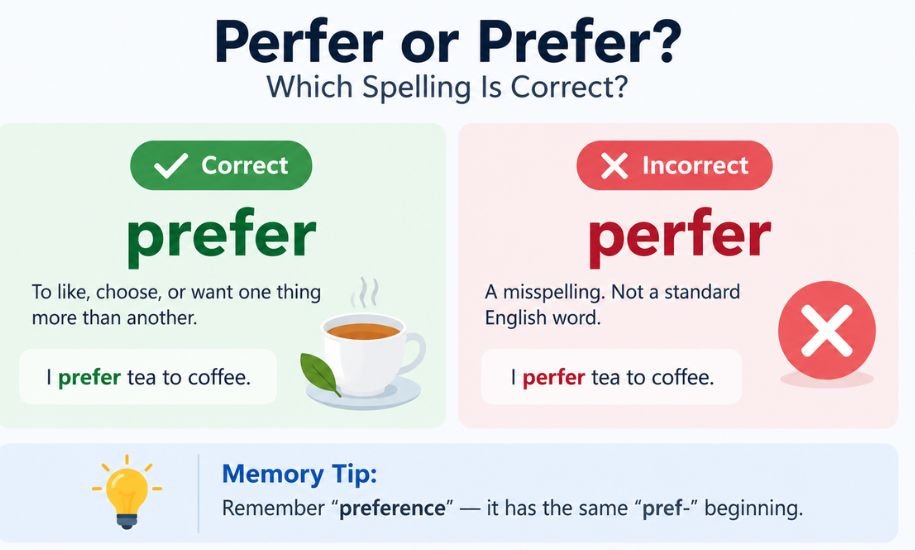
It is easy to hesitate over perfer or prefer, especially because the two spellings look and sound similar. However, there is no spelling choice to make in standard English: prefer is the correct word. Perfer is a misspelling and should not be used in formal or standard written English. The confusion often comes from typing the word the way it seems to sound or accidentally switching the letters in the middle of the word. Understanding the correct spelling and a few common grammar patterns will make this word much easier to use confidently.
Prefer is the correct spelling. Perfer is a misspelling, not a separate standard English word. Use “prefer” when you mean that you like, choose, or want one thing more than another.
Perfer or Prefer: Which Is Correct?
The correct spelling is prefer.
| Form | Correct? | Meaning | Example |
|---|---|---|---|
| prefer | ✅ Yes | To like, choose, or want one thing more than another | I prefer tea to coffee. |
| perfer | ❌ No | Misspelling of prefer | I perfer tea. ❌ |
So, if you are wondering prefer or perfer, always choose prefer in standard English.
The word prefer is a verb. It expresses a choice or a stronger liking for one option compared with another.
For example:
- I prefer working from home.
- She prefers the blue dress.
- We prefer trains to buses.
- Would you prefer coffee or tea?
There is no standard English meaning that should be assigned to perfer. It is simply an incorrect spelling of prefer.
What Does “Prefer” Mean?
Prefer means to like, choose, or want one person or thing more than another.
It can describe personal choices, habits, opinions, or decisions.
For example:
I prefer summer to winter.
This means the speaker likes summer more than winter.
Another example is:
Daniel prefers reading at night.
Here, prefers indicates that reading at night is Daniel’s favored choice.
The verb can be used in several useful structures:
Prefer + noun
I prefer tea.
Prefer A to B
I prefer tea to coffee.
Prefer + -ing form
She prefers walking to driving.
Prefer + to-infinitive
They prefer to arrive early.
These structures are common in both everyday and formal English.
Is “Perfer” a Real Word?
In standard modern English, perfer is not the correct spelling of the verb meaning “to like one thing more than another.”
If you write:
I perfer chocolate.
the intended meaning is clear, but the spelling is incorrect.
The correct sentence is:
I prefer chocolate.
It is therefore better to think of perfer as a spelling error rather than as an alternative form of prefer.
You should use prefer in school assignments, professional writing, emails, articles, applications, and other forms of standard written English.
Why Do People Confuse These Spellings?
The letters in prefer and perfer are very similar, so it is easy to accidentally put the second letter in the wrong order.
The correct word is:
P-R-E-F-E-R
A common incorrect version is:
P-E-R-F-E-R
The pronunciation can also contribute to the confusion. When people write a word from memory rather than recalling its spelling, they may choose a spelling that seems to match the sound.
There is also a natural tendency to associate the beginning of the word with per-, particularly because English contains many words beginning with that combination. However, prefer begins with pre-.
Prefer or Perfer Spelling: How to Remember It
A simple way to remember the correct spelling is to connect prefer with preference.
Notice the shared beginning:
- prefer
- preference
- preferred
- preferring
They all begin with pref-.
You can also break the spelling into two parts:
pre + fer = prefer
Remembering the first part as pre rather than per can help prevent the most common spelling mistake.
Another useful pair is:
prefer → preference
If you know how to spell preference, the correct spelling of prefer becomes easier to remember.
How to Use “Prefer” Correctly
One of the most useful grammar patterns is prefer A to B.
For example:
I prefer tea to coffee.
This means the speaker chooses tea rather than coffee.
More examples include:
Maria prefers books to movies.
We prefer trains to airplanes for short journeys.
He prefers autumn to spring.
I prefer working in the morning to working late at night.
Notice that to, rather than than, is normally used when directly comparing two things with prefer.
Prefer vs. “Prefer Than”
A common grammatical mistake is:
I prefer tea than coffee. ❌
The standard construction is:
I prefer tea to coffee. ✅
This is an important point because someone can spell prefer correctly while still using it incorrectly in a comparison.
“Prefer” With Verbs
When discussing activities, prefer can be followed by an -ing form.
For example:
I prefer walking to driving.
She prefers cooking at home to eating out.
They prefer studying in the library to studying at home.
It can also be followed by a to-infinitive:
I prefer to walk.
She prefers to cook at home.
They prefer to study in the library.
The exact construction can depend on the sentence and intended meaning, but both patterns are standard.
“Prefer” and “Would Prefer” Are Not Always the Same
Another useful distinction is between prefer and would prefer.
Prefer can describe a general preference:
I prefer tea to coffee.
This suggests a general liking or choice.
Would prefer is often used for a particular choice or situation:
I would prefer tea, please.
Here, the speaker is expressing what they want on this particular occasion.
Similarly:
I prefer to travel by train.
can describe a general preference, while:
I would prefer to travel by train tomorrow.
refers to a particular situation.
Correct and Incorrect Examples
Seeing the spelling in context makes the difference easier to remember.
Spelling
Correct:
I prefer this option.
Incorrect:
I perfer this option.
Comparison
Correct:
She prefers tea to coffee.
Incorrect:
She prefers tea than coffee.
Past tense
Correct:
We preferred the original design.
Incorrect:
We prefered the original design.
The past tense contains a double r:
prefer → preferred
-ing form
Correct:
He is considering which option he prefers.
Incorrect:
He is considering which option he perfer.
The important point is that the base spelling remains prefer.
Common Mistakes With “Prefer”
1. Writing “perfer”
I perfer blue. ❌
Use:
I prefer blue. ✅
2. Forgetting the second “r” in the past tense
The past form is:
preferred
not:
prefered
For example:
She preferred the smaller apartment.
3. Using “than” after a direct preference comparison
I prefer tea than coffee. ❌
Better:
I prefer tea to coffee. ✅
4. Forgetting the third-person singular ending
With he, she, or it, use prefers:
She prefers classical music. ✅
Not:
She prefer classical music. ❌
5. Using “prefer” when “would prefer” is more appropriate
For a specific request, would prefer can be more natural:
I would prefer a window seat, please.
This is different from stating a general preference:
I prefer window seats.
Prefer, Preferred, and Preferring
Knowing the related forms can help reinforce the correct spelling.
| Form | Use | Example |
|---|---|---|
| prefer | Base form | I prefer tea. |
| prefers | Third-person singular present | She prefers tea. |
| preferred | Past tense/past participle | He preferred tea. |
| preferring | -ing form | She is preferring the simpler option. |
The most important spelling detail is that preferred has two rs:
p-r-e-f-e-r-r-e-d
This is because the final consonant is doubled when the suffix -ed is added.
Is “Prefer” Used in American and British English?
Yes. Prefer is the standard spelling in both American and British English.
There is no American-versus-British spelling distinction in which perfer becomes acceptable in one variety.
For example, both varieties use sentences such as:
I prefer coffee to tea.
She prefers to walk.
Therefore, if you are asking is it prefer or perfer, the answer does not change depending on whether you are writing for an American or British audience.
A Simple Test
If you are unsure about the spelling, complete this sentence:
I have a ______ for one option over another.
The related noun is preference.
That connection can remind you that the verb is:
prefer
rather than:
perfer
You can also remember the word family:
prefer → preferred → preference
The shared pref- beginning is a useful visual clue.
Frequently Asked Questions
Is it prefer or perfer?
Prefer is correct. Perfer is a misspelling and should not be used in standard English. Use prefer when you want to express a stronger liking, choice, or desire for one thing over another.
Is it perfer or prefer?
It is prefer. The word is spelled P-R-E-F-E-R. The spelling perfer is not an accepted alternative spelling of the standard verb.
How do you spell prefer correctly?
The correct spelling is prefer. A useful way to remember it is to connect it with preference, which begins with the same pref- sequence.
What is the past tense of prefer?
The past tense is preferred, with two rs. For example: “She preferred the original plan.” The form prefered is incorrect.
Do you say “prefer to” or “prefer than”?
For a direct comparison, standard English normally uses prefer A to B: “I prefer tea to coffee.” Than is not the normal preposition in this construction.
Is “perfer” an acceptable spelling in formal writing?
No. Perfer should be treated as a spelling mistake in standard formal writing. Use prefer in professional documents, academic work, published content, and other contexts where correct English is expected.
Final Verdict: Perfer or Prefer?
The correct choice is prefer. Perfer is simply a misspelling and should be avoided. Remember the related word preference, and the correct spelling becomes easier to recognize. Once the spelling is clear, also remember the useful grammar pattern prefer A to B, as in “I prefer tea to coffee.” For more straightforward explanations of confusing English words and grammar choices, Grammarifyr follows the principle of helping readers know the difference and use the right words.
You may also Read : Surf or Sound: Meaning, Realty, OBX and More
One Comment