Either Or Meaning and How to Use It Correctly
Choosing between two possibilities is something we do constantly in English: you can take the train or drive, accept an offer or decline it, or study one subject or another. The expression either…or is one of the most useful ways to present these alternatives clearly. But because either can also be used on its own, its meaning can sometimes be confusing. Understanding how the paired construction works, when to use either of, and how it differs from neither…nor will help you use it naturally in both everyday and formal English.
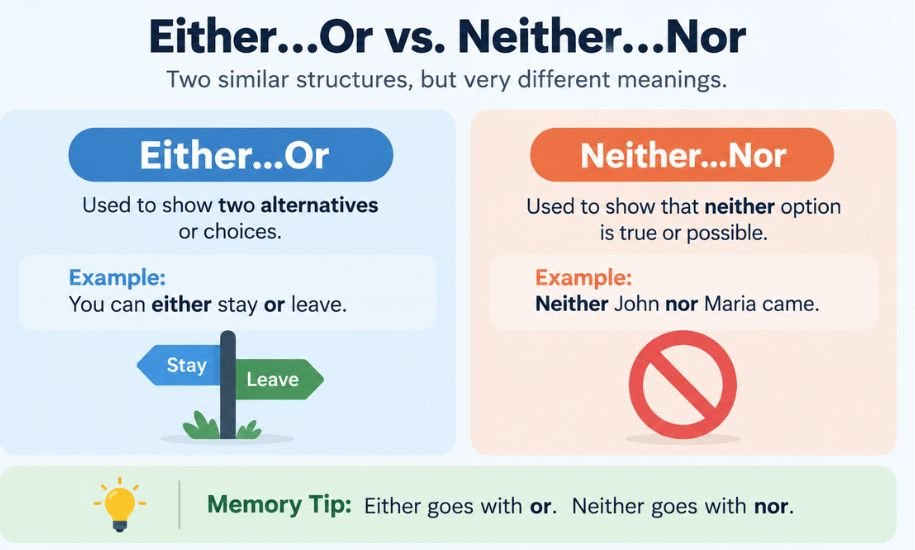
Either…or is used to present two alternatives or choices. For example, “You can either stay here or come with us” gives two possible options. Either by itself can also mean one of two people or things, depending on the sentence.
The Basic Meaning of Either…Or
The simplest way to understand either…or is:
either + option A + or + option B
It introduces two alternatives and tells the reader that one possibility or the other is being considered.
For example:
- You can either walk or take the bus.
- We can meet either today or tomorrow.
- She will either call me or send a message.
- The machine can operate through either manual or automatic controls.
In each sentence, two possibilities are connected.
The construction can join individual words, phrases, or larger clauses. What matters most is that the two alternatives are presented clearly and, where possible, in a parallel grammatical structure.
What Does “Either” Mean by Itself?
Either has more than one use, so its meaning depends on the sentence.
When referring to two people or things, it can mean one or the other of two.
For example:
Either answer is acceptable.
This means that one answer or the other is acceptable; the choice does not matter.
Another example is:
You can sit in either chair.
If there are two chairs under discussion, the speaker means that either one is suitable.
It can also be used with of:
Either of the candidates could win.
Here, either of refers to one of two candidates.
Other Uses of “Either”
In negative sentences, either can mean “also” or “too”:
I don’t like that restaurant either.
This means the speaker also does not like the restaurant.
There is another use in expressions such as:
There are trees on either side of the road.
Here, either side can refer to both sides of the road.
Therefore, either does not have only one fixed meaning. Context determines how it should be understood.
Either…Or vs. Neither…Nor
One of the most common sources of confusion is the difference between either…or and neither…nor.
| Expression | Basic meaning | Example |
|---|---|---|
| either…or | One alternative or the other | You can either stay or leave. |
| neither…nor | Not one and not the other | Neither John nor Maria came. |
| either | One of two | Either option is suitable. |
| neither | Not one of two | Neither option is suitable. |
Consider these two sentences:
Either Sarah or David will attend.
This presents Sarah and David as two alternatives.
Neither Sarah nor David will attend.
This says that both alternatives are rejected.
So, when someone asks about neither or either meaning, the easiest distinction is that either generally selects or considers one of two possibilities, while neither excludes both.
How to Use Either…Or in a Sentence
The construction is flexible and works in many types of sentences.
Connecting nouns
You can choose either tea or coffee.
The two nouns are tea and coffee.
Connecting verbs
We can either wait or leave.
The two verbs are wait and leave.
Connecting adjectives
The answer is either correct or incorrect.
The two adjectives are correct and incorrect.
Connecting phrases
She will travel either by train or by plane.
The alternatives are two prepositional phrases.
Connecting clauses
Either we leave now or we miss the beginning of the show.
Here, the construction connects two complete clauses.
These examples demonstrate why either…or is useful in both conversational and professional English.
“Either” and “Or” in Technical Writing
The phrase can also appear in formal and technical sentences. Your example, “surveillance can be performed through either stationary or mobile means,” is grammatically structured around two alternatives.
The alternatives are:
- stationary means
- mobile means
The pattern is:
either + stationary + or + mobile
The sentence therefore communicates that surveillance may be carried out using one of these two types of methods.
Similar examples include:
- The inspection can be conducted using either visual or electronic methods.
- The equipment may be controlled through either wired or wireless connections.
- Data can be stored using either local or remote systems.
- The procedure may require either manual or automated monitoring.
This construction is particularly useful when a writer needs to distinguish between two possible methods without making the sentence unnecessarily long.
Why Parallel Structure Matters
One of the most useful grammar rules for either…or is to keep the two alternatives grammatically balanced.
For example:
You can either drive to the station or take the train.
This is natural because drive and take are both verbs.
Another good example is:
The system uses either wired or wireless communication.
Here, wired and wireless function in the same grammatical role.
An awkward construction would be:
You can either drive to the station or the train.
The first alternative contains a verb, while the second is a noun phrase. The intended meaning is understandable, but the structure is not parallel.
A better version is:
You can either drive to the station or take the train.
Parallel structure makes alternatives easier to read and reduces ambiguity.
When to Use “Either Of”
Use either of when you are referring to one of two members of an already identified group.
Examples include:
- Either of these answers could be correct.
- Either of the roads will take you there.
- Either of my brothers can help.
- Either of the plans would work.
Notice that either of is normally followed by a determiner such as the, these, those, my, your, or their plus a plural noun.
Compare:
Either answer is acceptable.
with:
Either of the answers is acceptable.
Both can be grammatical, but the second explicitly refers to a particular pair of answers.
Is “Either-Or” the Same as “Either…Or”?
They are closely related, but their grammatical forms differ.
Either…or is the normal paired construction inside a sentence:
You can either call me or email me.
Either-or is a hyphenated expression often used as a noun or modifier to describe a choice between two alternatives.
For example:
It became an either-or decision.
or:
The situation is an either-or choice: we must select one option.
In ordinary sentence construction, either…or is generally the form you will need.
“Either Way” Meaning
Another useful expression is either way.
It means that the same result, conclusion, or action applies regardless of which of two alternatives is selected.
For example:
You can take the bus or walk. Either way, you’ll arrive before noon.
The speaker is saying that the particular choice does not change the relevant outcome.
Other examples:
- We can meet today or tomorrow. Either way, I’ll be available.
- You can pay online or in person. Either way is fine.
- She may accept the offer or reject it. Either way, we need a backup plan.
This is different from simply presenting two alternatives with either…or.
Common Mistakes With Either…Or
1. Using “either” without the appropriate alternative
A common mistake is to write:
You can either choose the blue one.
This can sound incomplete if the writer intends to present two alternatives. A clearer construction would be:
You can either choose the blue one or choose the green one.
However, either can be used by itself in other grammatical structures, so it is not always necessary to follow it with or.
2. Creating an unbalanced sentence
Avoid mixing unrelated grammatical structures:
You can either take a taxi or the bus.
Although this is often heard and understood, a more formally parallel version is:
You can either take a taxi or take the bus.
In natural English, repeated words can sometimes be omitted, but maintaining parallel structure is a useful editing principle.
3. Confusing either…or with neither…nor
Remember:
Either…or → alternatives
Neither…nor → both alternatives are rejected
Either Anna or James will present the report.
Neither Anna nor James will present the report.
4. Assuming “either” always means exactly one
In many contexts, either…or presents two alternatives and implies a choice between them. But English or can be inclusive depending on context. Therefore, the exact logical meaning should be determined from the sentence and situation rather than assuming that or always means “one but absolutely not both.”
An Easy Way to Remember the Difference
A simple memory rule is:
Either = one of two.
Or = the alternative.
Put them together:
Either A or B = A or B as alternatives.
For the negative counterpart:
Neither A nor B = not A and not B.
You can remember the pairs this way:
- Either → or
- Neither → nor
For example:
Either tea or coffee.
Neither tea nor coffee.
Once you recognize these paired patterns, they become much easier to use correctly.
More Examples in Everyday English
Here are some natural examples showing different uses:
- You can either call me tonight or contact me tomorrow.
- Either route will take you to the city center.
- We will either finish today or continue tomorrow.
- Either of these shirts would look good.
- The meeting can take place either online or in person.
- She is either working or studying.
- I don’t want dessert either.
- There are cafés on either side of the street.
- Neither option seems suitable.
- Neither the manager nor the assistant was available.
Notice that either changes its role depending on the sentence. It can introduce alternatives, refer to one of two items, appear in a negative statement, or form part of another expression.
Frequently Asked Questions
What does either or mean?
Either…or introduces two alternatives or possibilities. For example, “You can either stay or leave” presents staying and leaving as the two available alternatives.
Is either…or grammatically correct?
Yes. Either…or is a standard English construction used in both spoken and written language. It can connect words, phrases, and clauses, such as “either tea or coffee” and “either stay here or come with us.”
What is the difference between either and neither?
Either generally refers to one of two possibilities, while neither means not one and not the other. For example, “Either answer works” allows one of the two answers, whereas “Neither answer works” rejects both.
Does either always mean one?
No. Although either commonly means one of two, context can change its meaning. In “You can choose either option,” it refers to one of two choices. In “There are houses on either side,” it can refer to both sides.
Should I use either of or either?
Use either of when referring to one member of a particular group of two, such as “either of the answers.” When either directly modifies a singular noun, you can say “either answer.”
Final Verdict: What Does Either…Or Mean?
The central either or meaning is simple: either…or presents two alternatives or possibilities. Use it to make choices clear, such as “either tea or coffee” or “either call me or send an email.” Keep the alternatives grammatically parallel when possible, and remember that neither…nor expresses the opposite idea by excluding both choices. For clear explanations of confusing English words and grammar, Grammarifyr helps you know the difference and use the right words.
You may also Read : To vs Too: Meaning, Rules, and Examples