Modeling or Modelling: Correct Spelling Guide
If you have ever paused over modeling or modelling, you are dealing with a spelling difference rather than two different words. Both forms come from the verb model and can describe activities such as displaying clothes, creating a representation, or building a mathematical or computer model. The key distinction is regional: modeling is the standard spelling in American English, while modelling is the standard British English form.
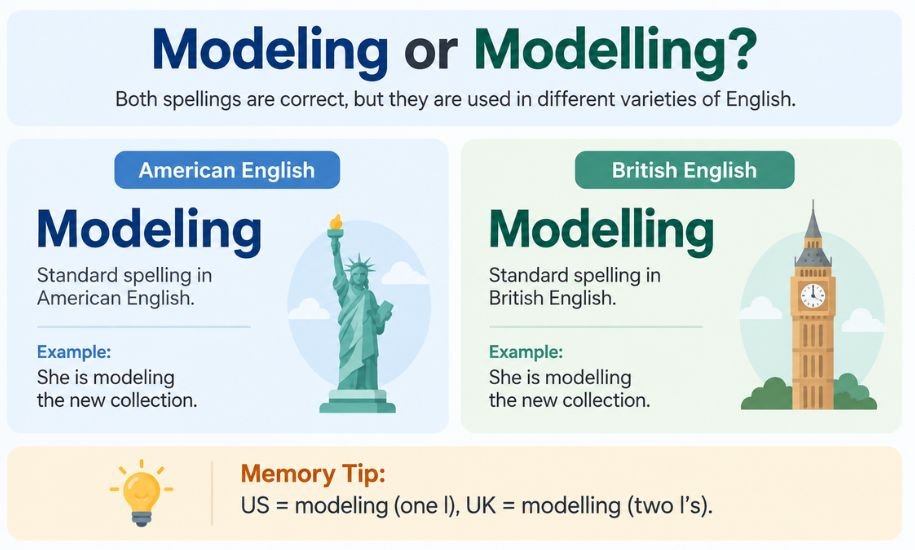
Both “modeling” and “modelling” are correct. “Modeling” is preferred in American English, while “modelling” is preferred in British English. The meaning is essentially the same, so choose the spelling that matches the variety of English you are using and stay consistent.
Modeling vs Modelling: The Key Difference
The difference is mainly spelling and regional convention, not meaning.
| Feature | Modeling | Modelling |
|---|---|---|
| Standard variety | American English | British English |
| Number of Ls | One | Two |
| Meaning | Same | Same |
| Verb form | Present participle of model | Present participle of model |
| Gerund | Yes | Yes |
| Past form | modeled | modelled |
| Related noun | modeler | modeller |
Cambridge identifies modeling as the US spelling and notes that UK English usually uses modelling. Scribbr likewise explains that the two spellings are forms of the same verb and that the choice generally follows US or UK English conventions.
So, neither spelling should automatically be treated as a mistake.
What Does “Modeling” Mean?
Modeling is the American English spelling. It is the present participle and gerund form of model.
The verb model can have several meanings. Someone can model clothing, for example, or a scientist can model a physical process using mathematics or a computer.
Examples:
- She is modeling the designer’s new collection.
- The researchers are modeling changes in the climate.
- The software is modeling the behavior of the system.
- Modeling is an important part of the engineering project.
Cambridge includes both fashion-related modeling and mathematical or computing uses in its definition. Collins similarly defines American modeling in contexts ranging from fashion and sculpture to mathematical representation and computer-based systems.
Modeling as a noun
The word can also function as a gerund or noun referring to the activity itself:
Modeling can be a demanding career.
Here, modeling names an activity rather than describing what someone is doing at a particular moment.
What Does “Modelling” Mean?
Modelling is the British English spelling of the same word.
It can be used in exactly the same kinds of contexts:
- She is modelling the latest collection.
- Scientists are modelling possible weather patterns.
- The engineers are modelling the structure digitally.
- Modelling is an important part of the research project.
Collins lists modelling as the British form and includes meanings involving creating models, fashion, and other applications.
Oxford-based usage guidance and other reference sources likewise recognize the double-l form as the British spelling.
Why Does “Modelling” Have Two Ls?
The extra l is a feature of regional spelling conventions.
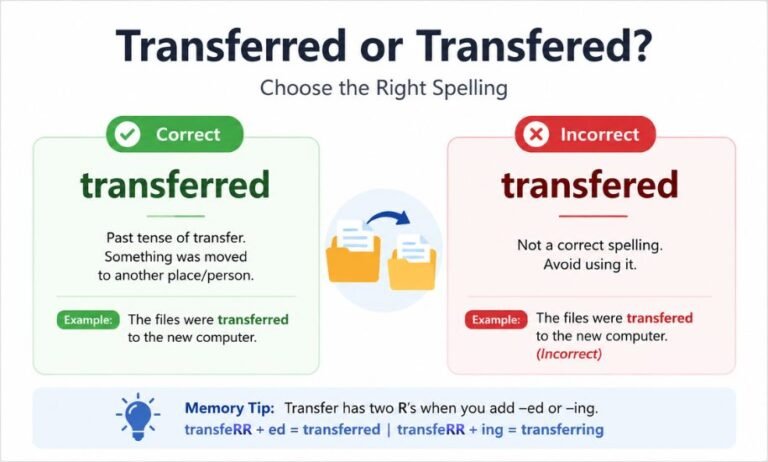
British English commonly uses double consonants in certain words when suffixes such as -ing or -ed are added. American English often uses a single consonant in comparable forms.
Compare:
- model → modeling — American English
- model → modelling — British English
You can see a similar difference in some other words:
- traveling / travelling
- labeled / labelled
- canceled / cancelled
The exact spelling conventions are more nuanced than simply saying that British English always doubles letters and American English never does. For model, however, the practical rule is straightforward: American English normally uses modeling, while British English normally uses modelling.
The Same Difference Appears in Other Forms
The regional spelling difference does not stop with the -ing form.
The past tense and related noun also vary:
| American English | British English |
|---|---|
| modeling | modelling |
| modeled | modelled |
| modeler | modeller |
For example:
American:
The computer modeled the proposed structure.
British:
The computer modelled the proposed structure.
Likewise:
American:
She works as a professional modeler.
British:
She works as a professional modeller.
The important point is consistency. If your document follows American English, it is generally better to use modeling, modeled, and modeler rather than mixing regional forms.
Modeling or Modelling in Different Contexts
The spelling difference remains the same regardless of what kind of modeling you mean.
Fashion
American English:
She began modeling professionally after college.
British English:
She began modelling professionally after college.
Science and mathematics
American English:
Mathematical modeling helps researchers test different scenarios.
British English:
Mathematical modelling helps researchers test different scenarios.
Computing and engineering
American English:
The team is using 3D modeling software.
British English:
The team is using 3D modelling software.
Art and sculpture
American English:
The course teaches clay modeling techniques.
British English:
The course teaches clay modelling techniques.
The meaning does not change simply because the spelling changes. Collins and Cambridge both document multiple meanings beyond fashion, including mathematical and computational applications.
Which Spelling Should You Use?
The best choice depends on your audience and style guide.
Use “modeling” for American English
Choose modeling when your writing follows American English conventions.
For example:
The students are learning computer modeling.
The company specializes in financial modeling.
She wants to pursue a career in modeling.
Use “modelling” for British English
Choose modelling when your writing follows British English conventions.
For example:
The students are learning computer modelling.
The company specializes in financial modelling.
She wants to pursue a career in modelling.
Neither version needs to be changed simply because the other spelling is more familiar to you. The goal is to match the regional variety used throughout your writing.
A Note About Technical Terms and Names
There can be situations where a particular product, organization, course, software package, or formal name uses a specific spelling.
For example, a technical name may preserve its official spelling even when the surrounding document follows another regional convention. The University of Edinburgh’s course material points out an interesting example: Unified Modeling Language (UML) retains the American spelling as part of its established name, even in a UK context.
Therefore, when writing about a named technical standard or product, it is sensible to preserve the official name rather than changing it merely to fit your general spelling preference.
Common Mistakes to Avoid
1. Calling “modelling” a spelling mistake
If you are writing American English, modeling is the normal choice. But that does not make modelling universally incorrect. It is the standard British spelling.
2. Calling “modeling” incorrect in British English
British English normally prefers modelling, but the single-l form can be encountered. More importantly, American English legitimately uses modeling.
3. Mixing the related forms
Avoid writing:
The researchers are modeling the data that was previously modelled.
If there is no special reason for the mixture, choose one regional convention:
The researchers are modeling the data that was previously modeled.
or:
The researchers are modelling the data that was previously modelled.
4. Assuming the spelling changes the pronunciation
For ordinary usage, modeling and modelling are pronounced essentially the same. The difference is primarily written spelling, not a difference in meaning or pronunciation.
An Easy Way to Remember the Difference
Use this simple association:
US = modeling
UK = modelling
Think of the British form as having an extra L.
You can apply the same idea to the related forms:
- US: modeled
- UK: modelled
- US: modeler
- UK: modeller
The easiest approach is not to memorize every example individually. Instead, remember which English variety you are using and apply its spelling consistently.
What About “Modelling or Modeling”?
If you encounter the question in reverse—modelling or modeling—the answer is exactly the same.
Modelling is the preferred British English spelling.
Modeling is the preferred American English spelling.
For example:
US: The scientists are modeling the results.
UK: The scientists are modelling the results.
The order in which the two forms appear in the question does not affect their correctness.
FAQs About Modeling and Modelling
Is “modeling” or “modelling” correct?
Both are correct. Modeling is the standard American English spelling, while modelling is the standard British English spelling. The two forms have the same basic meaning.
Is “modelling” British English?
Yes. Modelling is the standard British English spelling. American English generally uses modeling with one l.
Is “modeling” American English?
Yes. Modeling is the standard American English spelling. It is used for fashion, science, mathematics, computing, engineering, and other meanings of the verb model.
Should I write “modeled” or “modelled”?
Use modeled in American English and modelled in British English. Both are accepted regional forms of the past tense of model.
Is “modeling” only about fashion?
No. Modeling can refer to fashion, but it also describes creating representations of systems or processes. For example, scientists use mathematical modeling, while engineers and designers may use computer or 3D modeling.
Which spelling is better for formal writing?
Neither is inherently more formal. Choose the version required by your regional English or your organization’s style guide, then use it consistently throughout the document.
Final Verdict: Modeling or Modelling?
Modeling and modelling are both correct spellings of the same word. The main difference is regional: modeling is standard in American English, while modelling is standard in British English. The safest rule is simple—know your audience, choose the appropriate variety, and keep your spelling consistent. For more clear explanations of confusing English forms, Grammarifyr helps you know the difference and use the right words.
You may also Read : Adviser or Advisor: Spelling, Meaning and Examples