Traveled or Travelled: US vs UK Spelling
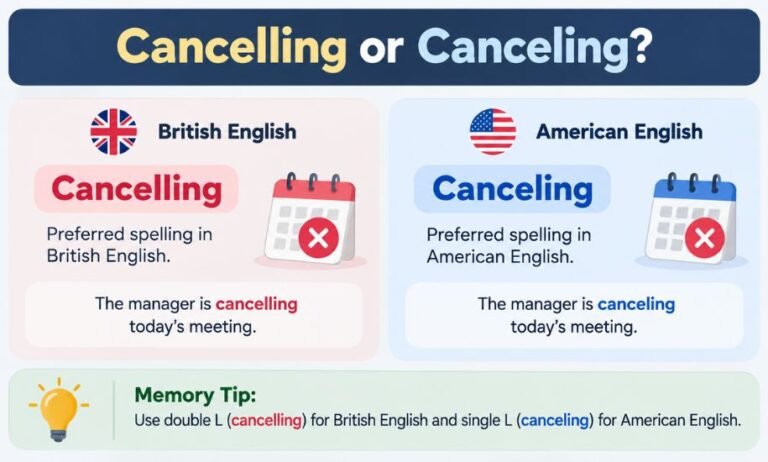
If you have ever hesitated between traveled and travelled, you are not alone. Both spellings are correct, but they belong to different varieties of English. The main difference is regional: traveled is the standard spelling in American English, while travelled is the standard spelling in British English and is also used in several other varieties that follow British spelling conventions. The same distinction appears in traveling and travelling. Once you know which form matches your intended audience, choosing the right spelling becomes simple.
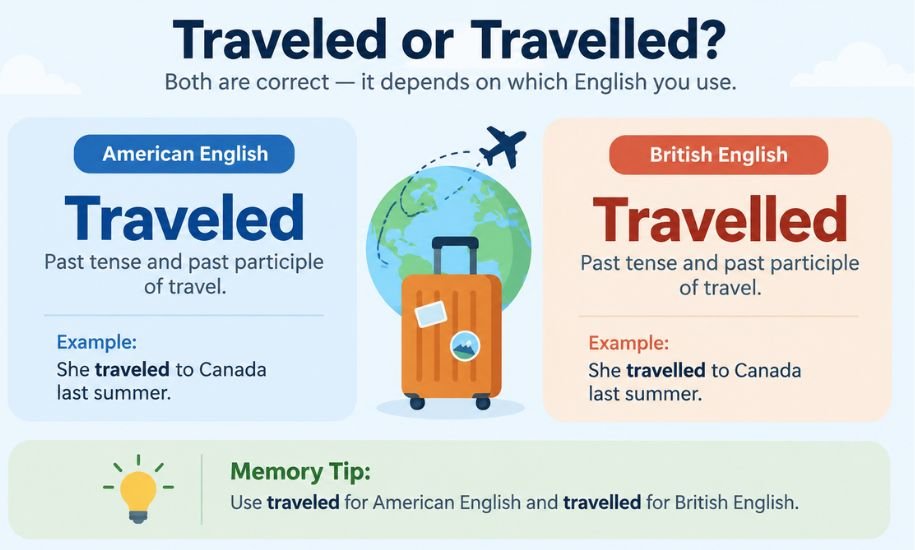
Traveled and travelled are both correct. “Traveled” is the usual American English spelling, while “travelled” is the usual British English spelling. They have the same meaning and grammatical function; the difference is simply the spelling convention you are following.
Traveled or Travelled: What’s the Difference?
The two forms are the past tense and past participle of the verb “travel.”
| Feature | Traveled | Travelled |
|---|---|---|
| Standard usage | American English | British English |
| Part of speech | Verb | Verb |
| Basic meaning | Went from one place to another | Went from one place to another |
| Past tense | Yes | Yes |
| Past participle | Yes | Yes |
| Present participle | traveling | travelling |
| Related noun | traveler | traveller |
The important point is that neither spelling changes the meaning of the word. The choice depends mainly on the variety of English being used.
American English
American English normally uses traveled:
We traveled across the country last summer.
She traveled to Boston for a conference.
British English
British English normally uses travelled:
We travelled across the country last summer.
She travelled to Manchester for a conference.
Both sentences communicate exactly the same idea.
What Does “Traveled” Mean?
Traveled is the past tense and past participle of travel in American English.
The verb travel means to move from one location to another, particularly when making a journey over some distance.
Examples:
- I traveled to California last year.
- They traveled by train through several states.
- She has traveled extensively for her job.
- We traveled abroad during the summer.
When writing for an American audience, traveled is normally the appropriate form.
It is also used in expressions such as:
- well-traveled
- traveled extensively
- traveled abroad
- traveled by train
For example:
He is a well-traveled writer who has visited more than 20 countries.
What Does “Travelled” Mean?
Travelled has the same meaning and grammatical role, but it is the conventional British English spelling.
Examples:
- I travelled to Scotland last year.
- They travelled by train.
- She has travelled extensively.
- We travelled throughout Europe.
British English also uses the double-l spelling in related forms such as travelling and traveller.
For example:
She is a frequent traveller who enjoys travelling by train.
So, if your document follows British spelling conventions, travelled is the natural choice.
Why Do American and British English Spell It Differently?
The difference comes from different spelling conventions for words ending in -l when suffixes are added.
American English generally uses:
- travel → traveled
- travel → traveling
- travel → traveler
British English generally uses:
- travel → travelled
- travel → travelling
- travel → traveller
This means the difference is not limited to one word. Once you identify the English variety being used, several related spellings follow the same pattern.
However, it is better to think of this as a regional spelling convention rather than a rule that makes one version universally correct and the other incorrect.
Travelling or Traveling: Which One Should You Use?
The same American-versus-British distinction applies to the present participle and gerund.
Traveling is standard in American English.
I enjoy traveling alone.
Travelling is standard in British English.
I enjoy travelling alone.
The forms can function as either a present participle or a gerund depending on the sentence.
Present participle
She is traveling around Europe.
She is travelling around Europe.
Gerund
Traveling can be an exciting experience.
Travelling can be an exciting experience.
Again, there is no difference in meaning. The spelling reflects the variety of English.
Traveled or Travelled in Example Sentences
Seeing the forms side by side makes the distinction easier to remember.
American English
James traveled to New York for the weekend.
We have traveled through several national parks.
Maria enjoys traveling by train.
He is an experienced traveler.
British English
James travelled to London for the weekend.
We have travelled through several national parks.
Maria enjoys travelling by train.
He is an experienced traveller.
Notice that the grammar and meaning remain the same. Only the spelling convention changes.
Traveled, Travelled, Traveling, and Travelling
These forms are related, so it can help to see them together.
| American English | British English |
|---|---|
| traveled | travelled |
| traveling | travelling |
| traveler | traveller |
| traveled extensively | travelled extensively |
| well-traveled | well-travelled |
If you choose American English, keep the American forms throughout your writing. If you choose British English, use the British forms consistently.
For example, mixing traveled with travelling in the same document may look inconsistent if there is no specific reason for the variation.
How to Choose the Right Spelling
The easiest approach is to consider your audience.
Writing for an American audience?
Use:
- traveled
- traveling
- traveler
Example:
The traveler traveled across the country while traveling between major cities.
Although that sentence is somewhat repetitive, the spelling illustrates the American convention.
Writing for a British audience?
Use:
- travelled
- travelling
- traveller
Example:
The traveller travelled across the country while travelling between major cities.
The same principle can be applied to other documents that follow British spelling conventions.
What if your audience is international?
Choose one spelling system and use it consistently. If your website follows American English, traveled and traveling are appropriate. If it follows British English, travelled and travelling are appropriate.
Consistency is generally more important than trying to mix regional conventions.
Common Mistakes to Avoid
1. Assuming “travelled” is always wrong
It is not. Travelled is the standard British spelling and is perfectly acceptable in writing that follows British English conventions.
2. Assuming “traveled” is always wrong
It is also not wrong. Traveled is the standard American spelling.
3. Mixing regional spellings unnecessarily
Using traveled, travelling, and traveller together can create an inconsistent style if you are otherwise following one variety of English.
4. Treating the two forms as different words
They are not different in meaning. The distinction is primarily one of regional spelling.
5. Confusing past and present forms
Remember that traveled/travelled are past-tense and past-participle forms, while traveling/travelling are present-participle or gerund forms.
For example:
She traveled to Rome last year.
but:
She is traveling to Rome this year.
An Easy Way to Remember the Difference
Think of the two spelling systems as pairs:
American English:
traveled → traveling → traveler
British English:
travelled → travelling → traveller
If your writing normally uses American spellings such as color, center, and favorite, then traveled will usually fit your style.
If you normally use British spellings such as colour, centre, and favourite, then travelled will usually be the better match.
The important thing is not to memorize the words separately. Remember the broader spelling system.
What About “What Travels Faster, Light or Sound?”
The phrase “what travels faster light or sound” belongs to a completely different topic. It is a physics question rather than a spelling or grammar question.
In that context, travels is simply the third-person singular present form of travel:
Light travels faster than sound.
The spelling comparison discussed in this article concerns traveled/travelled and their related forms, not scientific questions about how waves or energy move.
Likewise, questions about what travels through a food chain or food web are biology topics rather than English spelling questions. They should be treated separately rather than mixed into a discussion of regional spelling.
Frequently Asked Questions
Is “traveled” or “travelled” correct?
Both are correct. Traveled is the standard American English spelling, while travelled is the standard British English spelling. The meaning and grammatical function are the same.
Is “travelled” British or American?
Travelled is primarily associated with British English and other varieties that follow British spelling conventions. American English generally uses traveled with one “l.”
Is “traveling” or “travelling” correct?
Both spellings are accepted in their respective regional varieties. Traveling is standard American English, while travelling is standard British English.
Which is correct in American English: traveled or travelled?
Traveled is the usual American English spelling. For consistency, American English also generally uses traveling and traveler.
Which is correct in British English: traveled or travelled?
Travelled is the usual British English spelling. Related forms normally include travelling and traveller.
Can I use both spellings in the same article?
You can encounter both in an article, especially when quoting or discussing different regional varieties, but ordinary writing is usually clearer when you consistently follow one spelling convention.
Final Verdict: Traveled or Travelled?
There is no universal winner between traveled and travelled. Both are correct forms of the verb travel, with traveled used in American English and travelled used in British English. The same distinction applies to traveling/travelling and traveler/traveller. Choose the spelling that matches your intended variety of English and keep it consistent. For more clear, practical explanations of confusing English forms, Grammarifyr follows the simple principle: Know the Difference. Use the Right Words.
You may also Read : Flier or Flyer: Meaning and Correct Usage