Wack or Whack: Meaning, Difference, and Usage
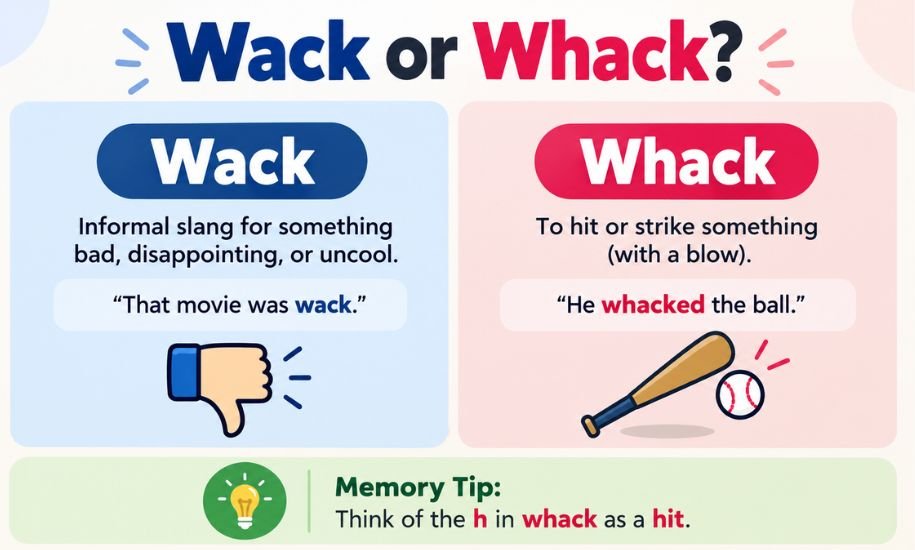
The words wack and whack sound exactly alike, but they have different meanings depending on how they are used. While wack is an informal slang term for something bad, disappointing, or uncool, whack usually refers to hitting something or giving it a sharp blow. However, both spellings can sometimes be used in slang to describe something as unpleasant or ridiculous. Understanding their meanings, examples, and common expressions can help you choose the right word in everyday writing and conversation.
Wack or Whack: What’s the Difference?
The main difference is how each word is used. Wack is generally an adjective in informal speech that expresses a negative opinion. Whack is primarily a verb or noun associated with hitting, striking, or a forceful blow.
| Feature | Wack | Whack |
|---|---|---|
| Meaning | Bad, disappointing, or uncool | To hit or strike |
| Part of speech | Mainly slang adjective | Verb and noun |
| Usage | Informal conversations and slang | Standard English and informal speech |
| Formal writing | Generally avoided | Acceptable when appropriate |
| Example | That movie was wack. | He gave the ball a whack. |
| Common expression | That’s wack! | Out of whack |
Although wack is the more familiar spelling for the slang meaning of bad or uncool, whack can also have this meaning in informal English. The intended meaning and context determine which spelling is appropriate.
What Does Wack Mean?
Wack is an informal slang word used to describe something that is bad, boring, ridiculous, disappointing, or of poor quality. It is particularly associated with American slang and hip-hop culture.
When someone calls something wack, they are usually expressing dissatisfaction or saying that they do not consider it interesting, impressive, or worthwhile.
Examples of wack in sentences:
- That new movie was wack. I expected a much better story.
- The food at the restaurant was wack, so we decided not to return.
- His excuse for missing the meeting sounds wack.
- I think the latest update to this game is wack.
- Cancelling the event at the last minute was a wack decision.
In these sentences, wack describes something negatively. It is common in casual conversations, text messages, social media posts, and informal dialogue.
The word is generally unsuitable for formal academic or professional writing. Depending on the context, alternatives such as poor, unreasonable, disappointing, unimpressive, or unsatisfactory may communicate the intended meaning more clearly.
What Does Whack Mean?
Whack is a standard English word that can function as both a verb and a noun. As a verb, it means to hit or strike something, often with a sudden or forceful movement. As a noun, it refers to a blow or the sound of a strike.
Whack as a Verb
When used as a verb, whack describes the action of hitting something.
Examples:
- He used a wooden stick to whack the ball across the field.
- She accidentally whacked her elbow against the table.
- The strong wind made the tree branches whack against the window.
- He whacked the dusty carpet to remove the dirt.
Whack as a Noun
As a noun, whack refers to a hit, blow, or forceful strike.
Examples:
- He gave the door a hard whack.
- I heard a loud whack coming from the garage.
- She took a whack at the ball but missed.
- The player delivered a powerful whack to the ball.
The word also appears in expressions such as have a whack at something, which means to attempt or try something.
For example: “I’ve never repaired a bicycle before, but I’ll have a whack at it.”
What Does “Out of Whack” Mean?
Out of whack is a common informal idiom that means something is not functioning correctly, is out of balance, or is not in its usual condition.
The expression can refer to schedules, machines, finances, expectations, routines, and other situations in which something is not as it should be.
Examples:
- My sleeping schedule is completely out of whack after the holidays.
- The computer system went out of whack following the software update.
- Our monthly budget is out of whack because of unexpected expenses.
- The car’s alignment seems to be out of whack.
- His expectations were out of whack with what the company could offer.
The established spelling is out of whack, not out of wack. Although the alternative may appear in informal writing, out of whack is the conventional form and is the one to use in standard English.
Is Wack or Whack Slang?
Both words can appear in slang, but wack is particularly associated with describing something as bad, uncool, or disappointing.
For example:
- That song is wack.
- This new fashion trend is wack.
- The rules of the competition are wack.
- That was a wack performance.
In these examples, wack communicates a negative judgment in a casual way.
Whack can also be used as slang for something bad, strange, or ridiculous. For instance, someone might say, “That idea is whack.” This informal meaning overlaps with wack, so the two spellings are not always completely separate in slang.
However, when describing a physical action, such as hitting a ball or striking a surface, whack is the standard spelling.
Wack or Whack When Describing Food
When describing food, wack is commonly used as informal slang to express disappointment with its taste, quality, or preparation.
Examples:
- This burger is wack. It has no flavour.
- The food at that restaurant was wack.
- I thought the dessert would be delicious, but it was wack.
- The meal was overpriced and wack.
In these examples, the speaker is expressing a personal opinion rather than describing a specific characteristic of the food.
By comparison, whack can refer to a physical action involving food or cooking, such as whacking a piece of dough or striking a surface with a utensil. The intended meaning determines the correct word.
Why Are Wack and Whack Confused?
The main reason these words are confused is that they are homophones. They have the same pronunciation but different spellings and common meanings.
Both words are pronounced with the same initial w sound and the same short vowel sound. The additional h in whack does not change its pronunciation in standard modern English.
Their meanings also overlap in informal slang. While wack is widely used to describe something as bad or uncool, whack can carry a similar meaning in certain casual contexts.
This overlap can make it difficult to determine which spelling to use, particularly in text messages and informal online conversations.
The easiest approach is to remember the main distinction: use whack for a hit or strike and wack when describing something as bad or uncool.
Common Mistakes to Avoid
Understanding the difference can help prevent spelling and usage errors.
| Incorrect or less suitable | Preferred form | Reason |
|---|---|---|
| My routine is out of wack. | My routine is out of whack. | Conventional idiom |
| He wacked the ball. | He whacked the ball. | Correct past-tense spelling |
| That movie was whack. | That movie was wack. | Preferred slang spelling |
| The machine is wack. | The machine is out of whack. | Clearer when describing a malfunction |
| The food was wack in a formal review. | The food was disappointing. | More suitable for formal writing |
It is worth noting that whack can also be used informally to mean bad or ridiculous. Therefore, describing something as whack is not necessarily grammatically incorrect. The table highlights the more conventional choices for each meaning.
Easy Way to Remember the Difference
A simple way to remember the distinction is to associate the h in whack with the action of hitting.
- Wack: Think of something that is bad, boring, or uncool.
- Whack: Think of a physical hit, strike, or blow.
For example, if you dislike a song, you can say, “This song is wack.” If someone hits a ball with a bat, you can say, “He gave the ball a whack.”
For the idiom, remember the fixed expression out of whack, which describes something that is out of order or balance.
Frequently Asked Questions
Is wack a real word?
Yes, wack is a recognized English slang word. It is used informally to describe something bad, disappointing, ridiculous, or uncool. Although it is not generally appropriate for formal writing, it is a valid choice in casual conversations, dialogue, and informal communication.
Is whack the correct spelling for hitting something?
Yes, whack is the standard spelling when referring to hitting or striking something. It can be used as both a verb and a noun. For example, “She whacked the ball” uses it as a verb, while “He gave the table a whack” uses it as a noun.
Does whack also mean bad?
Yes, whack can be used informally to mean bad, strange, ridiculous, or unsatisfactory. This slang meaning overlaps with wack. However, wack is a common spelling when expressing that something is uncool or of poor quality.
Should I write out of wack or out of whack?
The conventional spelling is out of whack. This idiom means something is not functioning properly, is unbalanced, or is not in its normal condition. For standard English writing, use out of whack.
Is wack appropriate for formal writing?
Generally, no. Wack is informal slang, so it is better suited to casual speech, text messages, creative dialogue, and social media. In professional or academic writing, use alternatives such as poor, unacceptable, unusual, or disappointing, depending on the intended meaning.
Final Verdict: Wack or Whack?
Both wack and whack are correct words, but they are most commonly used in different situations. Use wack to describe something bad, disappointing, or uncool in informal speech, and whack when referring to hitting, striking, or a forceful blow. Remember that out of whack is the established spelling of the idiom. Understanding these distinctions will help you choose the right word, and Grammarifyr is here to make confusing English words easier to understand and use correctly.
You may also Read : While or Awhile: Simple Grammar Rules Explained
One Comment