50+ Ways to Say You’re Welcome: Polite, Professional, Casual & Funny Alternatives
When someone says “thank you,” replying with “you’re welcome” is always correct, but it isn’t your only option. Depending on the situation, you might want to sound warmer, more professional, more relaxed, or simply more natural.
This guide explores useful ways to say you’re welcome, including polite expressions, workplace responses, casual phrases, text-message replies, and playful alternatives. The goal isn’t to replace “you’re welcome” every time, but to help you choose an expression that fits the conversation.
The Best Ways to Say You’re Welcome
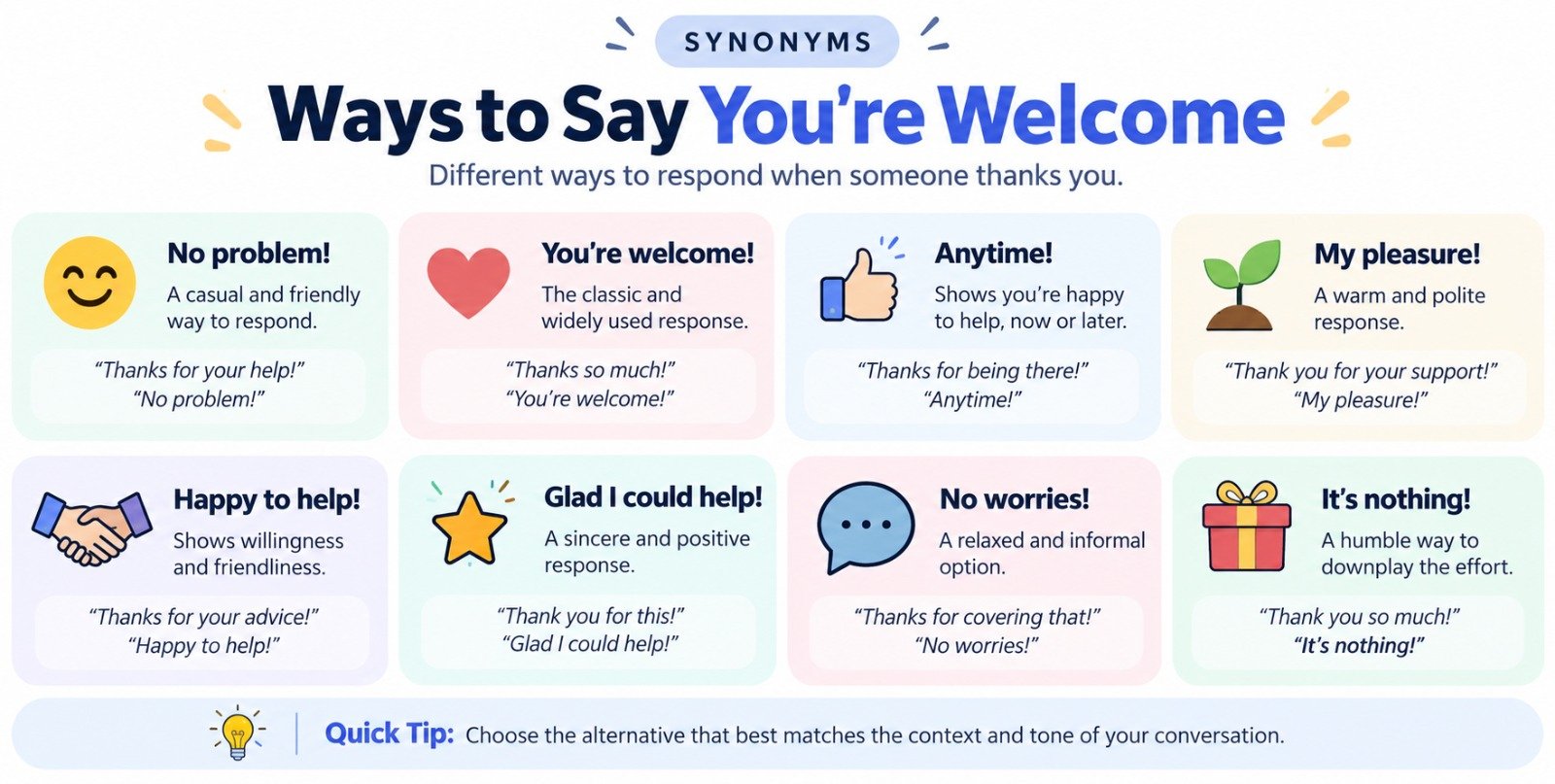
Here are some of the most useful alternatives, with their typical tone and context:
| Expression | Tone | Best Used For |
|---|---|---|
| My pleasure | Polite, warm | Professional and formal situations |
| No problem | Casual, neutral | Everyday conversations |
| No worries | Friendly, casual | Friends, coworkers, informal chats |
| Anytime | Warm, casual | Friends and people you know well |
| Of course | Natural, friendly | Everyday conversations |
| Happy to help | Warm, professional | Work and customer service |
| Glad I could help | Friendly | Work or personal situations |
| Don’t mention it | Polite, relaxed | Small favors |
| Not at all | Polite, somewhat formal | Formal or traditional situations |
| Sure thing | Casual | Friends and informal conversations |
| You got it | Informal, confident | Casual conversations |
| You bet | Friendly, informal | Casual American English |
| It was nothing | Humble, casual | Small favors |
| It’s my pleasure | Warm, formal | Professional communication |
| The pleasure is mine | Gracious, formal | Formal or appreciative exchanges |
Not every expression works in exactly the same situation. For example, “my pleasure” can sound polished in a business conversation, while “you bet” is much more relaxed. The best choice depends on the relationship and setting.
Other Ways to Say You’re Welcome
My Pleasure
“My pleasure” is one of the safest alternatives when you want to sound polite and genuinely happy to have helped.
Example:
“Thank you for staying late to help me.”
“My pleasure. I was happy to help.”
It works especially well in professional conversations, customer service, and situations where you want to show warmth without sounding overly casual.
No Problem
“No problem” is extremely common in everyday English. It tells the other person that helping them wasn’t an inconvenience.
Example:
“Thanks for picking me up.”
“No problem!”
It is natural with friends, family members, coworkers, and acquaintances. In very formal communication, however, “my pleasure” or “happy to help” may sound more polished.
No Worries
“No worries” is a friendly and relaxed response to thanks.
Example:
“Thanks for sending that file.”
“No worries!”
It is particularly natural in casual conversations and informal workplace communication.
Anytime
“Anytime” suggests that you’re happy to help again in the future.
Example:
“Thanks for helping me move.”
“Anytime!”
Because it has a warm, generous feeling, it works best when you actually have a friendly relationship with the person.
Of Course
“Of course” makes your help sound natural and expected rather than burdensome.
Example:
“Thanks for explaining that.”
“Of course!”
It can work in both casual and moderately professional conversations, although the surrounding conversation determines how formal it feels.
Happy to Help
“Happy to help” is a particularly useful professional alternative.
Example:
“Thanks for getting this report ready so quickly.”
“Happy to help.”
It communicates willingness and professionalism without being overly formal.
Glad I Could Help
This response focuses on the positive result of helping someone.
Example:
“Thank you for helping me solve the problem.”
“Glad I could help.”
It’s appropriate for coworkers, friends, clients, and everyday conversations.
Don’t Mention It
“Don’t mention it” means that the favor was small enough that the speaker doesn’t feel the need for thanks.
Example:
“Thanks for carrying my bag.”
“Don’t mention it.”
It sounds polite but somewhat traditional compared with expressions such as “no worries” or “no problem.”
Not at All
“Not at all” is a polite way of minimizing the effort involved in helping.
Example:
“Thank you for taking the time to explain everything.”
“Not at all.”
It can sound more formal or traditional than “no problem,” making it useful in polite conversations.
Sure Thing
“Sure thing” is an informal way to show that you’re happy to help.
Example:
“Thanks for grabbing me a coffee.”
“Sure thing!”
It’s best suited to relaxed conversations rather than formal business correspondence.
Professional Ways to Say You’re Welcome
In a workplace, email, meeting, or customer-service situation, the response should generally be courteous without becoming stiff.
It’s My Pleasure
“It’s my pleasure” is a polished version of “my pleasure.”
Example:
“Thank you for helping us with the project.”
“It’s my pleasure. I’m glad I could assist.”
Happy to Assist
“Happy to assist” has a professional tone and works particularly well when communicating with customers or clients.
Example:
“Thank you for resolving the issue so quickly.”
“Happy to assist. Please let me know if you need anything else.”
Glad to Be of Assistance
This is more formal than “happy to help.” It can be appropriate in customer service or formal professional communication.
Example:
“Thank you for your assistance.”
“Glad to be of assistance.”
Because it sounds quite formal, it may feel unnatural between close friends.
I’m Glad I Could Help
This is professional without sounding overly formal.
Example:
“Thank you for reviewing the proposal.”
“I’m glad I could help.”
It Was a Pleasure Helping You
This expression is warm and courteous, particularly after completing a task for a customer, colleague, or client.
Example:
“Thank you for helping us through the process.”
“It was a pleasure helping you.”
Casual and Friendly Ways to Say You’re Welcome
For friends, family, classmates, and informal conversations, you can use shorter and more relaxed expressions.
You Got It
“You got it” is an upbeat, informal response.
Example:
“Thanks for sending me the address.”
“You got it!”
You Bet
“You bet” is a casual expression commonly heard in American English.
Example:
“Thanks for helping me with the boxes.”
“You bet!”
It is friendly but informal, so it isn’t usually the best choice for a formal email.
It Was Nothing
“It was nothing” minimizes the effort you made.
Example:
“Thanks for fixing my bike.”
“It was nothing.”
Use it for relatively small favors. If you’ve made a major effort, saying “it was nothing” may sound as though you’re dismissing the other person’s appreciation.
No Sweat
“No sweat” is very informal and means that something wasn’t difficult or troublesome.
Example:
“Thanks for covering my shift.”
“No sweat!”
It’s best reserved for relaxed conversations.
All Good
“All good” is short and casual.
Example:
“Thanks for waiting for me.”
“All good!”
It works well in texts and informal spoken English.
Polite Ways to Say You’re Welcome
If you want to acknowledge someone’s thanks respectfully, these options are useful:
- My pleasure.
- You’re very welcome.
- Not at all.
- It was my pleasure.
- Don’t mention it.
- The pleasure is mine.
- Happy to help.
- I’m glad I could help.
- Glad to be of assistance.
- It was a pleasure.
You’re Very Welcome
“You’re very welcome” adds warmth and emphasis to the standard expression.
Example:
“Thank you so much for your advice.”
“You’re very welcome.”
It’s suitable in most polite situations.
The Pleasure Is Mine
“The pleasure is mine” is a gracious response that emphasizes that you enjoyed helping or participating.
Example:
“Thank you for joining us.”
“The pleasure is mine.”
It is more formal and elegant than everyday phrases such as “no problem.”
Ways to Say You’re Welcome in a Text
Text messages usually favor short, natural responses. Depending on your relationship, you could write:
- No worries!
- No problem!
- Anytime!
- Of course!
- Sure!
- Sure thing!
- You got it!
- Happy to help!
- All good!
- You bet!
- Don’t worry about it!
- Glad I could help!
Example:
Friend: “Thanks for picking up my package!”
You: “No worries!”
Or:
Coworker: “Thanks for sending that document.”
You: “Of course!”
For texting, there is usually no need to use a lengthy or highly formal response unless the situation calls for it.
Funny Ways to Say You’re Welcome
With close friends, a little humor can make your response more memorable. These aren’t formal substitutes, so use them only when the relationship makes the joke appropriate.
What Are Friends For?
This playful response suggests that helping a friend is simply part of being friends.
Example:
“Thanks for helping me move.”
“What are friends for?”
Anything for You!
This can sound affectionate or playful depending on the relationship.
Example:
“Thanks for bringing me coffee!”
“Anything for you!”
You Owe Me One!
This is a playful way to acknowledge a favor. It implies that the other person may return the favor someday.
Example:
“Thanks for covering for me.”
“You owe me one!”
Use this only when you’re clearly joking. It can sound demanding if the relationship or tone isn’t right.
No Applause Necessary
This humorous response exaggerates the importance of your favor.
Example:
“Thanks for fixing that for me.”
“No applause necessary!”
It’s best among friends or coworkers who appreciate playful humor.
Consider It Done
“Consider it done” is confident and can be playful when responding to a request that you’ve completed.
Example:
“Thanks for taking care of that.”
“Consider it done!”
It doesn’t exactly mean “you’re welcome,” but it can naturally acknowledge appreciation in the right context.
Creative Ways to Respond to “Thank You”
Sometimes you want your response to feel warmer without being overly formal. Try:
- Always happy to help.
- Glad I could make things easier.
- Anytime you need a hand.
- I was happy to do it.
- I’m glad it worked out.
- It was no trouble at all.
- I’m always happy to lend a hand.
- I’m pleased I could help.
- Happy I could make a difference.
- It was the least I could do.
Some of these expressions shift the focus slightly. For example, “it was the least I could do” communicates humility, while “anytime you need a hand” emphasizes future willingness to help.
Which Alternative Should You Choose?
The easiest way to choose among the different ways to say you’re welcome is to consider three things: who you’re talking to, how formal the situation is, and what feeling you want to communicate.
For a friend, “no worries,” “anytime,” or “you got it” will usually sound natural.
For a coworker, “happy to help,” “of course,” or “glad I could help” works well.
For a customer or client, “my pleasure,” “happy to assist,” or “it was a pleasure helping you” is more appropriate.
For a formal email, choose a polished phrase such as “my pleasure” or “I’m glad I could assist.”
For a close friend, a humorous response such as “what are friends for?” can make the exchange more personal.
“No Problem” vs. “My Pleasure”
These two expressions are both common, but they create different impressions.
“No problem” is relaxed and tells the person that their request wasn’t an inconvenience.
“My pleasure” is warmer and more polished. It emphasizes that you were happy to help.
Compare:
“Thanks for helping me with my homework.”
“No problem!”
This sounds casual and natural.
“Thank you for your assistance with the project.”
“My pleasure.”
This sounds more professional.
Neither expression is universally better. The situation determines which one fits.
“No Worries” vs. “You’re Welcome”
“No worries” is more casual than “you’re welcome.” It often makes the conversation feel relaxed and friendly.
Example:
“Thanks for waiting for me.”
“No worries!”
“You’re welcome,” meanwhile, is neutral and works in almost any setting.
If you’re unsure what to say, “you’re welcome” remains a perfectly good choice.
Common Mistakes to Avoid
Not every alternative should be used in every situation.
“No sweat” can sound too casual in a formal business email.
“You bet” is friendly but informal and may not suit every variety of English or professional setting.
“You owe me one” is playful, but it can sound demanding if the relationship doesn’t support the joke.
“It was nothing” works better for small favors than significant acts of assistance.
“My pleasure” is polite and versatile, but it may sound more formal than necessary in a very casual conversation.
Choosing the right expression is less about finding a perfect synonym and more about matching your words to the relationship and situation.
Frequently Asked Questions
What are other ways to say you’re welcome?
Common alternatives include my pleasure, no problem, no worries, anytime, of course, happy to help, glad I could help, don’t mention it, not at all, and sure thing. The best option depends on the level of formality.
What are different ways to say you’re welcome professionally?
For professional communication, try my pleasure, happy to assist, glad I could help, it was a pleasure helping you, or glad to be of assistance. These expressions are generally more polished than highly casual options.
What can I say instead of “you’re welcome” to a friend?
With a friend, natural choices include no worries, no problem, anytime, of course, you got it, sure thing, and you bet. A playful response such as “what are friends for?” can also work.
Is “my pleasure” a good way to say you’re welcome?
Yes. “My pleasure” is a polite and warm response that works particularly well in professional, customer-service, and formal situations. It communicates that you were happy to help.
Is “no problem” rude when someone says thank you?
Usually, no. “No problem” is a common and friendly response. However, some people may prefer “my pleasure” or “happy to help” in formal or customer-facing situations because these phrases sound more positive and polished.
What is a casual way to say you’re welcome?
No worries, no problem, anytime, sure thing, you got it, and you bet are all casual options. Choose according to your relationship and the style of conversation.
What is a good way to say you’re welcome in a text?
Keep it short. No worries!, Anytime!, Of course!, Sure thing!, Happy to help!, and You got it! are natural text-message responses.
What is a funny way to say you’re welcome?
For a close friend, you could say “What are friends for?”, “Anything for you!”, “You owe me one!”, or “No applause necessary!” These are playful rather than formal expressions, so context matters.
Is “anytime” the same as “you’re welcome”?
Not exactly. “Anytime” suggests that you’re willing to help again in the future, while “you’re welcome” is a straightforward acknowledgment of thanks. They often work in the same conversational situation, but their emphasis is slightly different.
Final Thoughts
There are plenty of ways to say you’re welcome, but the best response isn’t necessarily the most unusual one. A simple “no worries” may be perfect for a friend, while “my pleasure” can be better for a client. In other situations, “happy to help,” “of course,” or “glad I could help” may sound more natural.
Think about the audience, relationship, setting, and tone before choosing your words. That small adjustment can make your English sound much more natural. Grammarifyr focuses on exactly these everyday wording choices, helping you choose expressions that fit the situation instead of relying on the same phrase every time.
You may also Read : Ways to Say Thank You in Spanish: 20+ Natural Expressions for Every Situation