Different Ways to Say Goodbye: 100+ Casual, Formal & Funny Farewell Phrases
Saying “goodbye” is simple, but it isn’t always the best choice for every situation. You might want something warmer for a close friend, more professional for a coworker, or more playful when you’re joking around. Knowing different ways to say goodbye helps you match your words to the relationship, setting, and mood.
From everyday expressions like “See you later” to playful lines like “See you later, alligator,” there are plenty of natural options. The key is knowing when each one sounds appropriate.
QUICK ANSWER
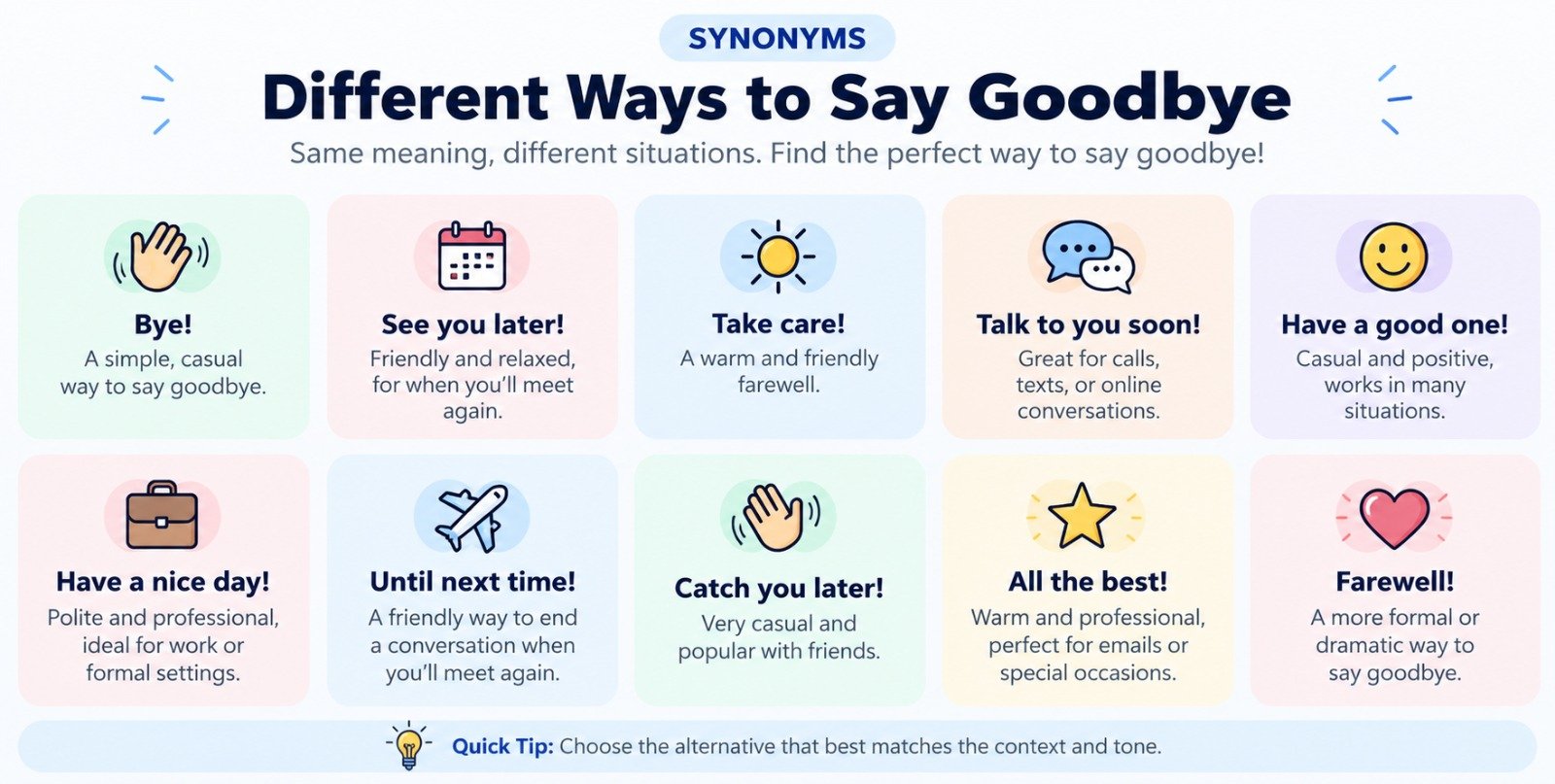
Some useful ways to say goodbye include “See you later,” “Take care,” “Have a good one,” “Talk to you soon,” “Farewell,” “Catch you later,” and “Until next time.” Choose based on the situation: casual phrases work well with friends, while polite or formal expressions are better for professional and unfamiliar settings.
Quick Comparison: Which Goodbye Fits Best?
| Goodbye Expression | Tone | Best Used For |
|---|---|---|
| Bye! | Casual | Friends, family, everyday conversations |
| See you later! | Friendly | People you expect to see again |
| Take care! | Warm | Friends, coworkers, acquaintances |
| Talk to you soon! | Friendly | Calls, texts, online conversations |
| Have a good one! | Casual | Friends and coworkers |
| Have a nice day! | Polite | Customers, coworkers, acquaintances |
| Until next time! | Warm | Friends, groups, recurring meetings |
| Farewell! | Formal/dramatic | Ceremonies, writing, dramatic situations |
| Catch you later! | Very casual | Friends and close coworkers |
| All the best! | Polite/warm | Emails and professional situations |
What Are Different Ways to Say Goodbye?
There isn’t one perfect replacement for “goodbye.” English has expressions that communicate different feelings.
For example, “Bye” is a simple everyday farewell, while “Take care” adds a little warmth. “Farewell” sounds considerably more formal or dramatic, and “See you later” suggests that you expect another meeting.
This distinction matters because a phrase can be grammatically correct but still sound unusual in a particular situation.
For everyday conversations, natural expressions are usually short and relaxed. In professional communication, slightly more polished wording may be preferable.
Common Ways to Say Goodbye
These are some of the most natural options for everyday English:
1. Bye!
“Bye!” is probably the simplest casual alternative to “goodbye.” It works in countless everyday situations.
Example:
“Thanks for coming over. Bye!”
2. See you!
“See you!” is friendly and suggests that you’ll meet again.
Example:
“I’m heading home now. See you tomorrow!”
3. See you later!
This is a relaxed way to leave a conversation when you expect to see the person again.
Example:
“I’ve got a meeting now. See you later!”
4. See you soon!
Use this when you expect to meet the person again relatively soon.
Example:
“Have a safe trip. See you soon!”
5. Take care!
“Take care!” adds warmth and concern. It can work with friends, relatives, coworkers, and acquaintances.
Example:
“Thanks for your help today. Take care!”
6. Talk to you later!
This is especially natural when you’ll speak to the person again rather than necessarily meet them face-to-face.
Example:
“I need to finish this report. Talk to you later!”
7. Talk to you soon!
This is a friendly choice for phone calls, texts, and online conversations.
Example:
“It was great catching up. Talk to you soon!”
8. Have a good day!
A polite, neutral farewell that works in many everyday situations.
Example:
“Thanks for stopping by. Have a good day!”
9. Have a good one!
This is casual and conversational. “One” usually refers to the day, evening, weekend, or another period understood from context.
Example:
“I’m heading out. Have a good one!”
10. Until next time!
This has a warm, slightly more memorable feel and works when another meeting is expected.
Example:
“Thanks for joining us, everyone. Until next time!”
Other Ways to Say Goodbye Casually
When you’re talking with friends or people you know well, you don’t always need to use a traditional farewell.
Here are some relaxed choices:
- Catch you later!
- Later!
- See ya!
- I’m off!
- I’m heading out.
- I’ve got to go.
- I’ve got to run.
- I should get going.
- See you around!
- Catch you soon.
- Talk later!
- I’ll see you.
- Until next time!
- Take it easy!
- Have a good one!
- I’m out of here!
- Gotta go!
- See you on the flip side!
“I’ve got to run” doesn’t literally mean that you’re going to run. It’s an informal way of saying that you need to leave.
Example:
“Sorry, I’ve got to run. I’ll call you tonight.”
Other Ways to Say “Bye” in a Friendly Conversation
If you want something short and natural, try:
- See you!
- Later!
- See ya!
- Take care!
- Catch you later!
- Talk soon!
- Until next time!
- Have a good one!
- Take it easy!
These are generally better suited to spoken or informal communication than formal business writing.
Funny Ways to Say Goodbye
Sometimes a standard “bye” feels too boring. With close friends, playful or humorous farewells can make the ending of a conversation more memorable.
1. See you later, alligator!
This classic rhyming expression is playful and familiar.
Example:
“I’m heading home. See you later, alligator!”
A traditional response is “In a while, crocodile,” which continues the rhyme.
2. In a while, crocodile!
This is usually used as the playful response to “See you later, alligator.”
3. Later, skater!
A silly rhyming farewell that works best among friends.
4. Catch you on the flip side!
This informal expression has a playful, retro feel and means you’ll speak to or see the person again.
5. Peace out!
“Peace out” is highly informal. It can sound humorous or relaxed, especially among friends.
Example:
“That’s everything from me. Peace out!”
6. Smell you later!
This intentionally silly expression is usually used jokingly rather than literally.
7. Gotta bounce!
A very casual way to say you need to leave.
Example:
“This was fun, but I gotta bounce.”
8. I’m outta here!
A playful, informal announcement that you’re leaving.
Example:
“It’s getting late. I’m outta here!”
9. Adios!
“Adios” is Spanish for goodbye, but English speakers sometimes use it jokingly or casually. In English conversation, it can have a playful or theatrical quality.
10. May the force be with you!
This is a pop-culture reference that can be used humorously with someone who understands the reference. It isn’t a standard replacement for “goodbye,” so context matters.
Other Funny Farewell Ideas
You can also use creative lines such as:
- Until we meet again!
- Don’t be a stranger!
- Keep in touch!
- Stay out of trouble!
- Don’t forget me!
- I’m disappearing!
- Time for me to vanish!
- See you in the next episode!
- That’s my cue to leave.
- And with that, I’m gone!
- Mission accomplished. I’m leaving!
- I’m making my grand exit.
- I’ll leave you to your adventures.
- The time has come for my dramatic departure.
These are creative farewells rather than direct synonyms for “goodbye.” Their humor depends heavily on your relationship with the listener.
Polite Ways to Say Goodbye
A polite farewell is useful when you’re speaking with someone you don’t know well, meeting a customer, leaving a social event, or ending a respectful conversation.
Consider:
- Have a nice day.
- Have a pleasant evening.
- Take care.
- All the best.
- It was nice seeing you.
- It was lovely speaking with you.
- I hope you have a wonderful day.
- Until next time.
- Enjoy the rest of your day.
- I hope to see you again soon.
Example:
“It was lovely speaking with you. I hope you have a pleasant evening.”
Formal Ways to Say Goodbye
Some situations call for more formal wording. This is particularly true in professional correspondence, ceremonies, official announcements, and situations involving a significant separation.
Farewell
“Farewell” is a genuine alternative, but it isn’t usually the most natural choice for an ordinary workplace conversation. It can sound formal, literary, old-fashioned, or dramatic.
Example:
“We bid farewell to our retiring director.”
All the Best
“All the best” is warm but professional enough for many emails and written messages.
Example:
“Thank you again for your support. All the best.”
Wishing You All the Best
This is useful when someone is leaving a job, moving away, or beginning a new stage of life.
Example:
“Wishing you all the best in your new role.”
It Was a Pleasure Speaking With You
This works well when ending a professional conversation.
Example:
“It was a pleasure speaking with you. I look forward to working together.”
I Look Forward to Speaking With You Again
This is particularly useful when the conversation will continue at a later date.
Example:
“Thank you for your time. I look forward to speaking with you again.”
Professional Ways to Say Goodbye at Work
Workplace farewells need a little more awareness of hierarchy and relationship.
With a coworker you’re friendly with, you can say:
“Have a good evening. See you tomorrow!”
With a client or business contact, something more polished may work better:
“Thank you for your time. I hope you have a great afternoon.”
When someone is leaving the company, a warmer message is appropriate:
“It’s been great working with you. Wishing you all the best in your next chapter.”
Avoid overly playful expressions such as “Smell you later!” in professional communication unless you know the workplace culture very well.
Ways to Say Goodbye to a Friend
Friends give you more freedom to be casual, affectionate, or funny.
Some natural choices include:
- See you soon!
- Catch you later!
- Take care!
- Talk soon!
- Later!
- Have a good one!
- See you around!
- Don’t be a stranger!
- Keep in touch!
- Stay safe!
- Take it easy!
- Catch you next time!
For a close friend, even a simple “Take care” can sound warmer than a plain “bye.”
Example:
“Thanks for hanging out today. Take care, and text me when you get home.”
Ways to Say Goodbye in a Text Message
Text messages usually favor short expressions.
Try:
- Talk soon!
- See you soon!
- Catch you later!
- Take care!
- Have a good night!
- Sleep well!
- Talk tomorrow!
- See you then!
- Later!
- Have a good one!
- Goodnight!
- Take it easy!
The right choice depends on what you’re doing next. “Talk soon” suggests another conversation, while “See you tomorrow” specifically indicates another meeting.
Heartfelt Ways to Say Goodbye
When you’re saying goodbye because someone is moving away, changing jobs, ending a chapter, or leaving for a long time, ordinary expressions may feel too brief.
You might say:
- I’ll miss you.
- Take care of yourself.
- I wish you all the best.
- It was wonderful knowing you.
- I hope our paths cross again.
- Stay in touch.
- I’ll always remember our time together.
- Wishing you happiness in your next chapter.
- Until we meet again.
- I hope to see you again someday.
These aren’t all direct synonyms for “goodbye.” Instead, they add emotion and explain why the farewell matters.
Creative Ways to Say Goodbye
Creative farewells are useful when you want your message to stand out.
You could say:
- Until our next adventure!
- See you on the other side!
- Until the next chapter!
- Time for my exit!
- I’ll see you around.
- Until our paths cross again.
- That’s a wrap for me!
- I’m signing off.
- See you in the next chapter.
- Until we meet again!
The best creative expression depends on the situation. “That’s a wrap” works especially well when you’re joking about finishing an activity or project, while “Until our paths cross again” has a more sentimental tone.
Goodbye Expressions That Are Not Always Interchangeable
Although people often group these expressions together, they don’t all communicate exactly the same thing.
“See you later” suggests another meeting or interaction.
“Talk to you later” usually suggests another conversation.
“Take care” expresses goodwill or concern.
“Farewell” can imply a more significant or final departure.
“Have a good day” focuses more on wishing someone well than on the act of leaving.
“Catch you later” is highly informal and generally belongs in relaxed conversations.
Understanding these differences makes your English sound more natural than simply replacing “goodbye” with any phrase from a synonym list.
How to Choose the Right Goodbye
Think about four things before choosing your expression:
Your Relationship
A close friend gives you much more freedom to say “Peace out!” or “Later!” than a customer or manager.
The Setting
A casual goodbye works at a coffee shop, but a business email usually needs something more polished.
The Expected Next Contact
Use “See you tomorrow” when you know you’ll meet tomorrow. Use “Talk to you soon” when another conversation is expected.
The Emotion
For an ordinary departure, “Bye!” is enough. For an emotional separation, “I’ll miss you” or “I wish you all the best” communicates much more.
Frequently Asked Questions
What are some different ways to say goodbye?
Some natural options are “Bye,” “See you,” “See you later,” “Take care,” “Talk to you soon,” “Have a good one,” “Until next time,” and “All the best.” The best choice depends on the situation and your relationship with the person.
What is a casual way to say goodbye?
“Later,” “See ya,” “Catch you later,” “Take it easy,” and “Gotta go” are casual options. They’re most appropriate for friends, family, and people you know well.
What are some funny ways to say goodbye?
Funny choices include “See you later, alligator,” “In a while, crocodile,” “Later, skater,” “Peace out,” “Gotta bounce,” and “Smell you later.” Some are intentionally silly, so they’re best reserved for informal conversations.
What is a professional way to say goodbye?
For professional situations, you can use “Have a great day,” “It was a pleasure speaking with you,” “All the best,” “I look forward to speaking with you again,” or “Wishing you all the best.”
Is “farewell” more formal than “goodbye”?
Usually, yes. “Farewell” can sound formal, literary, old-fashioned, or dramatic. “Goodbye” is much more neutral and works in ordinary situations.
Can I use “take care” instead of “goodbye”?
Yes. “Take care” is a natural and friendly farewell. It adds a sense of goodwill and works particularly well with friends, relatives, coworkers, and acquaintances.
What is a good way to say goodbye in a text?
“Talk soon,” “See you soon,” “Take care,” “Have a good night,” and “Catch you later” are natural text-message options. Choose one that matches the relationship and what you expect to happen next.
What is a good goodbye for someone leaving a job?
For a departing coworker, “It’s been great working with you,” “Wishing you all the best,” or “Good luck in your new role” can sound warmer and more meaningful than simply saying “goodbye.”
Final Thoughts
There are plenty of different ways to say goodbye, but the best expression isn’t necessarily the most unusual one. A simple “See you later” can be perfect with a friend, while “All the best” may suit a professional email. If you’re joking with someone close to you, a funny farewell can make the conversation more memorable.
The most natural choice comes down to context, relationship, tone, and formality. Once you understand those differences, choosing the right farewell becomes much easier. That attention to small wording choices is exactly what Grammarifyr is about: helping you choose language that fits the moment.
You may also Read : Cute Ways to Say Goodnight: Sweet, Funny & Adorable Messages
One Comment