30 Ways to Say Sorry for Your Loss: Heartfelt Alternatives for Every Situation
Losing someone you love is painful, and finding the right words for someone who is grieving can feel difficult. While “I’m sorry for your loss” is a kind and familiar expression, you may sometimes want something more personal or meaningful. These ways to say sorry for your loss offer thoughtful alternatives for texts, sympathy cards, conversations, friends, family members, and coworkers.
Other Ways to Say Sorry for Your Loss
Not every condolence expression has exactly the same meaning or emotional weight. Some are formal, some are warm and personal, and others are better suited to a short text message.
Here are some natural alternatives:
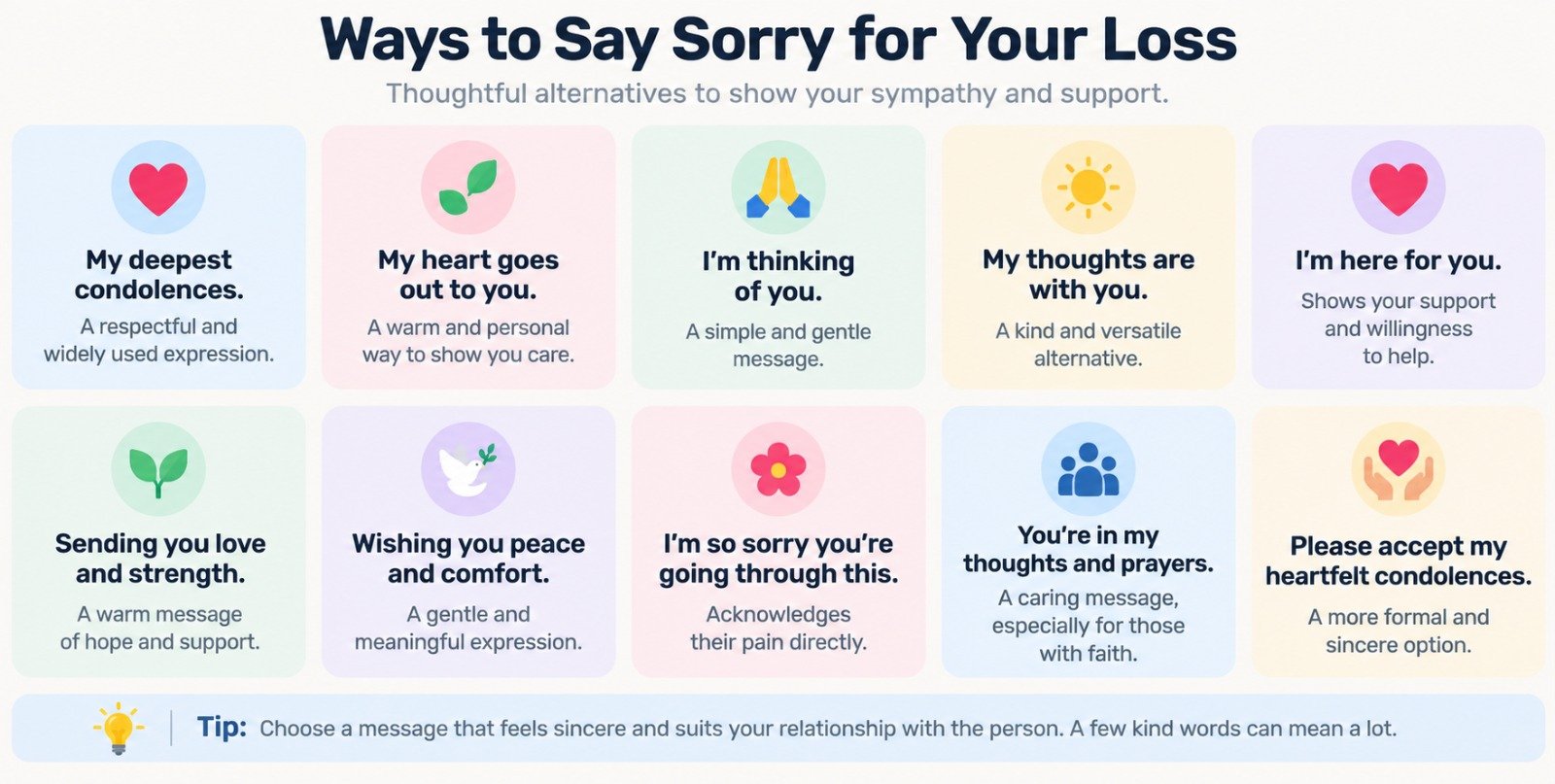
1. My Deepest Condolences
“My deepest condolences” is a respectful and widely appropriate alternative. It works well in sympathy cards, conversations, emails, and messages.
Example:
“My deepest condolences to you and your family during this difficult time.”
2. My Heart Goes Out to You
This sounds warmer and more personal than a traditional condolence. It works especially well when speaking to a friend or someone you know well.
Example:
“My heart goes out to you and your family. I’m so sorry you’re going through this.”
3. I’m Thinking of You
This is simple, gentle, and appropriate when you do not want to use formal language.
Example:
“I just wanted you to know that I’m thinking of you and your family.”
4. My Thoughts Are With You
A thoughtful choice for both personal and professional situations.
Example:
“My thoughts are with you and your family as you navigate this difficult time.”
5. I’m Here for You
This expression shifts the focus from sympathy to support. It is particularly meaningful when you genuinely intend to be available.
Example:
“I’m here for you, whenever you need someone to talk to.”
6. Sending You Love and Strength
This is warm and compassionate, making it especially suitable for close friends and relatives.
Example:
“Sending you love and strength as you remember and honor your loved one.”
7. Wishing You Peace and Comfort
This offers a gentle sentiment without assuming how the person should feel.
Example:
“Wishing you peace and comfort in the days ahead.”
8. I’m So Sorry You’re Going Through This
Rather than focusing only on the death, this recognizes the person’s current pain.
Example:
“I’m so sorry you’re going through this. Please know that I’m thinking of you.”
9. Please Accept My Heartfelt Condolences
This is a more formal version that works particularly well in written communication.
Example:
“Please accept my heartfelt condolences following the loss of your mother.”
10. I’m Keeping You in My Thoughts
A gentle expression that works in both personal messages and sympathy cards.
Example:
“I’m keeping you and your family in my thoughts during this difficult time.”
Comparison of Condolence Expressions
| Expression | Tone | Best Used For | Formality |
|---|---|---|---|
| My deepest condolences | Respectful | Cards, messages, acquaintances | Formal |
| My heart goes out to you | Warm | Friends and family | Neutral |
| I’m thinking of you | Gentle | Friends, coworkers, acquaintances | Neutral |
| My thoughts are with you | Compassionate | Most situations | Neutral |
| I’m here for you | Supportive | Close friends and family | Casual |
| Sending you love and strength | Warm | Close relationships | Casual |
| Wishing you peace and comfort | Gentle | Cards and messages | Neutral |
| Please accept my heartfelt condolences | Respectful | Professional or formal situations | Formal |
| I’m so sorry you’re going through this | Personal | Friends and relatives | Neutral |
| You’re in my thoughts and prayers | Caring | People comfortable with religious wording | Neutral/Formal |
Heartfelt Ways to Say Sorry for Your Loss
When someone close to you loses a loved one, a generic phrase may not fully express what you feel. A more personal message can acknowledge the person’s grief while offering genuine support.
11. I’m Holding You Close in My Thoughts
This has a tender, personal tone without being overly elaborate.
Example:
“I’m holding you close in my thoughts and sending you so much love.”
12. I Wish I Had the Right Words
Sometimes honesty is more comforting than trying to find a perfect phrase.
Example:
“I wish I had the right words to ease your pain, but please know how much I care.”
13. I’m Sending You My Love During This Difficult Time
This works well for someone you know personally and want to comfort from a distance.
Example:
“I’m sending you my love and hoping you find comfort in the memories you shared.”
14. Your Family Is in My Thoughts
A useful expression when the loss affects an entire family.
Example:
“Your family is in my thoughts, and I’m wishing you all strength and comfort.”
15. I’ll Always Remember Them Fondly
This becomes especially meaningful when you also knew the person who died.
Example:
“I’ll always remember Sarah fondly. She brought so much warmth to everyone around her.”
16. Their Memory Will Stay With Us
This can be appropriate when you want to recognize the lasting impact of the deceased person.
Example:
“His kindness touched so many people, and his memory will stay with us.”
Another Way to Say Sorry for Your Loss to a Friend
With a close friend, you can usually be less formal. Your message should sound like something you would genuinely say rather than something copied from a sympathy card.
17. I’m So Sorry, My Friend
Short, sincere, and natural.
Example:
“I’m so sorry, my friend. I’m here for you, whatever you need.”
18. I’m With You Through This
This emphasizes companionship rather than trying to explain the grief.
Example:
“You don’t have to go through this alone. I’m with you through this.”
19. Take All the Time You Need
This can reassure someone that they do not have to rush their grieving process.
Example:
“Take all the time you need. There’s no need to respond—I just want you to know I’m here.”
20. I’m Just a Call Away
A practical expression of availability.
Example:
“Whenever you need someone, I’m just a call away.”
Professional and Formal Alternatives
If a colleague, client, manager, or professional acquaintance has experienced a bereavement, keep the message respectful and sincere.
21. Please Accept My Sincere Condolences
This is appropriate for formal correspondence.
Example:
“Please accept my sincere condolences to you and your family.”
22. I Was Saddened to Hear of Your Loss
This works well in a professional email or card.
Example:
“I was saddened to hear of your loss. Please accept my sincere condolences.”
23. My Sincere Sympathies Are With You
A respectful option for someone you may not know particularly well.
Example:
“My sincere sympathies are with you and your family at this difficult time.”
24. Wishing You and Your Family Comfort
This keeps the message compassionate while remaining appropriate for professional relationships.
Example:
“Wishing you and your family comfort and peace in the days ahead.”
Short Ways to Say Sorry for Your Loss in a Text
A text message does not need to be long. In fact, a short and sincere message may be more appropriate when someone is grieving.
25. Thinking of You
Example:
“Thinking of you and your family today.”
26. Sending You Strength
Example:
“Sending you strength and love. I’m here if you need me.”
27. My Sincere Condolences
Example:
“My sincere condolences to you and your family.”
28. Sending Love Your Way
Example:
“Sending love your way. Take care of yourself.”
29. I’m Here Whenever You Need Me
Example:
“I’m here whenever you need me. No need to reply.”
30. Keeping You in My Thoughts
Example:
“Keeping you and your family in my thoughts.”
How to Make a Condolence Message More Personal
Sometimes the best other ways to say sorry for your loss are not complicated at all. A short personal detail can make a message feel much more genuine.
If you knew the person who died, consider mentioning a positive memory.
Instead of:
“I’m sorry for your loss.”
Try:
“I’m so sorry. I’ll always remember your dad’s incredible sense of humor. He could make everyone in the room laugh.”
You can also offer specific help rather than simply saying, “Let me know if you need anything.”
For example:
“I’m thinking of you. I can bring dinner over tomorrow if that would make things a little easier.”
Specific offers are often more useful because a grieving person may not have the energy to figure out what to ask for.
What to Say Instead of “Sorry for Your Loss” in Different Situations
The relationship should guide your wording.
To a close friend:
“I’m here for you through all of this. You don’t have to face it alone.”
To a coworker:
“I was very sorry to hear about your loss. My thoughts are with you and your family.”
To a family member:
“I’m so sorry. I’m thinking of you and sending you all my love.”
In a sympathy card:
“Please accept my heartfelt condolences. Wishing you peace and comfort in the days ahead.”
In a text message:
“Thinking of you. I’m here whenever you need me.”
When “I’m Sorry for Your Loss” Is Still the Best Choice
You do not always need to find an alternative. “I’m sorry for your loss” is simple, respectful, and widely understood.
If you are speaking to someone you do not know well, it can actually be safer than trying to sound unusually personal. A sincere delivery matters more than finding a complicated expression.
You can also combine the traditional phrase with a personal statement:
“I’m so sorry for your loss. Your mother was such a kind person, and I’ll always remember her warmth.”
This gives you the familiarity of the traditional condolence while making the message more personal.
What to Avoid Saying to Someone Who Is Grieving
Even well-intentioned words can sometimes cause discomfort. Avoid phrases that minimize grief or tell someone how they should feel.
Be cautious with statements such as:
- “Everything happens for a reason.”
- “At least they lived a long life.”
- “You need to stay strong.”
- “I know exactly how you feel.”
- “They’re in a better place,” unless you know the person’s beliefs.
- “You’ll get over it soon.”
Instead, acknowledge the person’s pain without trying to explain it away.
A simple “I’m here for you” can often be more helpful than an attempt to provide an explanation for their loss.
How to Choose the Right Condolence Expression
The best phrase depends on four things: your relationship, the setting, the person’s beliefs, and how personal you want to be.
For a professional contact, choose something respectful such as “Please accept my sincere condolences.” For a close friend, “My heart goes out to you” or “I’m here for you” can sound more natural. For a text, a short message such as “Thinking of you” may be enough.
Most importantly, don’t feel pressured to create the perfect sentence. Genuine compassion matters more than sophisticated wording.
Frequently Asked Questions
What is another way to say “sorry for your loss”?
Some natural alternatives include “My deepest condolences,” “My heart goes out to you,” “I’m thinking of you,” “My thoughts are with you,” and “I’m here for you.” Choose the expression according to your relationship and the situation.
What are some heartfelt ways to say sorry for your loss?
You could say, “My heart goes out to you,” “I’m holding you close in my thoughts,” “I’m sending you love and strength,” or “I wish I had the right words to ease your pain.” A personal memory can make the message even more meaningful.
What can I say instead of “sorry for your loss” to a friend?
With a close friend, try something more personal, such as “I’m here for you through this,” “You don’t have to go through this alone,” or “I’m just a call away whenever you need me.”
What is a respectful condolence message for a coworker?
For a coworker, keep the wording sincere and professional. For example: “I was saddened to hear about your loss. Please accept my sincere condolences to you and your family.”
What should I say in a sympathy text?
Keep it short and genuine. “Thinking of you and your family. I’m here whenever you need me” is a warm option that does not require the person to respond.
Is “I’m sorry for your loss” appropriate?
Yes. “I’m sorry for your loss” is a conventional and respectful expression of sympathy. You do not need to replace it simply because you have heard it many times. Adding a personal message can make it feel more sincere.
Should I mention the person who died?
If you knew the deceased or know their name, mentioning them can make your message more personal. A brief, positive memory can be particularly meaningful, as long as it feels appropriate.
Is it okay to say “I’m here for you”?
Yes, especially when you genuinely mean that you are available to provide emotional or practical support. If possible, consider offering specific help rather than making only a general promise.
Final Thoughts
There is no single perfect condolence phrase. “My deepest condolences” may suit a formal message, while “My heart goes out to you” can feel warmer with a friend. In many situations, the most meaningful approach is to combine a simple expression of sympathy with a personal memory or a genuine offer of support.
Choosing compassionate words is easier when you consider the relationship, setting, and emotional needs of the person who is grieving. That attention to context is exactly what Grammarifyr is about: helping you understand small differences in wording so your message says what you truly mean.
You may also Read : 5 Ways to Say Sorry in Spanish: Natural Apologies for Every Situation