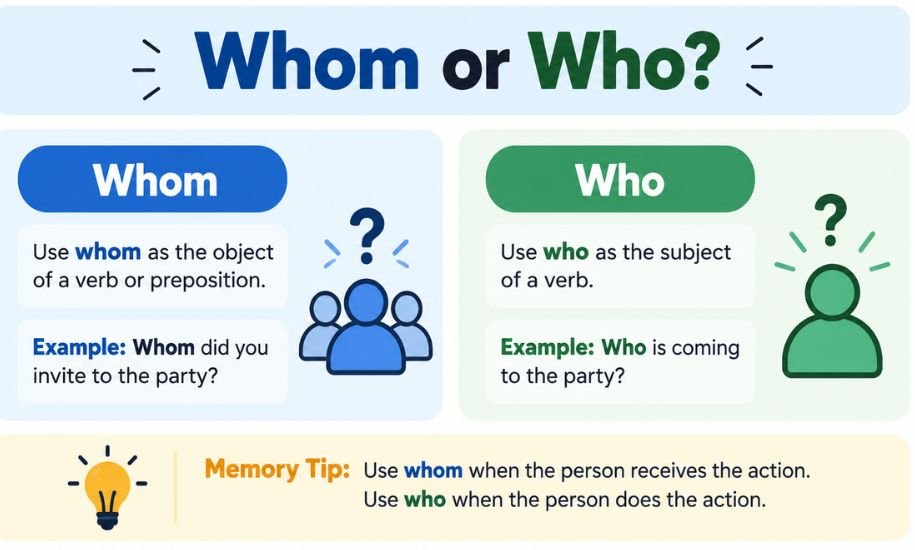
Whom or Who? Grammar Rules Explained
Choosing between who and whom can be surprisingly confusing. Both are pronouns that refer to people, but they traditionally perform different grammatical roles in a sentence. The simplest distinction is that who is used as a subject, while whom is used as an object. However, everyday English often uses who where formal grammar would traditionally call for whom.
Who is traditionally used for the subject of a sentence, while whom is used for the object. Try replacing the word with he/she/they or him/her/them: if the first group works, use who; if the second works, use whom. In informal English, who is often used instead of whom.
Who vs. Whom: The Basic Difference
The easiest way to understand the distinction is to look at what the person is doing in the sentence.
| Word | Traditional grammatical role | Example |
|---|---|---|
| Who | Subject | Who called you? |
| Whom | Object | Whom did you call? |
In “Who called you?”, the person represented by who performs the action of calling. Therefore, who is the subject.
In “Whom did you call?”, you perform the action, while the person represented by whom receives that action. Therefore, whom is the object.
This distinction is similar to the difference between he and him:
- He called me.
- I called him.
So:
- Who ≈ he/she/they
- Whom ≈ him/her/them
That substitution is one of the most useful ways to decide which form fits.
What Does “Who” Mean?
Who is a pronoun used to refer to a person or people when they are the subject of a verb.
Consider these examples:
- Who opened the window?
- Who wants another cup of coffee?
- Who sent this package?
- Who is responsible for the project?
In each sentence, who represents the person performing or being identified with the action.
For example:
Who wrote this report?
You can answer:
She wrote this report.
Because she works naturally as the answer, who is appropriate.
Who in Relative Clauses
Who can also introduce a relative clause when it refers to the subject:
The teacher who helped me was very patient.
Here, who performs the action helped.
Another example:
I met a woman who works at the library.
The woman is the person who performs the action of working, so who is the traditional choice.
What Does “Whom” Mean?
Whom is traditionally used when the person referred to is the object of a verb or preposition.
Examples include:
- Whom did you invite?
- Whom did they choose?
- To whom should I send the form?
- With whom are you travelling?
- For whom was the letter written?
Look at this sentence:
Whom did you invite?
The answer might be:
I invited him.
Because him is correct rather than he, the traditional form is whom.
Whom in Relative Clauses
The same principle applies to relative clauses:
The person whom I contacted replied quickly.
Here, I am the subject of contacted. The person is the object of that verb.
Compare:
The person who contacted me replied quickly.
In this version, the person performs the action of contacting me, so who is used.
This is an important distinction:
- The person who contacted me → the person did the contacting.
- The person whom I contacted → I did the contacting.
The Easy “He or Him” Test
If you are unsure which form to choose, use the he/him test.
Step 1: Replace the pronoun
Imagine answering the question with he or him.
If he/she/they sounds right, choose who.
If him/her/them sounds right, choose whom.
For example:
___ called the office?
Answer:
He called the office.
Therefore:
Who called the office?
Now consider:
___ did you call?
Answer:
I called him.
Therefore:
Whom did you call?
The same test works with she/her and they/them.
A Quick Memory Trick
Remember:
Who → he/she/they
Whom → him/her/them
The m in whom can remind you of the m in him.
It is not a complete grammar rule by itself, but it is an effective practical test.
Who or Whom After a Preposition?
Prepositions such as to, for, with, by, from, and about traditionally take an object. Therefore, whom is preferred in formal constructions when the preposition comes immediately before the pronoun.
For example:
To whom did you send the email?
With whom are you working?
For whom is this package?
From whom did you receive the message?
However, natural conversational English often places the preposition at the end of the sentence and uses who:
Who did you send the email to?
Who are you working with?
Who is this package for?
Who did you receive the message from?
The latter constructions are extremely common in everyday English. In formal writing, especially when a preposition begins the construction, whom can sound more appropriate.
Formal vs. Everyday English
One reason this topic can seem inconsistent is that English usage does not always follow the traditional rule in casual conversation.
For example:
Whom did you speak to?
is traditionally correct.
But:
Who did you speak to?
is very common in ordinary conversation and informal writing.
Likewise:
To whom did you speak?
is a formal construction.
The choice therefore depends partly on grammatical role and partly on register. If you are writing a formal document, academic text, or official correspondence, retaining whom where traditional grammar calls for it can be useful. In relaxed conversation, who is often the more natural choice.
This does not mean that whom is obsolete or that who is always correct. The two forms still have distinct traditional grammatical functions.
Who or Whom: Examples in Sentences
Here are several examples that show the difference clearly.
Example 1
Who called you?
→ She called me.
Because she is the subject, who is appropriate.
Example 2
Whom did you call?
→ I called her.
Because her is the object, whom is the traditional choice.
Example 3
Who prepared the presentation?
→ They prepared it.
The person performs the action, so use who.
Example 4
Whom did the manager select?
→ The manager selected him.
The person receives the action of selected, so whom is traditionally appropriate.
Example 5
The student who answered the question received a certificate.
The student performed the action of answering.
Example 6
The student whom the teacher praised received a certificate.
The teacher performed the action of praising; the student was the object.
Example 7
Who is waiting outside?
→ He is waiting outside.
Therefore, who is correct.
Example 8
Whom are you expecting?
→ We are expecting them.
Therefore, whom is the traditional grammatical choice.
Common Mistakes to Avoid
1. Using “whom” as the subject
Incorrect:
Whom is coming to dinner?
Traditional standard English requires:
Who is coming to dinner?
The person is the subject of is coming.
2. Assuming “whom” is always more correct
Whom is not simply a more sophisticated version of who. It has a particular grammatical function.
Incorrect:
Whom called you?
Correct:
Who called you?
Making a sentence sound formal does not make whom appropriate.
3. Forgetting the object test
Consider:
Who did you meet?
In everyday English, this is perfectly natural. Under the traditional subject/object distinction, however, whom would be used:
Whom did you meet?
The reason is that you are performing the action of meeting.
4. Confusing relative clauses
Compare:
The woman who interviewed me got the job.
with:
The woman whom I interviewed got the job.
In the first sentence, the woman performed the interviewing. In the second, I performed the interviewing.
5. Using “whome”
Whome is not the standard English pronoun. The correct forms are who and whom.
So:
Whome did you invite? ❌
should be:
Whom did you invite? ✓
A Simple Who-or-Whom Checker
You can effectively check many sentences yourself without a grammar tool.
Take:
___ did you invite?
Change it into a statement:
You invited ___.
Now try the object pronoun:
You invited him.
That tells you that whom is the traditional choice:
Whom did you invite?
Try another:
___ called the manager?
Turn it into a statement:
___ called the manager.
The answer is:
He called the manager.
So the correct traditional form is:
Who called the manager?
This method is usually more useful than trying to decide based on which word “sounds formal.”
Who, Whom, and Whose
It is also helpful not to confuse who and whom with whose.
- Who = subject
- Whom = object
- Whose = possession
Examples:
Who owns this car?
Whom did you meet?
Whose car is this?
A useful way to remember the third form is that whose asks who something belongs to.
Quick Practice Quiz
Choose who or whom in each sentence.
- ___ is responsible for the decision?
- ___ did you invite to the meeting?
- ___ wrote this article?
- To ___ should I address the letter?
- ___ are you going to the concert with?
- The person ___ helped me was very kind.
- The person ___ I helped thanked me.
Answers
- Who — subject of is responsible.
- Whom — traditional object of invite.
- Who — subject of wrote.
- Whom — object following to.
- Whom in formal traditional grammar, although who is common in conversation.
- Who — subject of helped.
- Whom — object of helped.
How to Choose the Right Form
When you encounter a difficult sentence, use this three-step process:
1. Identify the action.
Find the verb and determine who performs it.
2. Try the pronoun substitution.
Use he/she/they or him/her/them.
3. Consider the level of formality.
If the traditional object form is appropriate, choose whom. In informal English, particularly when a preposition appears at the end, who is often used naturally.
For example:
___ did you give the book to?
The underlying statement is:
You gave the book to him.
So whom is the traditional grammatical form:
Whom did you give the book to?
But this is also extremely natural in everyday English:
Who did you give the book to?
For formal writing, you could instead move the preposition:
To whom did you give the book?
Frequently Asked Questions
Is “who” or “whom” correct?
Both are correct words. Traditionally, who is used for subjects and whom for objects. In modern informal English, who is frequently used in places where traditional grammar would use whom.
Is “whom” still used in English?
Yes. Whom remains standard, particularly in formal writing, after prepositions, and in carefully edited text. It has not disappeared from English, even though who is more common in many everyday constructions.
Is “who” always informal?
No. Who is the standard subject form and is completely appropriate in formal writing when it functions as the subject. For example, “Who approved the proposal?” is correct in both formal and informal contexts.
How can I remember the difference?
Use the he/him test. If you could replace the word with he, she, or they, use who. If you could replace it with him, her, or them, use whom.
Is “whome” a correct word?
No. Whome is not the standard spelling of the pronoun. The correct forms are who and whom.
Final Verdict: Who or Whom?
The traditional rule is straightforward: use who when the person is the subject and whom when the person is the object. The he/him test makes the distinction much easier to apply. Remember, though, that everyday English often uses who instead of whom, especially in questions where the preposition comes at the end.
When formal grammar matters, knowing the traditional distinction helps you make a deliberate choice. For more clear explanations of easily confused English forms, Grammarifyr helps you know the difference and use the right words.
You may also Read : Ageing or Aging: British and American English
One Comment