Leaves or Leafs: Meaning and Correct Usage
If you are unsure whether the plural of leaf is leaves or leafs, you are not alone. The spelling can seem confusing because many English nouns form their plurals simply by adding -s. However, the standard plural of leaf is leaves when you are talking about more than one plant leaf, page, or similar object. Leafs is also a real form, but it has different and much more limited uses.
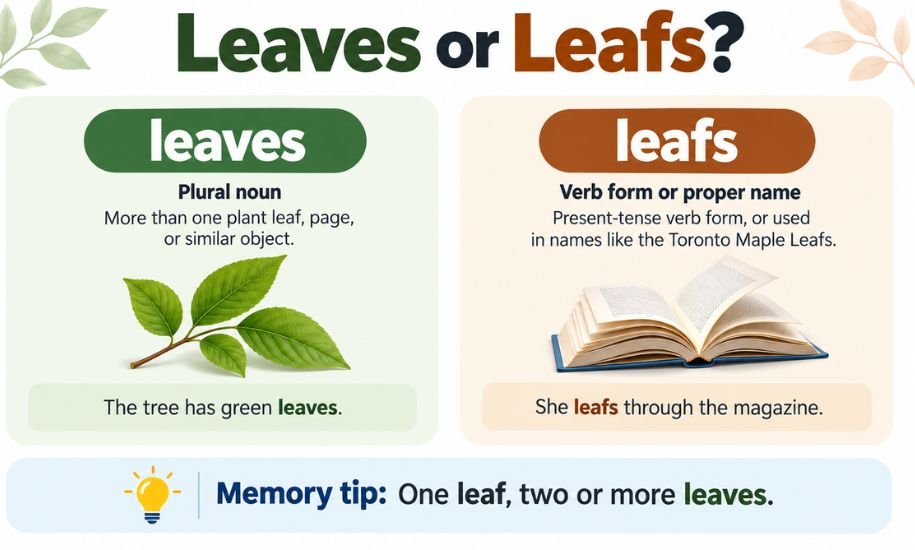
The standard plural of leaf is leaves. Use leaves for multiple plant leaves, book pages, and similar objects. Leafs is a legitimate word mainly as a verb form of leaf, and it also appears in proper names such as the Toronto Maple Leafs.
Leaves vs. Leafs: The Quick Difference
| Form | Correct? | Main use | Example |
|---|---|---|---|
| leaves | Yes | Plural noun | The tree has green leaves. |
| leafs | Yes, in specific contexts | Verb form or proper name | She leafs through the magazine. |
| leaf | Yes | Singular noun | A leaf fell from the tree. |
So, if you are writing about the foliage on a tree, leaves is the form you want.
Correct: The leaves are beginning to change color.
Incorrect in standard plural use: The leafs are beginning to change color.
However, it would be incorrect to say that leafs is never a word. It has legitimate grammatical and naming uses.
What Does “Leaf” Mean?
Leaf is a noun that commonly refers to the usually flat, green structure that grows from a plant or tree. Leaves play an important role in photosynthesis and help plants produce energy.
The singular form is leaf.
Examples:
- A large leaf was lying on the path.
- This plant has a broad leaf.
- I noticed a yellow leaf on the branch.
- The caterpillar was resting on a leaf.
The word can also refer to a sheet or page in a book or manuscript. In addition, a leaf can describe a hinged or removable section of certain tables and other objects.
When more than one is involved, the usual plural is leaves.
What Is the Plural of Leaf?
The standard plural of leaf is leaves.
This is an irregular plural because the spelling changes rather than simply adding -s:
leaf → leaves
Compare this pattern with several other English nouns:
- knife → knives
- wife → wives
- wolf → wolves
- life → lives
- half → halves
These words have historical spelling and sound patterns that distinguish their plural forms from ordinary -s plurals.
That is why leafs may look logical at first, but it is not the standard plural when you mean multiple leaves on a plant.
Examples
- The autumn leaves covered the ground.
- The tree has lost most of its leaves.
- Several green leaves were floating in the pond.
- The gardener removed the damaged leaves.
Is “Leafs” a Real Word?
Yes. Leafs is a real word, but it does not normally function as the plural noun for leaf.
One important use is as the third-person singular present tense of the verb “leaf.”
To leaf through something means to turn through the pages of a book, magazine, or similar publication, often casually or quickly.
For example:
- She leafs through the magazine while waiting.
- He leafs through the old photo album.
- The librarian leafs through the document to find the relevant page.
Here, leafs is a verb, not a plural noun.
The distinction becomes clearer when you compare the sentence structures:
Noun:
The tree has many leaves.
Verb:
She leafs through the book.
In the first sentence, leaves means multiple leaves. In the second, leafs describes an action.
Why Is “Leaves” the Plural?
English has several nouns ending in -f or -fe whose plural forms developed with a v sound and spelling.
Thus:
leaf → leaves
rather than:
leaf → leafs
The same general pattern appears in words such as knife → knives and wolf → wolves. However, this is not a universal rule for every English word ending in f. Some words simply take -s, such as:
- roof → roofs
- chief → chiefs
- belief → beliefs
- proof → proofs
Therefore, it is better to learn the plural of leaf as leaves rather than trying to apply a rule mechanically to every word ending in f.
When Is “Leafs” Correct?
Although leaves is the correct plural noun in ordinary usage, leafs can be correct in a few specific situations.
1. “Leafs” as a verb
As mentioned above, leafs can be the present-tense form of the verb leaf.
For example:
Daniel leafs through the newspaper every morning.
The subject Daniel is singular, so the verb takes -s.
The verb forms can be shown like this:
| Subject | Verb |
|---|---|
| I | leaf |
| You | leaf |
| We | leaf |
| They | leaf |
| He/She/It | leafs |
This is the same grammatical pattern seen in:
- read → reads
- walk → walks
- look → looks
- browse → browses
- leaf → leafs
2. “Leafs” in a proper name
Another famous example is the Toronto Maple Leafs, the professional ice hockey team.
Here, Leafs is part of the organization’s established proper name. It should not be changed to Leaves simply because the ordinary plural of leaf is leaves.
For example:
The Toronto Maple Leafs played last night.
The spelling is part of the team’s official name.
This is an important exception because someone familiar only with the ordinary plural might wonder why the team is called the Maple Leafs rather than the Maple Leaves.
3. Specialized uses
In some technical or specialized contexts, leafs may occur as a plural or terminology-specific form. Such uses depend on the particular field and should not be generalized to everyday English.
For ordinary writing about plants, trees, books, or similar objects, leaves remains the appropriate plural.
Leaves or Leafs in a Sentence
The easiest way to understand the difference is to look at them in context.
Use “leaves” for multiple leaves
The tree’s leaves turned golden in October.
Strong winds blew the leaves across the garden.
The gardener removed the dead leaves.
The plant has large, dark-green leaves.
Here, leaves is a plural noun.
Use “leafs” as a verb
She leafs through the newspaper while drinking coffee.
He leafs through the old journal.
Maria leafs through the catalog before choosing a product.
Here, leafs describes the action of turning pages.
Use “Leafs” in the proper name
The Toronto Maple Leafs have a long history in professional hockey.
The capital letter is another clue that Leafs is being used as part of a proper name.
Leaves or Leafs Pronunciation
Pronunciation can also help distinguish the ordinary plural from the verb form.
Leaf ends with an f sound. In leaves, that sound changes to a v sound:
- leaf — /liːf/
- leaves — /liːvz/
- leafs — /liːfs/
As a result, leaves and leafs are not pronounced identically in ordinary English.
The final sound in leaves is voiced, while the final sound in leafs remains unvoiced.
For learners, remembering the spelling together with the pronunciation can make the distinction easier.
Common Mistakes With These Forms
Mistake 1: Using “leafs” as the ordinary plural
Incorrect: The tree has thousands of leafs.
Correct: The tree has thousands of leaves.
When the word refers to more than one leaf, use leaves.
Mistake 2: Assuming “leafs” is always wrong
It is not.
Correct: She leafs through the magazine.
Here, leafs is a verb.
Mistake 3: Changing the name of the hockey team
Correct: Toronto Maple Leafs
The team’s name uses Leafs, even though the ordinary plural of leaf is leaves.
Mistake 4: Treating every word ending in “f” the same way
It is tempting to think that every noun ending in f must change to ves in the plural. English does not work that consistently.
For example:
- roof → roofs
- chief → chiefs
- belief → beliefs
So the safest approach is to learn established plural forms individually.
An Easy Way to Remember
Use this simple rule:
One leaf, two or more leaves.
If you are talking about things growing on a tree or plant, leaves is almost certainly the form you need.
For leafs, think about an action:
Someone leafs through pages.
You can also remember the three forms together:
leaf = one plant leaf
leaves = more than one
leafs = a verb form, or part of a proper name
This distinction covers most everyday situations.
A Few More Examples
Here are some examples that show the difference naturally:
- Leaf: One leaf fell from the branch.
- Leaves: Several leaves fell during the storm.
- Leafs: She leafs through her notebook before class.
- Leaves: The gardener waters the plant’s leaves carefully.
- Leafs: He leafs through the newspaper without reading every article.
- Leafs: The Toronto Maple Leafs are a professional hockey team.
Notice that context tells you whether the form is a noun or a verb.
Frequently Asked Questions
Is “leaves” or “leafs” correct?
Leaves is the standard plural of leaf when referring to more than one plant leaf, page, or similar object. Leafs is also a legitimate form, but it is mainly used as the third-person singular form of the verb leaf or in proper names such as the Toronto Maple Leafs.
Is “leafs” a word?
Yes. Leafs is a real English word. For example, “She leafs through the magazine” uses leafs as a verb. It is also part of the proper name Toronto Maple Leafs. It is not, however, the usual plural of the noun leaf.
Why is the plural of leaf “leaves”?
Leaf has an irregular plural form that developed with a spelling and sound change from f to v, giving leaves. Similar patterns occur in words such as knife → knives and wolf → wolves, although not every noun ending in f follows this pattern.
Should I write “tree leaves” or “tree leafs”?
Write tree leaves when referring to multiple leaves on a tree. For example: “The tree leaves were beginning to turn yellow.” Leafs would not be the standard plural in this context.
Why is the hockey team called the Toronto Maple Leafs?
Leafs is part of the team’s established proper name. Proper names do not have to follow the ordinary grammatical pattern of a common noun, so the team’s name remains the Toronto Maple Leafs rather than being changed to “Toronto Maple Leaves.”
How can I remember the correct plural?
The simplest rule is leaf → leaves. If you are talking about more than one leaf on a plant or tree, choose leaves. Reserve leafs for its specific verb use or established names.
Final Verdict: Leaves or Leafs?
For ordinary plural use, leaves is the correct choice: one leaf, several leaves. Leafs is not the standard plural noun, but it is still a legitimate form when used as a verb, as in “she leafs through a book,” or in a proper name such as the Toronto Maple Leafs. If you want a simple rule to remember, Grammarifyr recommends keeping leaves for multiple leaves and leafs for its specific grammatical or naming uses.
You may also Read : Intel or AMD: Which Processor Is Better in 2026?


One Comment