Acception or Exception: Spelling and Usage Guide
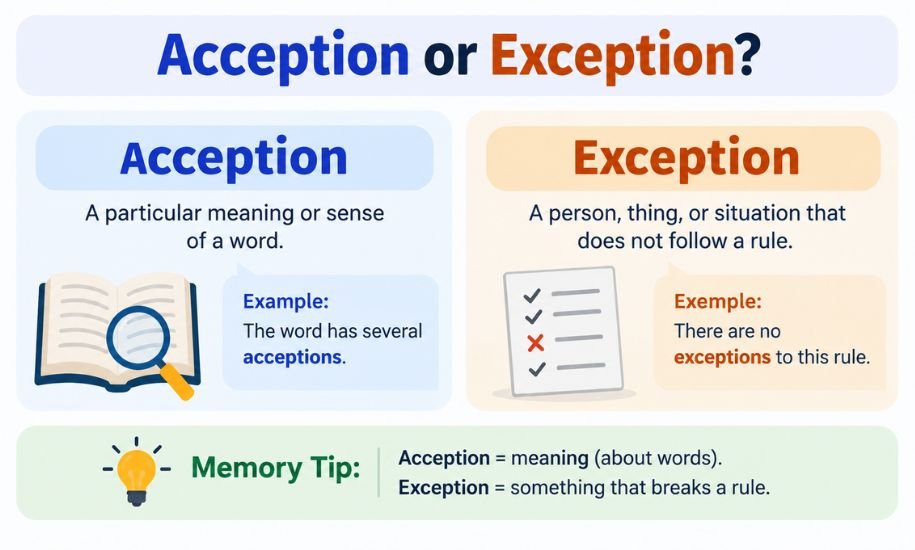
Have you ever wondered whether to write acception or exception? The two words look similar, but they have different meanings and are not interchangeable in everyday English. If you want to describe something that does not follow a rule, the correct word is exception. However, acception is also a real, rare word found mainly in historical or specialized contexts. Another related word, acceptance, means the act of accepting something. Understanding these distinctions will help you choose the right word in emails, essays, conversations, and other forms of writing.
Acception vs. Exception: What Is the Difference?
Although these words share several letters, their meanings are different. Choosing the correct one depends on what you want to communicate.
| Feature | Acception | Exception |
|---|---|---|
| Is it a real word? | Yes, but rare | Yes, standard English |
| Part of speech | Noun | Noun |
| Meaning | A particular or accepted sense of a word | Something excluded from a rule or general statement |
| Typical usage | Historical or specialized writing | Everyday and formal English |
| Common expression | Rarely used in modern expressions | “Make an exception” |
| Example | An older acception of a term | The rule has one exception. |
In modern writing, exception is the appropriate choice in most situations involving rules, requirements, restrictions, or unusual cases.
For example:
- Correct: The teacher made an exception for the student.
- Incorrect for the intended meaning: The teacher made an acception for the student.
The second sentence uses a genuine but rare word where the standard expression requires exception.
What Does “Exception” Mean?
An exception is something or someone that does not follow a general rule, requirement, pattern, or statement. It can also refer to something excluded from a group or condition.
The word is commonly used in education, work, everyday conversations, and formal documents.
Examples of exception in a sentence
- Everyone must attend the meeting, without exception.
- The store is open every day, with the exception of public holidays.
- The teacher made an exception and accepted my assignment late.
- This discount applies to all products, with one exception.
- There are no exceptions to the safety rules.
Each example describes a situation in which a rule applies generally but a particular case is treated differently, or no special cases are permitted.
Common expressions with exception
Several English expressions use this word regularly.
– Make an exception: Allow something that would normally not be permitted. My manager made an exception and approved my request.
– Without exception: Applying to everyone or everything without exclusions. All participants must follow the instructions without exception.
– With the exception of: Excluding a particular person or thing. The entire team attended, with the exception of Daniel.
– No exceptions: A firm statement that a rule applies in every relevant case. Late submissions are not accepted. No exceptions.
These expressions are standard English and are useful in both casual and formal writing.
What Does “Acception” Mean?
Acception is a real English noun, but it is uncommon in contemporary usage. Historically, it referred to the accepted meaning, interpretation, or particular sense of a word.
The term may appear in older dictionaries, historical texts, or specialized discussions of language. However, it is not the normal modern word for accepting an offer, approving a request, or allowing an exception to a rule.
In ordinary writing, more familiar words such as meaning, sense, and interpretation usually communicate the intended idea more clearly.
Examples of acception in a sentence
Because the word is rare, these examples illustrate its historical or specialized sense rather than everyday usage.
- The researcher examined an older acception of the term.
- The passage reflects a particular acception of the word in historical English.
- The scholar discussed how an earlier acception differed from the meaning used today.
These sentences are appropriate mainly when discussing historical word meanings or specialized linguistic topics.
For everyday communication, avoid using acception as a substitute for exception or acceptance.
Acception or Acceptance: Which Word Do You Need?
Another source of confusion is the word acceptance. It looks similar to acception, but it is much more common in modern English and serves a different purpose.
Acceptance means the act or state of accepting something. It can describe agreeing to an offer, approving a proposal, receiving someone into a group, or acknowledging a situation.
Consider these examples:
- Her acceptance of the job offer made her family happy.
- The university sent him a letter of acceptance.
- Acceptance of the new policy is required before employees can proceed.
- Learning self-acceptance can take time.
Compare the three words:
| Word | Main meaning | Example |
|---|---|---|
| Exception | Something that does not follow a rule | There is one exception. |
| Acception | A particular or accepted sense of a word, historically | The text uses an older acception. |
| Acceptance | The act of accepting something | We received acceptance of the offer. |
A useful way to choose is to ask yourself what you mean.
If you are talking about a rule that does not apply in one situation, choose exception. If you mean agreeing to or receiving something, choose acceptance. If you are discussing the historical sense of a word, acception may be appropriate.
Why Are These Words Confused?
The confusion mainly comes from their similar spelling and their relationship to the verb accept.
Acception and exception share the ending “-ception,” making them easy to mix up when writing quickly. Their meanings, however, are not the same.
The distinction between accept and except also helps explain the difference:
– Accept is a verb meaning to receive, agree to, or approve something. I accept your invitation.
– Except is generally a preposition or conjunction meaning “excluding” or “other than.” Everyone came except Maria.
– Acceptance is the noun related to accepting. Her acceptance was confirmed yesterday.
– Exception is the noun related to excluding something from a rule or general statement. The policy allows one exception.
Remembering the difference between accept and except can make it easier to distinguish acceptance from exception as well.
Correct and Incorrect Usage Examples
The following examples show how to choose the right word in everyday sentences.
| Incorrect or less suitable | Correct wording |
|---|---|
| I’ll make an acception for you. | I’ll make an exception for you. |
| There are no acceptions to this rule. | There are no exceptions to this rule. |
| She received an acception to the university. | She received acceptance from the university. |
| Everyone agreed, with one acception. | Everyone agreed, with one exception. |
| Thank you for your acception of my invitation. | Thank you for accepting my invitation. |
The third example depends on the intended meaning: acceptance is appropriate when referring to admission or approval, while exception would refer to a special case that differs from the usual rule.
Also, remember that acceptance and exception are nouns, while accept and except generally perform different grammatical roles. Choosing the correct word requires considering both meaning and sentence structure.
An Easy Way to Remember the Difference
Use these simple associations:
- Exception = exclusion. Both words begin with “ex,” which can help you remember the idea of something being left out.
- Acceptance = accepting. If someone agrees to an offer or receives approval, acceptance is usually the noun you need.
- Acception = historical word sense. Reserve it for the rare contexts in which it genuinely fits.
For example, if a school allows every student to participate except one, that student is an exception to the general situation. If the school approves a student’s application, the student receives acceptance.
The key is to focus on the meaning rather than choosing a word simply because it looks familiar.
Frequently Asked Questions
Is “acception” a real word?
Yes. Acception is a genuine but rare English word associated historically with an accepted or particular sense of a word. It is not a standard substitute for exception in ordinary writing.
Should I write “I’ll make an acception” or “I’ll make an exception”?
Write “I’ll make an exception.” This is the standard expression used when someone makes a special allowance or permits a situation that would normally be excluded by a rule.
Is acception the same as acceptance?
No. Acception has a rare historical meaning connected with a particular sense of a word. Acceptance means agreeing to, receiving, or approving something. The words should not be used interchangeably.
Is exception spelled differently in British and American English?
No. Exception is the standard spelling in both British and American English. Neither variety uses acception as an alternative regional spelling.
What does “no exceptions” mean?
“No exceptions” means that a rule applies without allowing special cases. For example, “All visitors must show identification, no exceptions” means that every visitor must comply with the requirement.
What is the easiest way to remember exception?
Associate exception with exclusion. When something is left out of a rule or general statement, exception is usually the word you need. When someone agrees to or receives something, consider acceptance instead.
Final Verdict: Acception or Exception?
For almost all everyday writing, exception is the correct choice when referring to a special case or something that falls outside a rule. Acception exists, but its use is rare and largely historical. If you mean agreeing to or receiving something, use acceptance. Understanding these distinctions will help you write more clearly and confidently. At Grammarifyr, our goal is simple: Know the Difference. Use the Right Words.
You may also Read : Weird or Wierd: Meaning, Spelling, and Examples

One Comment