5 Ways to Say Sorry in Spanish: Natural Apologies for Every Situation
Saying “sorry” in Spanish is not limited to one expression. The best phrase depends on why you are apologizing, how serious the situation is, and how formal the conversation is. For a small interruption, you might say perdón, while a sincere apology is more naturally expressed with lo siento.
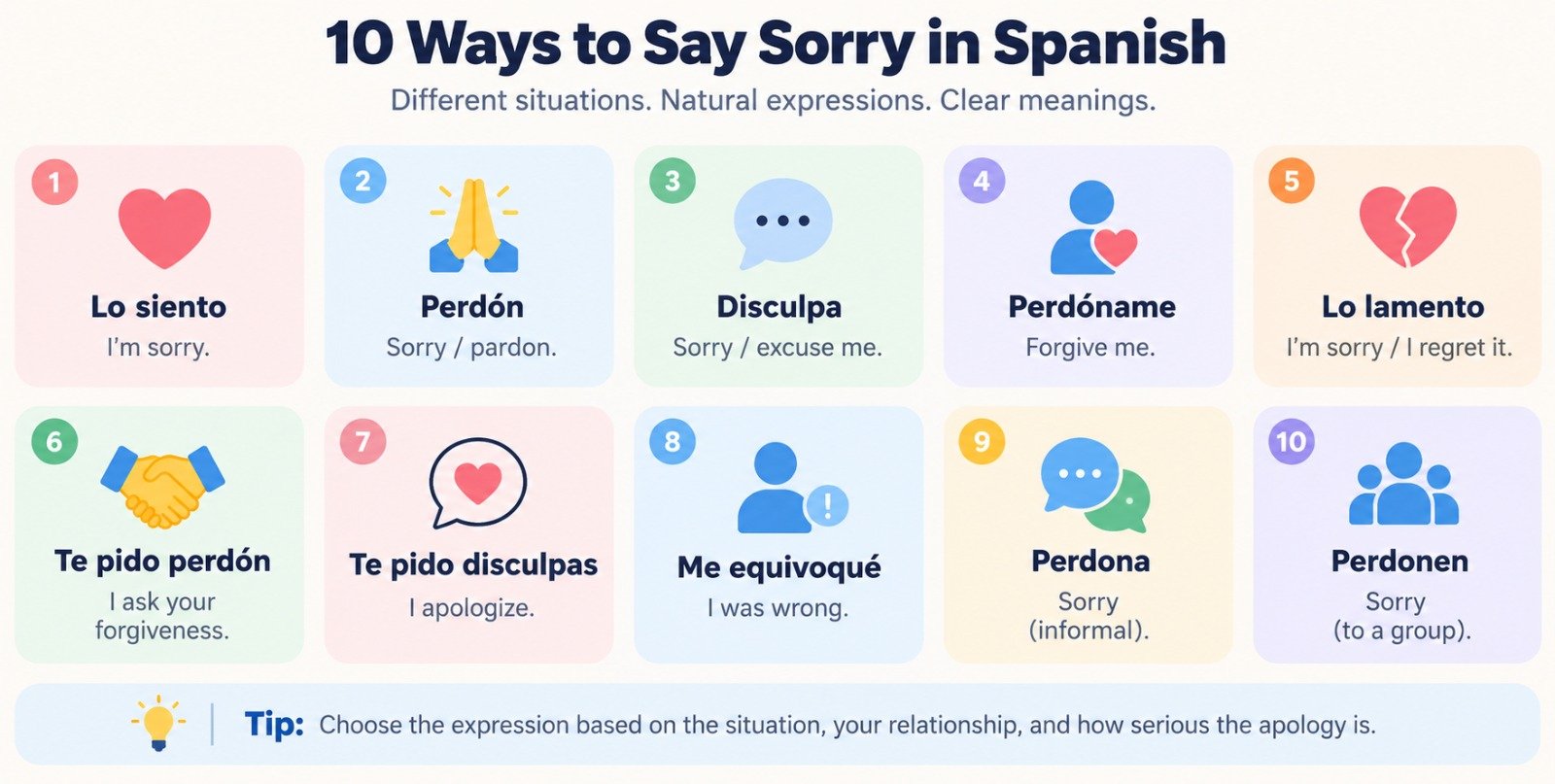
Below are 5 ways to say sorry in Spanish, along with their meanings, contexts, and examples so you can choose the expression that sounds natural.
5 Ways to Say Sorry in Spanish
Spanish has several natural ways to apologize, but they are not perfect substitutes for one another. Some are better for everyday mistakes, while others express deeper regret or ask directly for forgiveness. Spanish-language learning resources likewise distinguish expressions such as lo siento, perdón, disculpa, and lo lamento according to context.
1. Lo siento — “I’m sorry”
Lo siento is probably the most useful phrase to learn first. It directly expresses regret and works in many everyday situations.
You can use it after making a mistake, hurting someone’s feelings, arriving late, or hearing about something unfortunate.
Examples:
- Lo siento, llegué tarde. — I’m sorry, I’m late.
- Lo siento, no fue mi intención. — I’m sorry, I didn’t mean to.
- Lo siento mucho por lo que pasó. — I’m very sorry about what happened.
For a stronger apology, add mucho:
Lo siento mucho = “I’m very sorry.”
This is generally a better choice when you genuinely regret what happened rather than simply wanting someone’s attention.
2. Perdón — “Sorry” or “Pardon”
Perdón is short, common, and extremely useful in everyday Spanish. It can mean “sorry,” “pardon,” or “excuse me,” depending on the situation.
It is especially natural for small mistakes, interruptions, or asking someone to repeat something. SpanishDictionary also notes that perdón can be used when you did not hear or understand what someone said.
Examples:
- Perdón, no te vi. — Sorry, I didn’t see you.
- Perdón, ¿puedes repetirlo? — Sorry, can you repeat that?
- Perdón, ¿me dejas pasar? — Excuse me, can I get through?
If you accidentally bump into someone in a store or on the street, perdón can sound completely natural.
3. Disculpa — “Sorry” or “Excuse me”
Disculpa is another common everyday expression. It comes from the verb disculpar and is the informal form used with someone you address as tú.
The formal version is disculpe, while disculpen can be used when addressing more than one person.
Examples:
- Disculpa, ¿tienes un minuto? — Excuse me, do you have a minute?
- Disculpa por llegar tarde. — Sorry for being late.
- Disculpe, ¿puede ayudarme? — Excuse me, can you help me?
This makes disculpa particularly useful when you want to get someone’s attention politely or apologize for a minor inconvenience.
A useful distinction is that disculpa is informal, while disculpe is formal.
4. Perdóname — “Forgive me”
Perdóname is more personal and emotional than a quick perdón. It literally asks the other person to forgive you.
Use it when you have done something that genuinely affected another person, especially in a close relationship.
Examples:
- Perdóname, no quería hacerte daño. — Forgive me, I didn’t mean to hurt you.
- Perdóname por lo que dije. — Forgive me for what I said.
- Perdóname, cometí un error. — Forgive me, I made a mistake.
You would not normally need perdóname simply because you stepped in front of someone on a crowded sidewalk. It carries more emotional weight and is better suited to a meaningful apology.
5. Lo lamento — “I’m sorry” or “I regret it”
Lo lamento is another way to express sincere regret. It overlaps with lo siento, but it can sound more serious or solemn, particularly when responding to bad news or expressing condolences.
For example:
Lo lamento mucho. — I’m very sorry.
Lo lamento por tu pérdida. — I’m sorry for your loss.
SpanishDictionary and donQuijote both distinguish lo lamento as an expression that can be used for more serious situations, including condolences.
Quick Comparison: 5 Ways to Say Sorry in Spanish
| Spanish Expression | English Meaning | Tone | Best Used For |
|---|---|---|---|
| Lo siento | I’m sorry | Sincere, neutral | Genuine mistakes and apologies |
| Perdón | Sorry / pardon | Casual, flexible | Minor mistakes, interruptions, clarification |
| Disculpa | Sorry / excuse me | Polite, informal | Everyday situations and getting attention |
| Perdóname | Forgive me | Personal, heartfelt | Serious or emotional apologies |
| Lo lamento | I’m sorry / I regret it | Serious, solemn | Deep regret and difficult situations |
How to Choose the Right Spanish Apology
The easiest way to choose among these expressions is to think about the seriousness of the situation.
For a small accident, perdón is often enough:
Perdón, fue sin querer.
Sorry, it was an accident.
For a genuine mistake, lo siento is a strong general choice:
Lo siento, cometí un error.
I’m sorry, I made a mistake.
If you want someone’s attention or need to interrupt politely, disculpa works well in an informal setting:
Disculpa, ¿puedo preguntarte algo?
Excuse me, can I ask you something?
If you have seriously hurt someone’s feelings, perdóname makes the apology more personal:
Perdóname por haberte hablado así.
Forgive me for speaking to you like that.
And for serious news or expressions of sympathy, lo lamento may be more appropriate:
Lo lamento mucho. Mis condolencias.
I’m very sorry. My condolences.
Other Ways to Apologize in Spanish
The five expressions above are useful starting points, but Spanish offers other natural ways to take responsibility or express regret.
Te pido perdón — “I ask your forgiveness”
Te pido perdón is a direct and sincere way to ask someone for forgiveness. It is stronger than simply saying perdón.
Te pido perdón por lo que hice.
I ask your forgiveness for what I did.
Te pido disculpas — “I apologize”
Te pido disculpas is another direct apology. It can sound more deliberate and formal than a simple perdón.
Te pido disculpas por la confusión.
I apologize for the confusion.
For formal situations, le pido disculpas is appropriate when addressing someone with usted.
Me equivoqué — “I was wrong”
You do not always need to translate “sorry” literally. Sometimes the most effective apology is to acknowledge the mistake.
Me equivoqué. Lo siento.
I was wrong. I’m sorry.
This approach takes responsibility rather than simply expressing regret. Enforex also identifies me equivoqué as a useful way of acknowledging that you made a mistake.
Formal vs. Informal Ways to Say Sorry
Spanish changes depending on the relationship between speakers. This is especially noticeable with disculpa and disculpe.
Informal
Use disculpa, perdona, or perdóname when speaking to someone you address with tú.
Disculpa por la demora.
Sorry for the delay.
Formal
Use disculpe, perdone, or perdóneme when speaking respectfully to someone you address with usted.
Disculpe la demora.
Sorry for the delay.
The distinction matters because choosing the formal or informal form helps your Spanish sound more natural and socially appropriate.
What About “Sorry for Your Loss” in Spanish?
A serious apology and an expression of sympathy are different things. If someone has experienced a death, simply saying perdón would not normally convey the intended meaning.
Common condolence expressions include:
- Lo siento mucho. — I’m very sorry.
- Lamento mucho tu pérdida. — I’m very sorry for your loss.
- Mi más sentido pésame. — My deepest condolences.
SpanishDictionary specifically lists mi más sentido pésame and related expressions for condolences.
Common Mistakes to Avoid
One common mistake is assuming that every Spanish word for “sorry” works in exactly the same situation.
For example, perdón is often suitable for a minor interruption, while lo siento can communicate genuine regret. Similarly, perdóname directly asks for forgiveness and therefore can sound too strong for a tiny everyday inconvenience.
Another mistake is overlooking formality. Disculpa is informal, whereas disculpe is formal.
Also remember that con permiso means “excuse me” when asking to pass or move through a space. It is not literally an apology for something you did wrong.
Frequently Asked Questions
What is the most common way to say sorry in Spanish?
Lo siento is one of the most widely recognized and versatile ways to say “I’m sorry” in Spanish. It is appropriate for many genuine apologies.
Is “perdón” the same as “lo siento”?
Not always. Perdón is often used for minor mistakes, interruptions, or asking someone to repeat something. Lo siento generally expresses more direct or sincere regret.
How do you say “I’m very sorry” in Spanish?
You can say lo siento mucho, which means “I’m very sorry.” It adds emphasis to the basic expression lo siento.
How do you say “forgive me” in Spanish?
Perdóname means “forgive me” and is generally more personal than simply saying perdón.
What is the formal way to say “sorry” in Spanish?
Depending on the context, you can use disculpe, perdone, or perdóneme when addressing someone formally. For a sincere apology, lo siento and lo lamento can also work in formal situations.
How do you say sorry for a small mistake in Spanish?
Perdón, disculpa, or perdona can work well for a small mistake or interruption. The appropriate choice depends on whether you are using formal or informal Spanish.
How do you apologize sincerely in Spanish?
For a sincere apology, lo siento mucho, te pido perdón, or perdóname can be appropriate. The best expression depends on how serious the situation is and your relationship with the other person.
Final Thoughts
Learning 5 ways to say sorry in Spanish gives you more than a list of translations. It helps you recognize the difference between a quick “excuse me,” a genuine apology, and a heartfelt request for forgiveness. Start with lo siento as your general-purpose option, use perdón for many everyday situations, and choose stronger expressions such as perdóname or lo lamento when the situation calls for greater sincerity or emotion.
The right words can make a small but meaningful difference in communication, and Grammarifyr makes those differences easier to understand so you can choose the Spanish expression that truly fits the moment.
You may also Read : Other Ways to Say “However”: 25+ Useful Alternatives for Any Situation