Other Ways to Say “However”: 25+ Useful Alternatives for Any Situation
“However” is one of the most useful transition words in English, but repeating it too often can make your writing feel predictable. Fortunately, there are plenty of other ways to say however, from formal choices such as “nevertheless” and “nonetheless” to conversational options such as “but,” “still,” and “though.”
The important point is that these alternatives are not all interchangeable. Some express direct contrast, while others introduce a different perspective, acknowledge a limitation, or show that something remains true despite what came before.
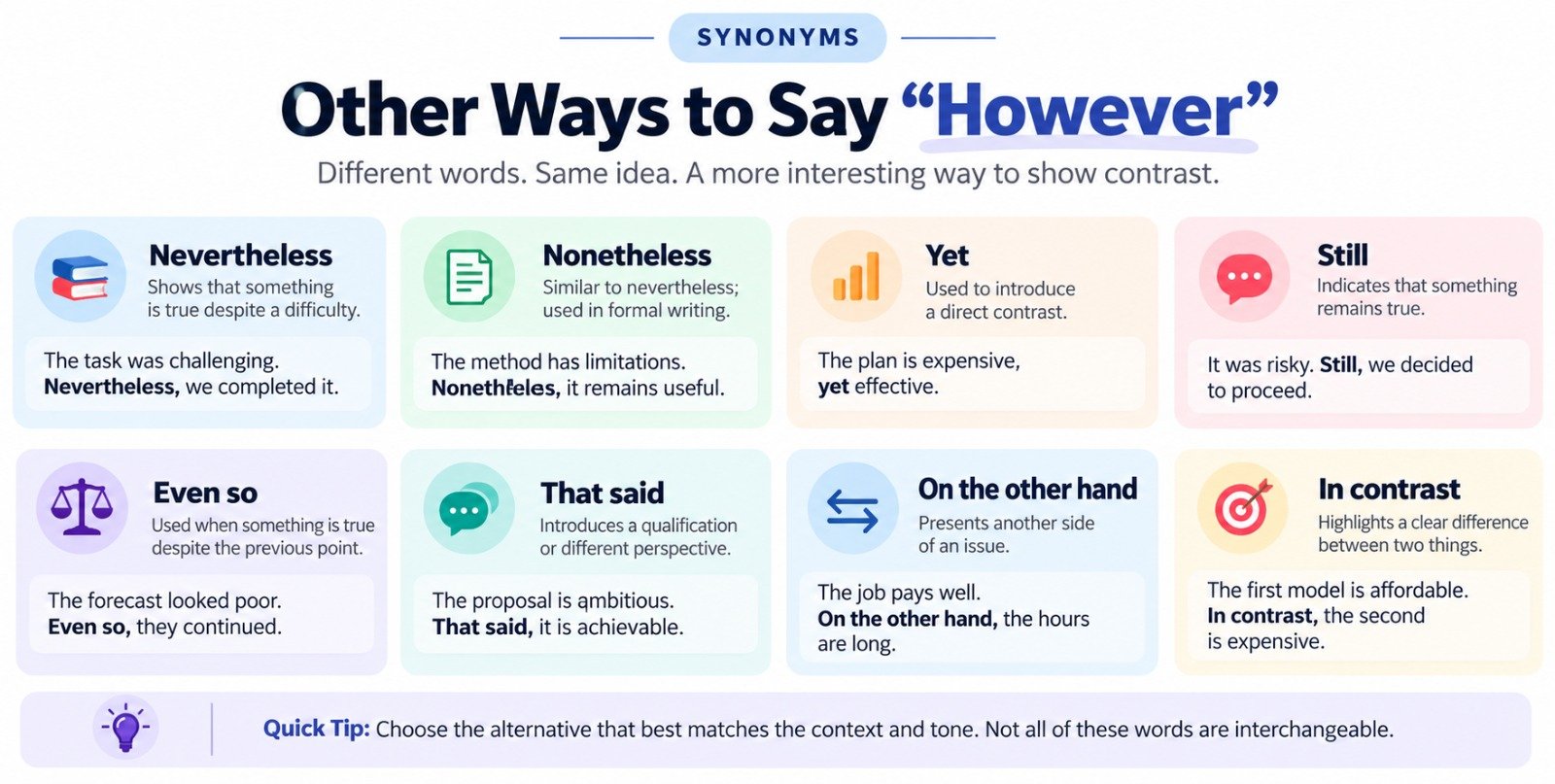
Other Ways to Say “However” at a Glance
| Alternative | Tone | Best Used For | Example |
|---|---|---|---|
| Nevertheless | Formal | Essays, reports | The task was difficult. Nevertheless, we completed it. |
| Nonetheless | Formal | Academic and professional writing | The method has limitations. Nonetheless, it remains useful. |
| Yet | Neutral | Direct contrast | The plan is expensive, yet effective. |
| Still | Neutral | Spoken and written English | It was risky. Still, we decided to proceed. |
| Even so | Neutral | Concession | The forecast looked poor. Even so, they continued. |
| That said | Conversational/Professional | Qualifications and counterpoints | The proposal is ambitious. That said, it is achievable. |
| But | Neutral/Casual | Everyday communication | I wanted to go, but I was too tired. |
| Though | Casual/Neutral | Conversation and informal writing | The restaurant was crowded. It was good, though. |
| In contrast | Formal | Comparing differences | The first model is affordable. In contrast, the second is expensive. |
| On the other hand | Neutral | Presenting another perspective | The job pays well. On the other hand, the hours are long. |
| Conversely | Formal | Opposite relationships | Sales increased in cities. Conversely, rural sales declined. |
| Despite this | Formal/Neutral | Acknowledging a problem | The evidence is limited. Despite this, the conclusion is useful. |
Cambridge lists nevertheless, nonetheless, still, and yet among words associated with the contrastive meaning of “however,” while Purdue’s writing guidance groups “however,” “nevertheless,” “nonetheless,” “but,” and “on the other hand” among expressions used to indicate contrast.
Formal Other Ways to Say “However”
When you’re writing an academic essay, report, research paper, or formal document, you may want a more polished transition than the everyday “but.”
Nevertheless
Nevertheless is one of the closest formal alternatives to “however.” It means that the second statement remains true despite what was just mentioned.
Example:
“The sample size was relatively small. Nevertheless, the findings were useful.”
Use it when you want to acknowledge a limitation without allowing that limitation to undermine the next point.
Nonetheless
Nonetheless has almost the same meaning as “nevertheless.” It is especially natural in academic, analytical, and professional writing. Cambridge identifies “nonetheless” as another form related to “nevertheless.”
Example:
“The procedure was time-consuming. Nonetheless, it produced reliable results.”
Notwithstanding
Notwithstanding is a highly formal option. It is useful when you want to emphasize that something remains true despite a particular fact or obstacle.
Example:
“Notwithstanding these concerns, the committee approved the proposal.”
It can sound unnecessarily formal in casual conversation, so use it selectively.
In Contrast
In contrast works best when you’re explicitly comparing two different situations, qualities, or results.
Example:
“The first design is compact. In contrast, the second requires considerably more space.”
It is not always a direct replacement for “however” because it focuses on comparison rather than simply qualifying a previous statement.
Conversely
Conversely signals an opposite or reversed relationship.
Example:
“Higher prices reduced demand. Conversely, lower prices attracted more customers.”
This makes it particularly useful in analytical and academic writing.
Other Ways to Say “However” in an Essay
If you’re writing an essay, avoid replacing every occurrence of “however” with the same synonym. Instead, choose a transition according to the relationship between the ideas.
Nevertheless
Best when the second point remains valid despite the first.
“The experiment had several limitations. Nevertheless, the results provide useful evidence.”
Nonetheless
A polished alternative when you want to acknowledge a weakness but continue with a positive or important point.
“The theory is difficult to test. Nonetheless, it remains influential.”
Yet
Yet provides a concise contrast and can work naturally inside a sentence.
“The explanation is simple, yet it addresses the central problem.”
Even So
Use even so when the second statement is true despite the preceding fact.
“The evidence was incomplete. Even so, the researchers decided to publish their findings.”
That Said
That said introduces a qualification or a different consideration. It is somewhat more conversational than “nevertheless.”
“The approach is expensive. That said, it could save money in the long term.”
On the Other Hand
Use this when you’re presenting another side of an issue rather than simply contradicting the previous sentence.
“Working from home saves commuting time. On the other hand, some employees miss the social interaction of an office.”
Academic-writing resources and language guides commonly identify “nevertheless,” “nonetheless,” “yet,” “although,” “though,” “still,” and related expressions as alternatives for expressing contrast.
Professional Ways to Say “However”
In workplace emails, reports, presentations, and business communication, you have several choices depending on how formal you want to sound.
That Said
This is a particularly useful professional expression for introducing a qualification.
“The proposal needs some revisions. That said, the overall strategy is promising.”
Nevertheless
Choose this when you want a more formal tone.
“The deadline was demanding. Nevertheless, the team delivered the project on time.”
Still
Still is shorter and more conversational.
“The initial results were disappointing. Still, we learned several useful lessons.”
On the Other Hand
This is useful when discussing advantages and disadvantages.
“The software is affordable. On the other hand, it has fewer advanced features.”
Having Said That
Having said that introduces a qualification after acknowledging a previous point.
“The current system works reasonably well. Having said that, it could be more efficient.”
It is natural in professional communication but generally less formal than “nevertheless.”
Casual and Conversational Alternatives to “However”
In everyday English, you often don’t need a sophisticated synonym. Simple words can sound much more natural.
But
But is the most straightforward alternative.
“I wanted to join you, but I had too much work.”
There is no need to avoid “but” simply because it is less formal. In fact, “but” is extremely common in natural English. Oxford University Press notes that “but” is generally much more frequent than alternatives such as “although,” “however,” “yet,” and “nevertheless.”
Still
“The weather wasn’t great. Still, we had a good time.”
Though
Though is especially natural in conversation and informal writing.
“The movie was a little long. It was entertaining, though.”
Then Again
Use then again when reconsidering or adding another perspective to something you just said.
“The apartment is expensive. Then again, it’s in a great location.”
All the Same
All the same means that something remains true despite what has just been mentioned.
“I understand your concerns. All the same, I think we should give it a try.”
Alternatives That Introduce a Different Perspective
Not every alternative to “however” expresses exactly the same kind of contrast.
On the Other Hand
This phrase introduces another side of an issue.
“The course is challenging. On the other hand, it offers excellent preparation.”
In Contrast
Use it to emphasize a clear difference.
“The northern region received heavy rainfall. In contrast, the south remained dry.”
By Contrast
This has a similar function to “in contrast” and is useful in comparisons.
“The old model was relatively slow. By contrast, the new version performs much faster.”
Conversely
This is stronger and more analytical because it indicates an opposite relationship.
“Some consumers prefer lower prices. Conversely, others associate higher prices with quality.”
Alternatives That Show “Despite This”
Sometimes you don’t simply want to signal contrast. You want to say that something remains true despite the previous information.
Despite This
“The instructions were unclear. Despite this, everyone completed the task.”
In Spite of This
“The journey was difficult. In spite of this, we enjoyed the experience.”
Even So
“The evidence is limited. Even so, the argument deserves consideration.”
All the Same
“The risks are obvious. All the same, the opportunity is worth considering.”
These expressions are useful because they make the relationship between the two ideas clearer than simply inserting another transition word.
Other Ways to Say “However” Without Changing the Meaning Too Much
If you want a close replacement, start with these:
- Nevertheless
- Nonetheless
- Yet
- Still
- Even so
- That said
- All the same
- Despite this
- In spite of this
- But
Of these, nevertheless and nonetheless are generally the closest formal substitutes. Cambridge defines both in terms of something remaining true despite what was previously stated.
“However” Is Not Always Interchangeable With “Although”
This is an important grammar point.
However can function as a sentence-level adverbial connector:
“The plan was expensive. However, we approved it.”
Although normally introduces a subordinate clause:
“Although the plan was expensive, we approved it.”
So you cannot simply replace one word with the other without changing the sentence structure.
The same principle applies to despite:
“The plan was expensive. Despite this, we approved it.”
or:
“Despite the high cost, we approved the plan.”
These alternatives express related ideas, but their grammatical roles differ.
Common Mistakes When Replacing “However”
1. Using “on the other hand” for every contrast
“On the other hand” is best when you’re presenting another side or consideration. It isn’t always the most natural replacement for a simple “however.”
2. Using “conversely” for a mild contrast
“Conversely” generally suggests an opposite or reversed relationship. Don’t use it merely because two ideas are slightly different.
3. Making casual writing too formal
Words such as notwithstanding can sound stiff in a text message or casual conversation.
Instead of:
“Notwithstanding your concerns, I shall attend.”
A natural conversational version would be:
“I understand your concerns, but I’ll still go.”
4. Assuming “although” can replace “however” word-for-word
It usually requires a different sentence structure.
5. Replacing “however” when you don’t need to
There is nothing wrong with using however. If it expresses the relationship between your ideas clearly, keeping it may be better than forcing an unusual synonym.
Which Alternative Should You Choose?
A simple way to decide is to identify what you want the transition to accomplish.
- Need a formal contrast? Use nevertheless or nonetheless.
- Want a simple everyday contrast? Use but or yet.
- Want to emphasize persistence? Try still or even so.
- Want to qualify a previous statement? Use that said.
- Want to present another perspective? Use on the other hand.
- Want to highlight a clear difference? Use in contrast or by contrast.
- Want to show an opposite relationship? Use conversely.
- Want to emphasize something despite a fact? Use despite this or in spite of this.
- Want an informal conversational option? Try though or then again.
The goal isn’t to eliminate “however.” It’s to choose the transition that accurately describes the relationship between your ideas.
Frequently Asked Questions
What is another word for “however”?
Some close alternatives are nevertheless, nonetheless, yet, still, even so, and but. The best choice depends on the sentence and desired level of formality.
What are the best other ways to say “however” in an essay?
For essays, nevertheless, nonetheless, yet, in contrast, conversely, and even so are useful choices. However, choose based on meaning rather than simply trying to avoid repetition.
What is a formal way to say “however”?
Nevertheless and nonetheless are two of the closest formal alternatives. Notwithstanding can also work, but it is considerably more formal and should be used only where it sounds natural.
What can I say instead of “however” in a professional email?
Depending on the context, try that said, nevertheless, still, on the other hand, or having said that. “That said” is particularly useful when you want to acknowledge one point before adding a qualification.
Is “but” a good replacement for “however”?
Yes. But is one of the most natural ways to express contrast in everyday English. It can also be appropriate in professional or academic writing when the sentence calls for a straightforward contrast.
Are “nevertheless” and “nonetheless” the same?
They are very close in meaning and can often be substituted for one another. Both express the idea that something remains true despite what was previously said.
Can I use “although” instead of “however”?
Sometimes, but you normally need to restructure the sentence. “Although” introduces a subordinate clause, while “however” commonly functions as a contrastive adverbial connector.
Is “on the other hand” the same as “however”?
Not exactly. “On the other hand” usually introduces another perspective, option, advantage, disadvantage, or consideration. “However” is broader and can simply signal contrast.
What is the most natural alternative to “however”?
For everyday English, but is often the most natural. For formal writing, nevertheless or nonetheless are strong choices. The context should ultimately determine the best option.
Conclusion
There are plenty of other ways to say however, but the strongest choice isn’t necessarily the most sophisticated word. Use nevertheless or nonetheless for formal contrast, but or yet for straightforward contrast, still or even so when something remains true despite a previous point, and on the other hand or in contrast when you’re deliberately presenting a different perspective.
Good writing isn’t about replacing every repeated word with a synonym. It’s about choosing the transition that accurately reflects the connection between your ideas. That’s the kind of distinction Grammarifyr is designed to make easier: understanding the small differences that help you use the right words in the right situation.
You may also Read : 50+ Ways to Say You're Welcome: Polite, Professional, Casual & Funny Alternatives
One Comment